How to Renew Your COE and Account for Fees and Deadlines
A five-year COE renewal in Singapore costs 50% of the Prevailing Quota Premium (PQP), rounded up to the nearest dollar; a ten-year renewal costs the full PQP. The total cost of COE renewal can depend on the renewal terms and timing, including any applicable fees or the value of time remaining on an existing COE. Timing matters: a renewed COE starts on the first day of the following month, and any remaining time on the old COE is forfeited.
It’s easy to focus on the premium and overlook how the renewal period, vehicle category and expiry date affect the total cost. A late renewal also means paying the PQP for the month the COE expires, plus the applicable late fee.
This guide compares five-year and ten-year renewals, explains the restrictions and late-renewal costs, and shows how timing affects the value left on your current COE. You’ll also learn how PQP is calculated and which deadlines matter, so you can compare renewal with your next step.
Key Takeaways
- Compare five-year and ten-year renewal options against your vehicle’s category and how long you plan to keep it.
- Check whether your vehicle can use a five-year renewal more than once before choosing that shorter term.
- Use your COE expiry date to plan ahead, since late renewal involves both the relevant PQP and a category-based fee.
- Understand how renewal timing affects the remaining value of your current COE before deciding when to renew.
- Learn how the three-month PQP calculation affects the premium used for renewal.
Five-year COE renewal costs and restrictions
Start with your vehicle’s COE category and the PQP for its renewal month. A five-year renewal costs 50% of the PQP, rounded up to the nearest dollar.
-
Compare renewal with vehicle replacement
Compare the renewal amount with the cost of buying a new or pre-owned vehicle in Singapore. Renewal lets you keep your current vehicle for a shorter COE period; replacing it means weighing the purchase cost, COE period and suitability of another vehicle.
Include the vehicle’s condition and your expected ownership period in the comparison. If you plan to change vehicles soon, for example, a five-year term may not suit your plans. Hidden costs of COE renewal can extend beyond the premium, so compare the full ownership picture.
-
Check renewal rules and payment timing
Check the expiry date and identify your vehicle’s category before arranging payment. You must renew within one month after expiry or dispose of the vehicle immediately. After expiry, the vehicle is automatically deregistered and cannot be used on the road until its COE is renewed.
SGQR PayNow can be used when the PQP is more than S$100,000. This payment option does not change the premium due. Avoid treating the period after expiry as extra road-use time.
-
Work out the renewal premium
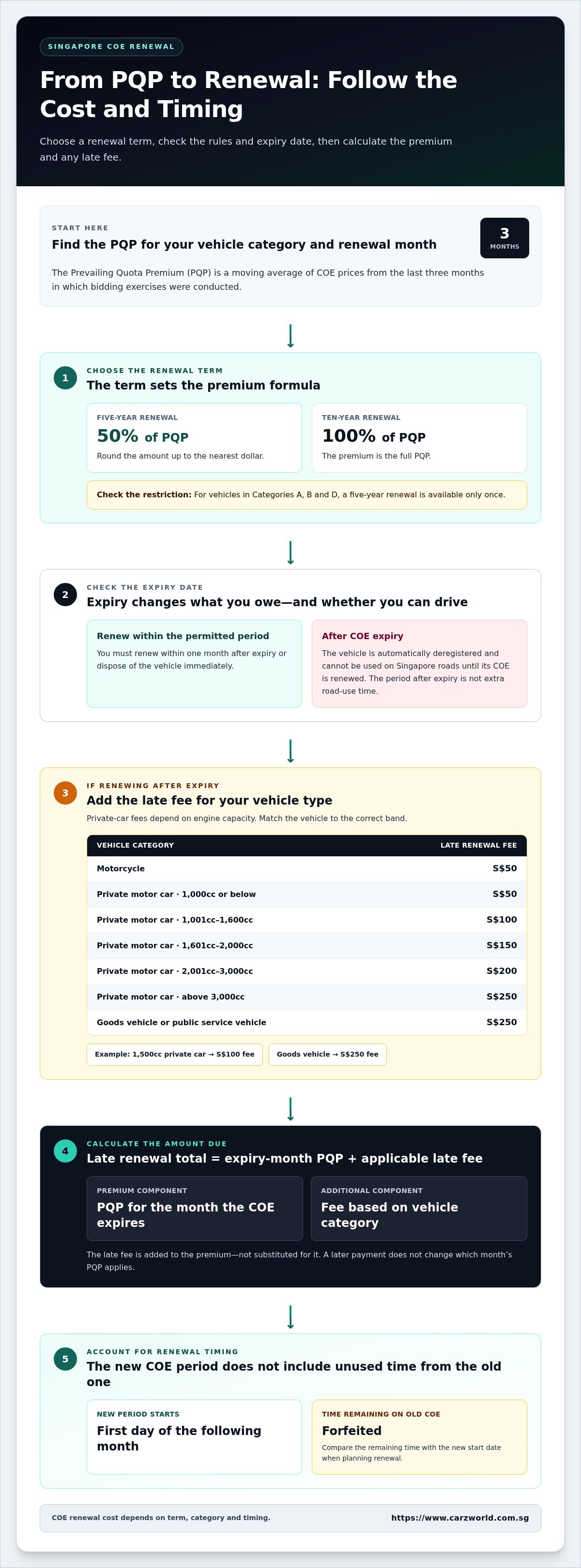
Find the PQP for your vehicle category, then calculate 50% for a five-year renewal and round up to the nearest dollar. The PQP is a moving average of COE prices from the last three months in which bidding exercises were conducted.
For vehicles in Categories A, B and D, a five-year renewal is available only once. Check your category before choosing this term, especially if you may need another renewal later. This restriction is one of the hidden costs of COE renewal to account for when planning ownership.
-
Budget for additional renewal expenses
List road tax, insurance, inspection and registration-related expenses separately from the PQP. These amounts depend on the vehicle and policy details, so treat them as distinct budget items rather than assuming the renewal premium covers everything.
Ask your lender about financing terms and compare insurance premiums for your circumstances. Renewal can also affect resale planning, as the remaining COE period forms part of the vehicle’s ownership profile. Rebates or tax implications when renewing or scrapping depend on the vehicle and applicable rules, so include them in your comparison rather than assuming a rebate will offset the renewal cost.
Late renewal deadlines and fees
Use the expiry date to plan your renewal: delaying it adds a fee to the PQP. After expiry, the vehicle is automatically deregistered and cannot be driven on Singapore roads until its COE is renewed.
-
Record the COE expiry date. You must renew within one month after expiry or dispose of the vehicle immediately. This period does not give you extra time to use the vehicle. Once the COE expires, automatic deregistration takes effect, and the vehicle must stay off the road until renewal.
Plan around the expiry date rather than a more convenient payment date. This helps you avoid the late fee and the risk of having a deregistered vehicle that you cannot use on the road.
-
Identify your vehicle’s late-fee category. Singapore’s late renewal fees vary by vehicle type and, for private cars, engine capacity. Use the fee category that matches your vehicle, not another car’s fee.
- Motorcycle: S$50.
- Private motor car with engine capacity of 1,000cc or below: S$50.
- Private motor car with engine capacity from 1,001cc to 1,600cc: S$100.
- Private motor car with engine capacity from 1,601cc to 2,000cc: S$150.
- Private motor car with engine capacity from 2,001cc to 3,000cc: S$200.
- Private motor car with engine capacity above 3,000cc: S$250.
- Goods vehicle or public service vehicle: S$250.
For example, a private car with a 1,500cc engine falls into the S$100 fee band. A goods vehicle has a S$250 late renewal fee.
-
Budget for both components after expiry. Renewing after the COE expires requires the PQP for the month the COE expires, plus the applicable late renewal fee. The fee is added to the premium, not a replacement for it.
For a motorcycle, calculate the total using that expiry-month PQP and the S$50 late fee. For a private car, use its engine-capacity band to identify the fee. The PQP amount depends on the expiry month, so a later payment does not change which month’s PQP applies.
-
Act before the deadline where possible. Complete the renewal process within the permitted period and allow time to arrange payment. If the expiry date has passed, account for both the expiry-month PQP and the category-based fee before proceeding.
Use the vehicle’s registration details to identify whether it is a private car, motorcycle, goods vehicle or public service vehicle. Correct classification helps you avoid applying the wrong fee, particularly because private-car fees depend on engine capacity.
Renewal timing and forfeited COE
If you miss the expiry date, the vehicle is automatically deregistered and cannot be used on the road until its COE is renewed.
-
Check the renewal timing
Plan around the COE expiry date and decide whether to renew before it. A renewal made before expiry starts the new COE period on the first day of the following month. Unused time on your current COE may not carry over to a renewed period.
Compare the time remaining on your current COE with the start date of the new period. Renewing before expiry does not add unused days to the new COE period. Include that lost time when deciding whether early renewal suits your plans.
Use the expiry date as your key planning point, rather than focusing only on when you intend to pay. This helps you weigh the value of using the remaining COE against the risk of leaving renewal too late.
Keep the timing rule in mind: early renewal means the new period begins on the first day of the following month. The unused portion of the old COE is forfeited, so it does not extend the new period.
-
Understand the consequences of missing renewal
Act promptly if the COE expires before you complete renewal. The vehicle is automatically deregistered at expiry and cannot be used on Singapore roads until its COE is renewed. You have one month after expiry to renew or must dispose of the vehicle immediately.
Do not assume you can drive the vehicle during that one-month period. It is a limited time to renew or dispose of the vehicle, but road use must stop once the COE expires.
Factor in the financial impact of late renewal. The required payment includes the PQP for the month the COE expires, plus the applicable late renewal fee. The relevant PQP month is determined by the expiry date, even if you pay later.
Compare three points to make a practical decision: the remaining COE value, the start date of the next period, and the deadline after expiry. Renewing early forfeits unused time. Missing expiry means deregistration, restricted road use and additional payment.
Keep the expiry date and intended renewal timing together in your plans. This helps you avoid treating the post-expiry month as permission to keep driving or assuming unused COE time transfers to the renewed period.
In Singapore, renewing before expiry means the new COE period begins on the 1st day of the following month, while any unused portion of the previous COE is forfeited. Keep those consequences in view when choosing the renewal date: the change of period does not preserve unused time. Decide whether using the remaining COE or setting the new period in motion sooner better fits your plans, and make that decision before the expiry point rather than treating the two periods as continuous.
If expiry passes, the owner’s choice is limited to renewing within 1 month or disposing of the vehicle immediately. Keep that deadline distinct from the question of whether the vehicle may be used; the section’s road-use restriction applies from expiry. A clear plan should therefore account for both the lost unused portion from early renewal and the short post-expiry period for renewal or disposal.
Ten-year COE renewal costs
A ten-year renewal costs the full PQP for the vehicle’s category. A five-year renewal costs 50% of the PQP, rounded up to the nearest dollar.
-
Use the full PQP as your ten-year premium. Find the PQP for your vehicle category and budget the full amount for a ten-year renewal. Unlike the five-year option, the ten-year option does not halve the premium. The amount depends on the applicable PQP, so use the figure for the relevant category and renewal month when comparing options.
For the same category, the five-year premium is half the PQP, rounded up, while a ten-year renewal requires the full PQP. The initial premium is therefore higher for ten years, but it buys a longer COE period.
-
Match the renewal term to your ownership plan. Compare the full-PQP payment with how long you expect to keep using the vehicle. A ten-year term gives you longer before another renewal decision; a five-year term requires a lower initial premium but provides a shorter period.
Compare both options for the same vehicle and category. Consider the upfront amount, the renewal period and when you expect to change vehicles. This shows the difference between a lower initial payment and the longer term purchased with ten years.
-
Check whether repeat ten-year renewals are allowed. For vehicles in Categories A, B and D, ten-year renewals can be repeated without limit, provided the vehicle has no statutory lifespan. By contrast, the five-year option can be used only once for those categories.
Check whether a statutory lifespan applies before assuming repeated renewals are possible. An omnibus has a statutory lifespan of 17 years, a goods vehicle has a statutory lifespan of 20 years, and a non-electric taxi has a statutory lifespan of 8 years. Those limits affect how long the vehicle can remain eligible for renewal.
-
Compare the premium with the overall cost, not the term alone. The full PQP is the COE renewal payment, not the total cost of owning a vehicle. Budget other expenses, such as road tax and insurance, separately, and compare them over the period you plan to keep the vehicle.
If the PQP changes before your renewal month, use the new applicable figure. A different PQP changes the amount required for a ten-year renewal. Recalculate using the current premium for your category instead of relying on an earlier estimate.
How is the Prevailing Quota Premium (PQP) calculated for COE renewal?
Use the PQP for your vehicle category to estimate the renewal premium. It is a moving average of COE prices from the last three months in which bidding exercises were conducted.
-
Identify your vehicle’s COE category. The applicable category determines which PQP is used for renewal, so start with your vehicle’s classification. Do not substitute a figure from another category. The relevant premium is based on COE prices for your category, not on a price selected from a different vehicle group.
Use the same category throughout your comparison. A premium for one category cannot reliably estimate the renewal cost for a vehicle in another.
-
Understand which COE prices feed into the PQP. The calculation uses a moving average of COE prices from the last three months in which bidding exercises were conducted. It reflects multiple bidding exercises, not just the latest result.
When reviewing a renewal premium, think of it as an average drawn from that three-month bidding window. It can reflect earlier prices as well as more recent ones.
-
Use the PQP for your renewal calculation. A ten-year renewal requires the full PQP for the vehicle category. A five-year renewal requires 50% of the PQP, rounded up to the nearest dollar. Keep the renewal term in the calculation, because the same PQP produces different amounts for those two options.
Write down the category, applicable PQP and intended renewal term. That simple working note makes it easier to compare the required premium without confusing the full-PQP ten-year amount with the five-year calculation.
-
Apply the expiry-month rule if renewal is late. If the COE has expired, renewal requires the PQP for the month it expires, plus the applicable late renewal fee. The relevant PQP month is tied to the expiry date, not the later payment date.
Separate the premium and late fee in your estimate. This keeps the PQP calculation clear and shows which part of the total is due to delayed renewal.
-
Use the calculation to compare your next step. Once you have the category and PQP, compare the renewal amount with your planned ownership period and other vehicle costs. If renewal changes your plans, compare vehicle options as part of your decision.
Keep the PQP separate from road tax, insurance and other ownership expenses. It is the COE renewal premium; those costs belong in separate budget items.
In Singapore, the PQP used for COE renewal is a moving average of COE prices from the last three months in which bidding exercises were conducted. Use that window as the basis of the figure rather than treating the PQP as the latest bidding price.
When checking an estimate, align the vehicle category and renewal term with the PQP you use; otherwise, the comparison will not reflect the intended renewal calculation. Note the category, PQP figure and whether the calculation uses the full amount or half, rounded up to the nearest dollar.
Carz World Pte Ltd: Pre-Owned Cars
Carz World Pte Ltd offers pre-owned cars for drivers weighing renewal against replacing their current vehicle. If the renewal premium, forfeited COE time or future ownership costs have changed your plans, comparing another car may help you decide what to do next.
Review pre-owned cars as an alternative, and consider each vehicle’s condition, COE period and suitability for your needs. Look beyond the renewal premium and consider how long you intend to keep the vehicle.
If replacing your vehicle better suits your plans, explore Carz World’s pre-owned cars. Contact Carz World Pte Ltd to discuss your vehicle requirements.
Choose the next step that fits your plans
A COE decision is also a chance to reassess how you want to travel. Instead of focusing only on keeping your current vehicle, consider whether replacing it or using a vehicle temporarily better suits your needs. This broader view puts the hidden costs of COE renewal in the context of your next move.
Carz World Pte Ltd offers pre-owned cars and brand-new cars for drivers considering a replacement. Car rental is also available if you need temporary vehicle use rather than an immediate purchase. Compare these options with your ownership plans to decide what suits your circumstances.
For a straightforward next step, explore vehicle options with Carz World Pte Ltd and discuss what you’re looking for. A clear view of your choices can make the decision easier to approach, at your own pace.
Frequently Asked Questions
What are the current COE renewal fees in Singapore by vehicle category?
Renewal premiums depend on the PQP for the vehicle’s COE category, rather than one flat fee. A five-year renewal costs 50% of the PQP, rounded up; a ten-year renewal costs the full PQP. Late fees are separate: motorcycles and private cars up to 1,000cc incur S$50; 1,001cc to 1,600cc, S$100; 1,601cc to 2,000cc, S$150; 2,001cc to 3,000cc, S$200; above 3,000cc, S$250. Goods and public service vehicles incur S$250.
What are the risks and limitations of choosing a 5-year COE renewal?
A five-year renewal provides a shorter extension than a ten-year renewal, so you’ll face another renewal or replacement decision sooner. For vehicles in Categories A, B and D, the five-year option is available only once. Before choosing it, consider how long you plan to keep the vehicle and whether a shorter term fits those plans. Renewing early also forfeits any unused portion of the existing COE.
Disclaimer
This content is provided for general informational purposes only. Readers are encouraged to independently verify important information.
In Same Category
- How to Renew Your COE and Account for Fees and Deadlines
- Compare car financing options with no credit history in SG
- Find reliable low maintenance second hand cars in Singapore by mileage
- Car Trade-In Services in Sengkang for Comparing Offers
- Car Loan Hidden Fees: Which Application and Setup Charges Are Reasonable
Related by Tags
- How to Renew Your COE and Account for Fees and Deadlines
- Risks of Buying a Car with 1 Year of COE Left in Singapore (2026 Guide)
- Best Time to Renew COE in 2026: A Practical Singapore Guide
- COE Renewal for 5 Years vs 10 Years: Pros and Cons in Singapore
- Pros and Cons of Buying a High PARF Car in Singapore
- Calculating the Breakeven Point for COE Renewal in Singapore
- COE Renewal Conditions and Eligibility in Singapore: 2026 Guide
- COE Results Singapore: How to Read the Latest Bidding Outcomes in 2026
- Getting Car Finance as a Freelancer in Singapore: 2026 Guide
- Financial Checklist Before Buying a Car in Singapore: 2026 Expert Guide