The Real Cost of Owning a Car in Singapore: 2026 Comprehensive Guide

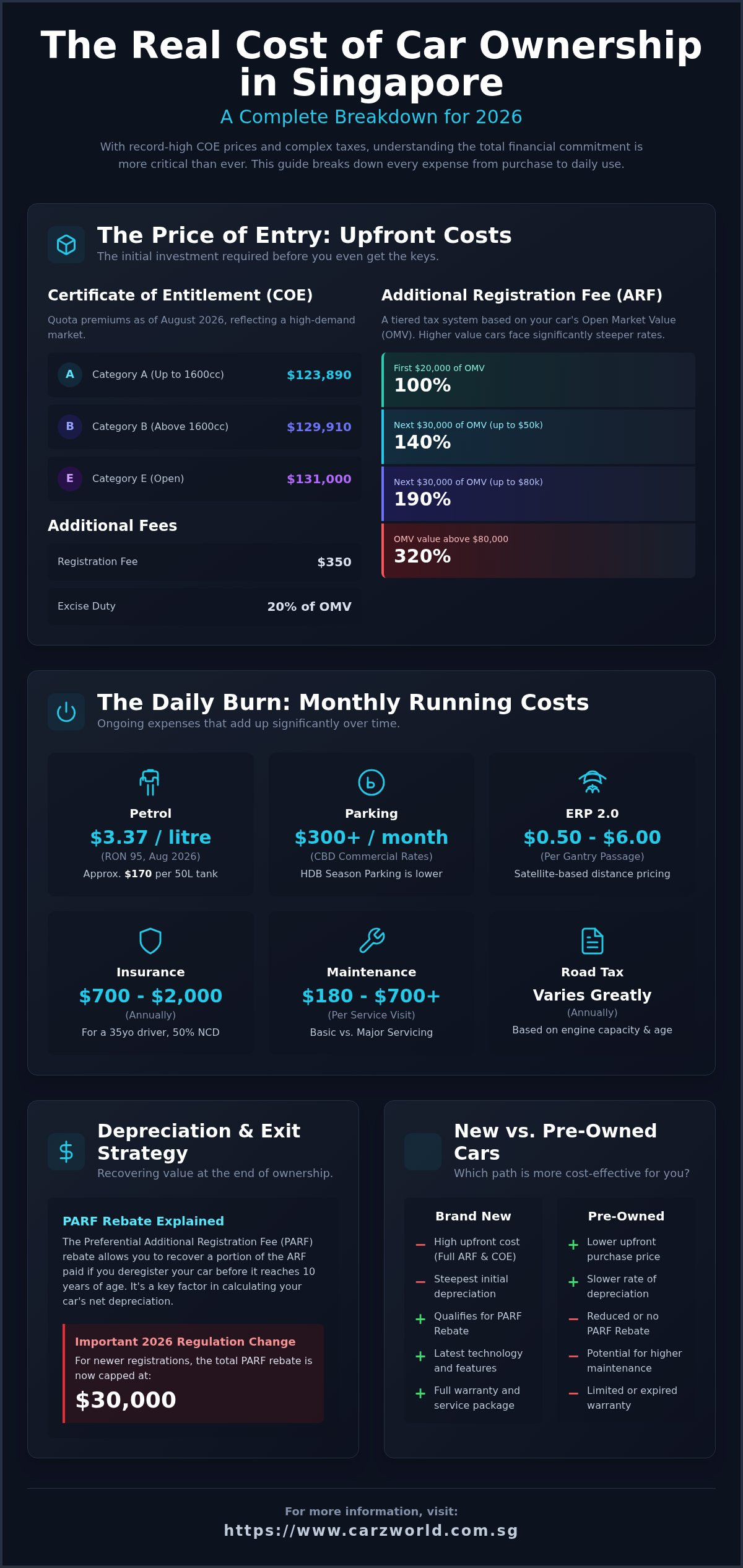
With Category A COE prices hitting $123,890 in August 2026, the dream of driving often feels like a luxury reserved for the few. It's no secret that the total cost of owning a car in singapore has reached unprecedented levels, leaving many to wonder if a personal vehicle still fits their financial plan. You're likely feeling the pressure of record-high premiums and complex tax structures like the tiered ARF, which now reaches up to 320% for high-value models.
We understand how overwhelming it is to track every hidden expense, from RON 95 petrol at $3.37 per litre to the latest ERP 2.0 requirements. This 2026 guide provides a complete breakdown of car ownership costs to help you make an informed choice. We move beyond the initial sticker price to show you the real net loss after accounting for COE rebates and export potential. You'll learn the financial difference between buying new versus pre-owned, see a realistic monthly budget, and discover strategies to minimize depreciation. Our goal is to provide the clarity you need to move forward with confidence.
Key Takeaways
- Learn how to calculate your total entry price by understanding the current relationship between OMV and the latest 2026 COE market trends.
- Discover the true monthly cost of owning a car in singapore by accounting for often-overlooked expenses like ERP 2.0 charges and seasonal parking.
- Master a clear strategy for calculating annual depreciation and explore how car export services can help you recover value at the end of ownership.
- Compare the long-term financial impact of purchasing brand new vehicles versus pre-owned cars to find the most cost-effective path for your budget.
- Navigate complex MAS loan restrictions and understand how your vehicle financing choice affects your overall debt servicing limits.
The Price of Entry: Upfront Costs in 2026
Buying a vehicle starts with the Open Market Value (OMV), but that's only the baseline. The Certificate of Entitlement (COE) system remains the most volatile factor in the total cost of owning a car in singapore. Beyond the vehicle's price, you'll need to account for a standard registration fee of $350 and an excise duty which is 20% of the OMV. These initial layers form the foundation of your investment before the car even touches the road.
To visualize how these figures impact your bank account, watch this breakdown of the current market:
COE Categories and 2026 Trends
The ARF and OMV Relationship
The Additional Registration Fee (ARF) is the heaviest tax you'll encounter. It's calculated as a percentage of the OMV, and the rates scale sharply. For the first $20,000 of OMV, you pay 100%. High-end luxury models are hit hardest by the tax hikes implemented in previous years. Any value above $80,000 now attracts a 320% ARF rate. This tiered structure makes premium vehicles significantly more expensive in 2026 compared to a decade ago.
Understanding these tiers helps you decide between brand new cars or pre-owned options. While new cars carry the full weight of these taxes, they also qualify for Preferential Additional Registration Fee (PARF) rebates later. This rebate allows you to recover a portion of the ARF if you deregister the car before it turns ten years old. However, keep in mind that 2026 regulations have reduced the PARF rebate cap to $30,000 for newer registrations, which changes the math for long-term depreciation.
The Daily Burn: Monthly Running Expenses
The daily cost of owning a car in singapore extends far beyond the initial downpayment. Petrol isn't cheap. With RON 95 petrol priced at $3.37 per litre as of August 2026, a standard 50-litre tank now costs nearly $170 before credit card discounts. Electric vehicle (EV) owners enjoy lower "fueling" costs, but they must account for varying commercial charging rates as the EV Early Adoption Incentive (EEAI) moves toward its scheduled 2026 conclusion. Parking adds another layer of expense. While HDB season parking remains stable, CBD commercial rates can easily exceed $300 monthly for those working in the city center.
Insurance and road tax are mandatory annual hits that you should budget for monthly. For a 35-year-old driver with a 50% No-Claim Discount, comprehensive insurance premiums typically range from $700 to over $2,000 annually depending on the car's OMV. While you can find the official breakdown of vehicle taxes online, recurring costs like road tax depend on your engine capacity and the vehicle's age. If these recurring costs seem too high, a car rental might be a more flexible way to stay mobile without the long-term commitment.
ERP 2.0 and Distance-Based Pricing
Singapore's transition to a gantry-less ERP system is a significant change for 2026 commuters. All vehicles now use the new On-Board Unit (OBU), which tracks movements via satellite. ERP charges currently range from $0.50 to $6.00 per gantry during peak hours. In March 2026, rates increased by $1 at several expressway locations to manage growing congestion. To keep your budget in check, use navigation apps that calculate real-time tolls. Planning your route to avoid peak-hour gantries can save you hundreds of dollars over a year.
Maintenance and Servicing Schedules
Managing the cost of owning a car in singapore requires a proactive approach to maintenance. A standard basic car servicing in 2026 typically costs between $180 and $300. Major servicing, which includes changing transmission fluids and spark plugs, can range from $400 to over $700. Japanese models often boast more affordable parts, whereas Continental cars may require specialized diagnostics and higher-priced components. Independent specialists offer a cost-effective alternative to authorized workshops, provided they have the right equipment for your specific model. Don't forget to set aside funds for wear-and-tear items like tyres and batteries, which usually need replacement every two to three years.
The Invisible Cost: Depreciation and Exit Strategies
Depreciation is the single largest component of the total cost of owning a car in singapore, yet it often catches owners by surprise. You calculate this by taking the vehicle's purchase price, subtracting the expected PARF and COE rebates, and dividing that sum by the number of years you plan to keep the car. Most vehicles experience a steep drop in value within the first three years. This happens because the initial "brand-new" premium and high registration taxes vanish as soon as the car becomes a used asset on the open market.
When you're calculating the affordability of a car, your exit plan is just as critical as your downpayment. For cars registered with COEs from February 2026 onwards, the PARF rebate is capped at $30,000. This is a sharp reduction from previous years. If you deregister your car between the ninth and tenth year, you'll only receive 5% of the ARF paid. These tighter 2026 regulations mean that holding a car for the full ten years might not be the most financially efficient choice for everyone.
Maximising Value Through Car Export
Selling locally is not your only option, and it's often not the most profitable. If your vehicle is a model in high demand overseas, Carz World Pte Ltd export services can help you secure a higher return than local scrap or resale channels. Exporting allows you to recoup the "body value" of the car, which is often higher for reliable Japanese and certain Continental models. We recommend evaluating your export options around the eighth year to see if international demand offers a better recovery of your initial investment than the local market.
Understanding COE Rebates
The "Paper Value" of your car is the combination of the PARF rebate and the pro-rated COE rebate. If you choose to deregister your car before the 10-year mark, you're entitled to a refund for the unused portion of your COE premium. For vehicles purchased during the high-premium cycles of 2026, this rebate can be a significant amount of cash. However, because you're losing a portion of that $120,000+ premium every month, timing your exit correctly is essential to protecting your overall bank balance.
New vs. Pre-Owned: Which Path is More Cost-Effective?
Choosing between a factory-fresh model and a seasoned vehicle is a critical step in managing the cost of owning a car in singapore. While the allure of a new car is undeniable, pre-owned cars offer a strategic way to bypass the initial ARF sting. Since the first owner has already absorbed the steepest part of the depreciation curve, your entry price is significantly lower. You'll need to weigh these savings against the cost of peace of mind. New cars come with manufacturer warranties, but older models may require more frequent maintenance as parts wear out.
Financing also impacts your long-term math. Interest rates for new cars in 2026 sit at approximately 2.78% per annum. Used car loans generally carry higher interest rates, but the smaller loan principal often leads to more manageable monthly payments. If you're considering a "COE car", which is a vehicle older than 10 years, remember that these cars no longer have a PARF rebate value. You'll also face a road tax surcharge that increases by 10% each year after the tenth year until it hits a 50% cap. This is a vital comparison for anyone trying to lower the overall cost of owning a car in singapore.
The Math of a 5-Year-Old Car
The period between a car's fifth and eighth year is often considered the financial sweet spot. Depreciation has stabilized, and insurance premiums are lower because the vehicle's market value has dropped. However, if you're a high-mileage driver, brand new cars might actually be more economical. Newer engines are often more fuel-efficient, and the comprehensive warranty protects you from the high costs of heavy usage. You should calculate your expected mileage before deciding which path offers the best value.
Rental as a Flexible Alternative
For those who want to avoid COE volatility entirely, car rental is an increasingly popular choice. It's a "no-strings-attached" model where you pay a fixed monthly fee that covers insurance, road tax, and maintenance. When you compare this against the total cost of ownership (TCO) of a purchased car, rental often wins for short-term stays or for those who don't want to deal with the logistics of selling a car later. It removes the risk of sudden market drops or changes in tax regulations.
If you're ready to find the right balance for your budget, explore our latest vehicle inventory today.
Financing Your Vehicle: Loans and Trade-Ins
Managing the cost of owning a car in singapore requires more than just looking at the monthly instalment. You must navigate strict Monetary Authority of Singapore (MAS) regulations that dictate your borrowing power. For cars with an Open Market Value (OMV) exceeding $20,000, you're required to provide a 40% downpayment. If the OMV is $20,000 or less, the downpayment requirement drops to 30%. The maximum loan tenure for any car loan is capped at 7 years. These rules are designed to prevent over-leveraging, but they also mean you need significant liquid cash upfront to secure a vehicle in 2026.
Your car loan is a major component of your Total Debt Servicing Ratio (TDSR). Since your total monthly debt obligations can't exceed a specific percentage of your income, a large car loan can shrink your borrowing power for a home mortgage. Bank loans generally offer the most competitive interest rates, currently around 2.78% for new vehicles as of August 2026. In-house financing is an alternative that often provides faster approval or more flexibility for different credit profiles. Choosing the right lender is a balance between interest costs and procedural ease.
The Power of the Trade-In
To manage high upfront costs, leverage your current vehicle's equity. Getting a fair valuation for your current car is the first step toward reducing your cash outlay. You can use the trade-in value to offset the downpayment of your next purchase immediately, which significantly lowers the amount of fresh cash you need to provide. While a direct sale to a dealer is the fastest way to get cash, consignment services often yield a higher return. Consignment allows you to set a target price while the dealer handles the marketing and viewings. We help you weigh these options to ensure you get the best possible value for your asset.
Budgeting for the "Hidden" Downpayment
Don't make the mistake of budgeting only for the 30% or 40% loan gap. The true initial cost includes the first year of comprehensive insurance and road tax, which must be paid upfront. For a typical mass-market car in 2026, these "hidden" entry costs can add several thousand dollars to your starting budget. We recommend looking at the Total Cost of Ownership (TCO) rather than just the loan amount. This holistic view ensures that the cost of owning a car in singapore remains sustainable throughout your 7-year loan tenure, even as running costs fluctuate.
Secure Your Financial Future on the Road
Owning a vehicle in 2026 requires a clear understanding of tiered tax structures and record-high COE premiums. By analyzing the complete cost of owning a car in singapore, you can identify significant savings, such as choosing a five-year-old pre-owned model or utilizing export services to recoup value at the end of the vehicle's life. Strategic financing and leveraging trade-in equity are essential tools for managing your initial cash outlay effectively.
Carz World Pte Ltd simplifies this complex process by offering a one-stop shop for buying, selling, and exporting. The team provides expert handling of all LTA paperwork and financing, ensuring a seamless experience for every client. With over 100 positive customer testimonials, the business has established a mature and stable reputation for reliability. The focus remains on making the transaction fluid so you can enjoy the journey ahead.
Browse our latest inventory of value-packed pre-owned cars and discover how we can help you navigate the market with confidence. Taking the next step toward car ownership doesn't have to be overwhelming when you have a knowledgeable partner by your side.
Frequently Asked Questions
How much salary do I need to own a car in Singapore in 2026?
Used cars are typically more cost-effective in the long run because they've already bypassed the steepest period of depreciation. While new cars offer lower interest rates and manufacturer warranties, the massive upfront taxes like ARF make them more expensive overall. Buying a five-year-old car allows you to enjoy lower annual depreciation. However, you must factor in potential repair costs as the vehicle ages and the lower PARF rebate caps for 2026 registrations.
What is the "Paper Value" of a car and how do I calculate it?
The "Paper Value" is the total sum you receive from the government when you deregister your vehicle before its 10-year lifespan ends. It consists of two parts: your pro-rated COE rebate and your PARF rebate. To calculate it, add the unused portion of your COE premium to your eligible PARF amount. In 2026, remember that the PARF rebate for new registrations is capped at $30,000, which directly impacts your final calculation and exit strategy.
Can I use my CPF to pay for car ownership costs?
No, you cannot use your CPF savings to pay for any car ownership costs, including the downpayment, monthly instalments, insurance, or road tax. CPF funds are strictly reserved for retirement, housing, and healthcare. All vehicle-related expenses must be paid using cash or through a bank loan. This is why budgeting for the mandatory 30% or 40% cash downpayment is such a critical step for potential buyers in the current high-interest market.
How does the COE bidding process affect the final price I pay?
The COE bidding process determines the "quota premium," which is the amount you pay for the right to own a car for ten years. Bidding happens twice a month, and prices fluctuate based on supply and demand. If many people bid during a specific cycle, the final price of your car will rise significantly. These volatile premiums are the primary reason why the cost of owning a car in singapore has reached record levels in 2026.
Is car rental more cost-effective than buying a car for expats?
Car rental is often more cost-effective for expats on short-term assignments. It eliminates the risk of losing money on heavy depreciation or fluctuating COE prices when it's time to leave. Rental fees are inclusive of insurance, road tax, and maintenance, providing a predictable monthly expense. This "no-strings-attached" approach is ideal for those who prefer not to manage the logistics of selling a vehicle or exporting it at the end of their stay in Singapore.
What happens to the cost if I sell my car before the COE expires?
If you sell or deregister your car before the COE expires, you'll receive a pro-rated rebate for the remaining unused duration of the COE. You also get back your PARF rebate, provided the car is under ten years old. However, selling a car early often means you've absorbed the highest years of depreciation. You should compare the local resale value against the potential returns from car export services to see which strategy recovers more investment.
Are electric cars (EVs) actually cheaper to own in Singapore?
Electric cars can be cheaper to own if you maximize available incentives like the EV Early Adoption Incentive, which offers a 45% ARF rebate until the end of 2026. While the upfront price can be higher, lower "fueling" costs and reduced maintenance requirements provide long-term savings compared to petrol vehicles. However, as petrol prices hit $3.37 per litre, the financial gap depends heavily on your annual mileage and access to affordable charging infrastructure.
Disclaimer
This content is provided for general informational purposes only. Readers are encouraged to independently verify important information.
In Same Category
- Calculating the Breakeven Point for COE Renewal in Singapore
- Financial Checklist Before Committing to a Car Purchase in Singapore (2026)
- COE Renewal Conditions and Eligibility in Singapore: 2026 Guide
- Balloon Scheme Car Loan in Singapore: Pros and Cons for 2026
- Getting Car Finance with a New Business in Singapore: A Practical Guide
Related by Tags
- Used Cars for Sale in Tampines: 2026 Buyer's Guide
- Car Downpayment vs Monthly Instalment in Singapore: The 2026 Budgeting Guide
- Car Loan Singapore: The Complete 2026 Guide to Financing Your Vehicle
- How Much Salary to Afford a Car in Singapore: 2026 Affordability Guide
- Buying a Used Car in Singapore: 2026 Ultimate Guide
- What is PARF? The Ultimate Guide to Singapore’s Car Rebate System
- Mercedes-Benz EQB 250+ Review: The Ultimate 7-Seater Family EV in Singapore
- Long Term Car Rental Singapore: 2026 Definitive Guide
- How to Buy a Car in Singapore: The Ultimate 2026 Step-by-Step Guide
- Second Hand Hybrid Cars Singapore: The 2026 Value & Inspection Guide
- Cheapest Car in Singapore: The 2026 Guide to Affordable Ownership
- Parallel Import Cars Singapore: 2026 Buyer’s Guide
- Toyota Harrier Singapore: The Definitive 2026 Buyer’s Guide
- Suzuki Swift Singapore: The Ultimate Smart-Money Hatchback Guide 2026
- The Ultimate Toyota Alphard Singapore Guide: Luxury & Performance in 2026
- Sell My Car in Singapore (2026): Complete Guide
- Nissan Qashqai Singapore: Ultimate Buyer’s Guide 2026
- The Ultimate Used Car Buying Guide for Singapore in 2026
- Used Honda Singapore: The Ultimate Buyer’s Guide for 2026
- The Real Cost of Owning a Car in Singapore: 2026 Comprehensive Guide