Toyota Sienta vs Honda Freed: The Ultimate 2026 Singapore MPV Comparison
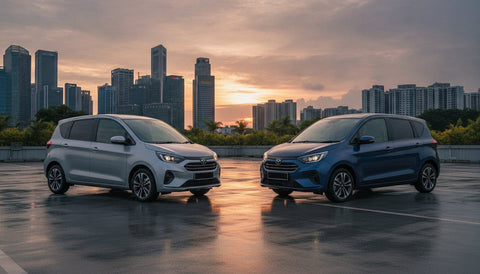
Is spending a small fortune on a Category A COE worth it if your family is still complaining about the heat in the third row? In Singapore's current market, choosing the right compact MPV isn't just about brand loyalty; it's about making a calculated investment. This toyota sienta vs honda freed comparison is more relevant than ever as families look for ways to maximize every cent. You need a vehicle that squeezes into tight parking spots at the mall while providing enough room for the whole tribe.
We understand that high ownership costs make the decision feel heavy. You want a car that promises excellent fuel efficiency and keeps its value when it's time to trade in five or ten years down the road. This article breaks down the 2026 specifications to help you decide which model truly reigns supreme for your family's needs. We'll look at real-world fuel consumption, ease of access for elderly passengers, and how each brand tackles the lack of rear AC vents in our tropical climate.
Key Takeaways
- Learn why the Sienta and Freed continue to dominate the Category A COE segment for families seeking maximum value in 2026.
- Compare the toyota sienta vs honda freed to see which hybrid powertrain offers the best balance of fuel efficiency and driving smoothness.
- Discover how sliding door designs and specific seating configurations solve common Singaporean pain points like tight parking and rear passenger comfort.
- Understand the long-term ownership costs, including PARF rebates and resale value expectations for both Japanese MPVs.
- Get a clear verdict on which model suits your specific lifestyle, whether you prioritize low-floor accessibility or a more premium cabin experience.
The Battle of Compact MPVs in Singapore: Sienta vs Freed
The competition between the toyota sienta vs honda freed is a defining feature of the Singaporean automotive market. Both models strategically target the Category A COE segment. With Category A COE prices reaching $128,501 in August 2026, these compact MPVs offer a more accessible entry point for families than larger Category B alternatives. They've evolved significantly from their original boxy silhouettes. The latest generations embrace a "lifestyle" aesthetic that blends urban utility with modern design.
Choosing between an Authorized Dealer (AD) and a Parallel Import (PI) version is a key decision for local buyers. AD models often come with standardized local warranties. PI models frequently provide access to hybrid drivetrains or specific Japanese-spec features that might not be available through official channels. In a 2026 climate of high fuel costs, the hybrid variants of these vehicles have become essential for managing monthly overheads. Our inventory of brand new cars often includes these high-efficiency models to meet this growing demand.
The Toyota Sienta: A Masterclass in Packaging
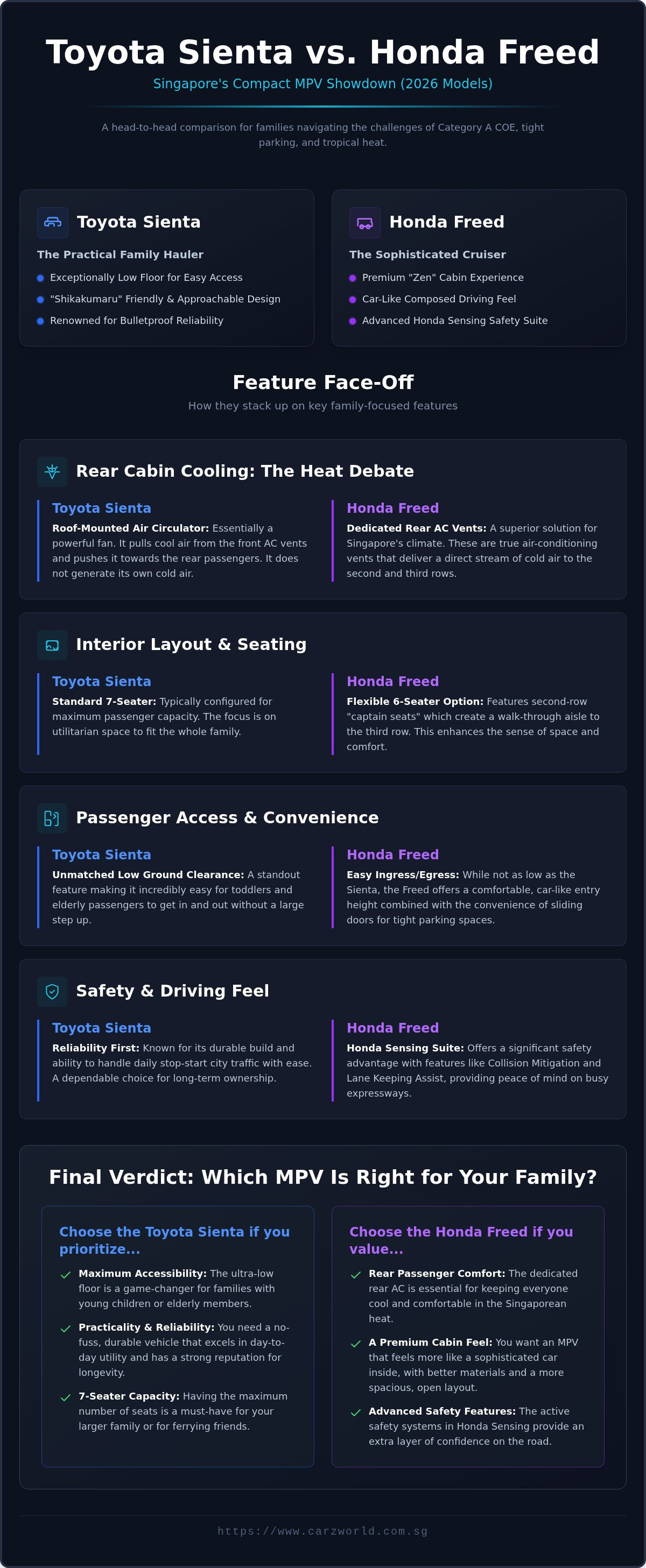
The current Toyota Sienta utilizes a unique "Shikakumaru" design philosophy. This approach rounds off square edges to create a friendly, approachable look. You can explore the Toyota Sienta model history to see how this design has matured over three generations. Its standout feature for Singaporean families is the exceptionally low ground clearance. This design makes ingress and egress effortless for toddlers and elderly parents alike. It's a critical factor when comparing the toyota sienta vs honda freed for multi-generational households. Toyota's reputation for bulletproof reliability remains a major draw for those navigating the stop-start traffic of the CTE or AYE daily.
The Honda Freed: The Sophisticated Alternative
While the Sienta prioritizes utility, the Honda Freed focuses on a "zen" interior experience. The cabin materials feel more premium, moving away from the hard plastics sometimes found in its rival. It targets drivers who want the space of an MPV without the sensation of driving a commercial van. The driving position is car-like and composed. Safety is another priority, with the Honda Sensing suite providing essential assistance on busy expressways. This package includes features like collision mitigation and lane-keeping assist, which are vital for local road safety. Whether you are browsing for used cars or the latest hybrid models, the Freed remains a top-tier choice for the discerning family who values cabin ambiance.
Interior Practicality and the Infamous Rear AC Debate
The sliding door advantage is a defining factor for families navigating Singapore's tight multi-story carparks. Both models allow passengers to enter and exit without worrying about hitting the car parked next to them. When comparing the toyota sienta vs honda freed, the interior layout often dictates the final choice. The Sienta typically arrives as a full 7-seater. The Freed offers more flexibility with a 6-seater configuration featuring second-row captain seats. These captain seats create a walk-through cabin that feels significantly more spacious. For local parents, fabric seats are often preferred as they breathe better in our humidity, though synthetic leather is easier to wipe down after a spill.
Cargo flexibility is another priority. With the third row up, space is limited in both vehicles. You'll likely fit a few grocery bags or a slim umbrella stroller. However, once you fold the rear seats, the differences in engineering become apparent. If you are looking for a vehicle that handles both school runs and weekend hauling, you can explore our current car inventory to compare these layouts in person.
Solving the Cooling Crisis: Air Circulators vs Rear Vents
Singapore's 33-degree weather makes rear cooling a non-negotiable topic for many. The Sienta uses a roof-mounted air circulator. This is essentially a fan that pulls cool air from the front and pushes it to the back. It's efficient but doesn't generate its own cold air. In contrast, the Freed features dedicated rear AC vents. These vents provide a direct stream of cold air to the second and third rows. As noted in the Straits Times Honda Freed review, this dedicated cooling system is a major selling point for those who frequently carry a full load of passengers during mid-day heat. To keep either cabin cool, we recommend high-quality solar films and parking in the shade whenever possible.
Seat Folding Mechanisms: Magic Seats vs Dive-In
The way these cars hide their seats is fundamentally different. The Sienta uses a "dive-in" mechanism where the third row tucks neatly under the second-row seats. This creates a completely flat and low loading floor, which is perfect for heavy items or bicycles. The Freed utilizes a side-folding third row. These seats flip up and latch against the side windows. While this is quick to operate, it eats into the lateral width of the boot and can obstruct the driver's rear-quarter vision. In terms of legroom, the Freed generally offers a bit more knee room for adults in the third row, making it the slightly better choice for carrying teenagers or older family members on longer trips across the island.
Performance and Hybrid Efficiency: Real-World SG Consumption
Analyzing the performance of the toyota sienta vs honda freed reveals two distinct approaches to hybrid engineering. Toyota utilizes its proven Hybrid System (THS) with a 1.5-liter, 3-cylinder engine in the latest Sienta. Honda employs the e:HEV system in the Freed, which often relies on the electric motor for direct propulsion while the engine acts as a generator. This difference makes the Freed feel exceptionally smooth during low-speed urban crawling in the CBD. Toyota focuses on maximum thermal efficiency, which appeals to drivers who prioritize the lowest possible fuel bills.
Real-world consumption data shows the Freed Hybrid achieving between 18.5km/L and 19.6km/L. For those driving primarily on expressways like the PIE or KPE, hitting 20-25km/L is a realistic goal with a light right foot. The Sienta Petrol variant manages approximately 16.1km/L. In 2026, these hybrids serve as the perfect "bridge" cars. They offer the range of a petrol engine with the efficiency of an EV, all without the need for a private charging point. If you are looking for these high-efficiency models, our inventory of brand new cars often features the latest hybrid variants from Japan.
Toyota’s TNGA Platform vs Honda’s Driving Feel
The Sienta's move to the TNGA platform has significantly improved its handling. It reduces the "top-heavy" sensation typical of compact MPVs and minimizes body roll during cornering. Honda’s driving feel remains more engaging for those who enjoy the "VTEC" legacy. The Freed feels more planted at higher speeds, providing more confidence when overtaking on the ECP. Braking feel also differs; Toyota’s system has a more noticeable transition between regenerative braking and mechanical friction, while Honda’s e:HEV system offers a more linear and car-like pedal feel.
Maintenance and Long-Term Reliability
Maintenance is a critical concern for Singaporean owners. Common wear-and-tear items include suspension bushings and hybrid batteries, which usually require attention after the 5-year mark. Spare parts for Parallel Import (PI) models are abundant in local workshops due to the sheer volume of these cars on our roads. Toyota remains the king of resale value in the second-hand market. This reputation for reliability makes it a safer bet for those planning to sell before the 10-year COE expires. For buyers seeking peace of mind, we offer a wide selection of certified used cars that have undergone rigorous checks to ensure long-term durability.
Ownership Costs: COE, PARF, and Resale Value
The financial reality of owning a compact MPV in Singapore is heavily dictated by the Category A COE. When weighing the toyota sienta vs honda freed, the initial purchase price is only one part of the equation. Long-term costs like the Preferential Additional Registration Fee (PARF) rebate significantly influence your total cost of ownership. For vehicles deregistered within five years, the rebate stands at 75% of the Additional Registration Fee (ARF) paid. This percentage decreases annually; making the timing of your resale crucial for maximizing returns. High COE prices in 2026 mean that every dollar of your car's scrap value counts.
Insurance premiums for these models are generally competitive. The Sienta's massive popularity often leads to a more predictable claims history, which can keep rates stable. In the resale market, both models are high-demand items. Toyota typically enjoys a faster turnaround due to its reputation for reliability. Honda often commands a slightly higher price floor because of its perceived premium status and higher Open Market Value (OMV). Understanding these nuances helps you plan a 10-year ownership cycle effectively. It's about balancing the upfront investment with the eventual payout at the end of the car's life.
Buying New vs Pre-Owned in 2026
Choosing between a fresh model and a used one depends on your budget and tolerance for depreciation. A brand-new parallel import gives you access to the latest 2026 safety tech and hybrid efficiency. Conversely, a three-year-old vehicle is often considered the "sweet spot" for value. By this stage, the first owner has absorbed the steepest part of the depreciation curve; yet the car remains modern enough for another seven years of reliable service. You can explore our certified used car collection to find high-quality options that fit these criteria.
Parallel Import (PI) Considerations
Many Singaporeans prefer Parallel Import (PI) models for their wider range of features. When going this route, focus on the OMV. A higher OMV generally translates to a better PARF rebate at the end of the car's life. It's also vital to verify the warranty and servicing package provided by the dealer. Reliable dealers provide comprehensive coverage that rivals official distributors, ensuring your hybrid system remains in top condition. You can view the latest brand-new parallel imports to compare specifications and OMV values directly. If you want a personalized quote or need help calculating your trade-in value, speak with our team about finding the right MPV for your family.
Final Verdict: Which MPV Should You Drive Home?
Choosing between the toyota sienta vs honda freed ultimately comes down to your family's specific daily routine. If you prioritize a low ground clearance for young children or elderly parents, the Sienta remains the champion of accessibility. Its "dive-in" seats provide a flat loading floor that is hard to beat for grocery runs and bulky items. Conversely, the Honda Freed is the superior choice if you value a more premium cabin environment and better rear cooling for your passengers. Its captain seat configuration offers a sense of space and ease of movement that the Sienta's bench layout cannot match.
Both vehicles represent the pinnacle of hybrid efficiency in 2026. They allow you to navigate Singapore's high fuel prices with confidence. The decision often rests on whether you prefer Toyota's focus on utilitarian packaging or Honda's emphasis on a sophisticated driving experience. Regardless of your choice, both models offer excellent resale value and long-term reliability in our unique driving landscape.
Why Trust Carz World for Your Next MPV?
We understand that buying a vehicle in Singapore involves significant trust. Our team is committed to total transparency regarding Open Market Value (OMV) and the COE bidding process. We don't use high-pressure tactics. Instead, we focus on providing accurate data so you can make an informed decision. You can read our customer testimonials to see how we have helped other families achieve a seamless vehicle handover. We also offer personalized financing solutions. These are designed to help you manage the monthly costs associated with high-COE vehicles without compromising your family's financial stability.
Ready to Upgrade Your Family Ride?
Making the switch is easier when you have the right partner. If you are upgrading to a larger MPV, we recommend starting with a clear understanding of your current car's worth. You can get a free valuation for your current car today through our platform. We invite you to visit our showrooms at Ubi or Alexandra. Here, you can perform a side-by-side comparison of the toyota sienta vs honda freed to see which one fits your lifestyle better. Our consultants are available for non-obligatory consultations to answer any questions about parallel import warranties or servicing. Taking a test drive is the best way to feel the difference in hybrid smoothness and cabin cooling for yourself.
Choosing Your Next Family Companion
Deciding between the toyota sienta vs honda freed depends on whether you value Toyota's practical low-floor entry or Honda's premium cabin with dedicated rear cooling. Both models offer the hybrid efficiency needed to navigate Singapore's 2026 driving landscape successfully. We focus on making this transition smooth and rewarding for your family. Our team prides itself on being a reliable partner for your automotive journey.
With over 100 positive Google reviews, we've built a reputation for excellence and customer satisfaction. We maintain strict transparency regarding OMV and COE pricing so you can buy with confidence. Every vehicle comes with comprehensive parallel import warranties, ensuring your investment is protected for years to come. Whether you need a brand-new hybrid or a certified pre-owned model, we have the inventory to match your needs.
Find your perfect family MPV at Carz World; browse our Sienta and Freed inventory now!
Your next family adventure starts with a vehicle that truly fits your lifestyle. We look forward to helping you find the right match.
Frequently Asked Questions
Is the Toyota Sienta or Honda Freed more fuel-efficient in Singapore?
The Freed Hybrid is generally more efficient for urban driving in Singapore. Real-world data indicates averages between 18.5km/L and 19.6km/L for the Freed Hybrid e:HEV models. In contrast, the Sienta Petrol variant manages approximately 16.1km/L. Both vehicles are highly competitive in the Category A COE segment. Your actual consumption will vary based on your driving mix between stop-start city traffic and smoother expressway travel on the PIE or KPE.
Does the Toyota Sienta have rear air-con vents?
No, the Toyota Sienta does not have dedicated rear air-con vents. Instead, it features a roof-mounted air circulator designed to pull cool air from the front and push it toward the rear passengers. While this system is efficient, it doesn't generate its own cold air. Families who prioritize direct cooling for third-row passengers often find the Honda Freed's dedicated rear vents more effective in our humid tropical climate during the afternoon sun.
Which MPV has better resale value after 10 years?
Toyota generally holds a slightly higher resale value due to its widespread reputation for bulletproof reliability. However, the Honda Freed often commands a strong price floor because of its higher Open Market Value (OMV). When comparing the toyota sienta vs honda freed over a 10-year cycle, the PARF rebate becomes a critical factor. Toyota's massive popularity in the used market ensures a faster transaction, while the Freed appeals to premium-seeking buyers looking for captain seats.
Can the Honda Freed fit into standard HDB multi-storey carparks?
Yes, the Honda Freed fits easily into standard HDB multi-storey carparks. It has a height of approximately 1,710mm, which is well below the typical 1.9m or 2.1m height limits found in most Singaporean parking structures. Its compact footprint and sliding doors make it one of the easiest 7-seater vehicles to maneuver in tight spaces. You won't have any issues navigating the ramps or parking in older housing estates where lots are narrower.
What is the difference between an Authorized Dealer and a Parallel Import Sienta?
The main difference lies in the available specifications and the warranty provider. Authorized Dealers offer standardized local packages and servicing. Parallel Import (PI) models often provide access to higher-trim Japanese variants, such as the hybrid versions, which may not always be available through official channels. PI models also frequently include different interior materials or advanced safety features. It's essential to check the specific warranty coverage and OMV provided by your dealer before committing.
Is the 1.5L engine powerful enough for a full 7-person load?
Yes, the 1.5L engine is sufficient for urban commuting with a full load. While it won't feel sporty when fully packed, the CVT transmission is tuned to maximize torque for city driving. The Honda Freed Petrol offers 129 hp, while the Sienta Petrol provides 106 hp. Both models handle the school run or weekend family outings across the island with ease. You'll only notice the engine working harder during steep climbs or rapid expressway overtaking.
How long does the hybrid battery last in a Honda Freed?
A hybrid battery in a Honda Freed typically lasts between 8 to 10 years under normal driving conditions in Singapore. Factors like extreme heat and high mileage can affect its longevity. Most reputable dealers provide extended warranties specifically for the hybrid battery to give owners peace of mind. Regular servicing and maintaining the cooling system for the battery pack are vital for ensuring it reaches its full expected lifespan without significant performance degradation.
Which car is safer for families, the Sienta or the Freed?
Both models are equipped with advanced safety suites that make them excellent choices for families. The toyota sienta vs honda freed comparison shows that both brands prioritize driver assistance. Toyota features the Toyota Safety Sense suite, while Honda utilizes the Honda Sensing package. Both include essential features like collision mitigation, lane-keeping assist, and adaptive cruise control. These systems are specifically designed to help drivers stay safe on busy expressways like the ECP or the AYE.
Disclaimer
This content is provided for general informational purposes only. Readers are encouraged to independently verify important information.
In Same Category
- Calculating the Breakeven Point for COE Renewal in Singapore
- Financial Checklist Before Committing to a Car Purchase in Singapore (2026)
- COE Renewal Conditions and Eligibility in Singapore: 2026 Guide
- Balloon Scheme Car Loan in Singapore: Pros and Cons for 2026
- Getting Car Finance with a New Business in Singapore: A Practical Guide
Related by Tags
- What is PARF? The Ultimate Guide to Singapore’s Car Rebate System
- Mercedes-Benz EQB 250+ Review: The Ultimate 7-Seater Family EV in Singapore
- Cheapest Car in Singapore: The 2026 Guide to Affordable Ownership
- Parallel Import Cars Singapore: 2026 Buyer’s Guide
- Toyota Harrier Singapore: The Definitive 2026 Buyer’s Guide
- Honda Civic Singapore: 2026 New & Pre-Owned Guide
- Suzuki Swift Singapore: The Ultimate Smart-Money Hatchback Guide 2026
- Mazda 3 Singapore Guide 2026: Specs, Prices, and Buying Tips
- The Ultimate Toyota Alphard Singapore Guide: Luxury & Performance in 2026
- Nissan Qashqai Singapore: Ultimate Buyer’s Guide 2026
- Honda Odyssey Singapore: 2026 Family Buying Guide
- Toyota Sienta vs Honda Freed: The Ultimate 2026 Singapore MPV Comparison
- Used Honda Singapore: The Ultimate Buyer’s Guide for 2026
- Nissan Kicks e-Power Review Singapore (2026): The Ultimate No-Charge Electric SUV?