Electric Vehicle Guide 2026: Types, Charging and Buying in Singapore
Could the right electric vehicle for Singapore be the one that fits your charging routine, rather than the one with the longest advertised range? If you’re weighing a fully electric car against a hybrid or a familiar petrol model, consider more than the vehicle itself. Where you park, how far you drive and how long you plan to own it can all shape the decision.
Charging access and range can feel like big unknowns, especially if you rely on public carparks or haven’t used an EV charger before. The basics are easier to understand once you know the difference between fully electric and hybrid vehicles, and what AC and DC charging mean in everyday use.
This guide explains how electric vehicles work and what ownership involves in Singapore. You’ll learn how to assess your driving patterns and charging options, compare EVs with hybrids and petrol cars, and consider factors such as running costs, road tax and current incentives. It also covers what to look for when exploring brand-new or pre-owned electric vehicles, so you can make a practical choice that suits your needs.
Key Takeaways
- Distinguish fully electric vehicles from hybrids by looking at how each powertrain is powered and used.
- Understand how battery capacity, charger output and driving conditions shape charging time and real-world range.
- Assess whether an electric vehicle suits your routine by considering charging access, parking, regular journeys and passenger or luggage needs.
- Compare EV, hybrid and petrol ownership based on your driving patterns and comfort with charging or refuelling.
- Use the same practical criteria to explore brand-new and pre-owned options, then evaluate models against your priorities.
What Is an Electric Vehicle? Understand the Main Types in Singapore
An electric vehicle uses one or more electric motors to help move the car. The term covers different powertrains, so check whether a vehicle runs only on battery power or also has a petrol engine. That distinction affects how you charge or refuel, which journeys the vehicle may suit, and what to compare when shopping in Singapore.
For a broader overview of the technology and its different forms, see this introduction to the electric vehicle.
To see how charging fits into Singapore driving, watch this video:
What is the difference between a BEV, PHEV, and hybrid?
These powertrains differ in whether they use petrol and whether they plug in to recharge. The difference determines what your charging or refuelling routine looks like.
- BEV (battery electric vehicle): Uses an electric motor powered by a rechargeable battery. It has no petrol engine and needs external charging.
- PHEV (plug-in hybrid electric vehicle): Combines a rechargeable battery and electric motor with a petrol engine. You can plug it in, while petrol provides another way to power journeys.
- Conventional hybrid: Combines an electric motor and petrol engine, but doesn’t plug in for external charging. The petrol engine and regenerative braking help recharge its battery.
This is a useful first comparison, but not a complete buying decision. Charging methods, driving needs and vehicle design vary by model. A fully electric car depends on access to charging; hybrids retain a petrol engine, though plug-in and conventional hybrids charge their batteries differently.
How does an electric vehicle produce movement?
A BEV uses electricity stored in a rechargeable battery to power an electric motor and turn its wheels. In simple terms, energy flows from the battery to the motor, which drives the car. The motor’s output and the vehicle’s design influence how it feels on the road.
During regenerative braking, the motor can work as a generator as the car slows, converting some movement energy into electrical energy and returning it to the battery. This can recover some energy during deceleration, but it doesn’t replace plugging in to charge. How much energy is recovered depends on driving and vehicle conditions.
Knowing the powertrain helps you ask the next practical questions: how you’ll charge, what your regular journeys look like, and which vehicle design suits your needs.
How Electric Vehicle Charging and Driving Range Work
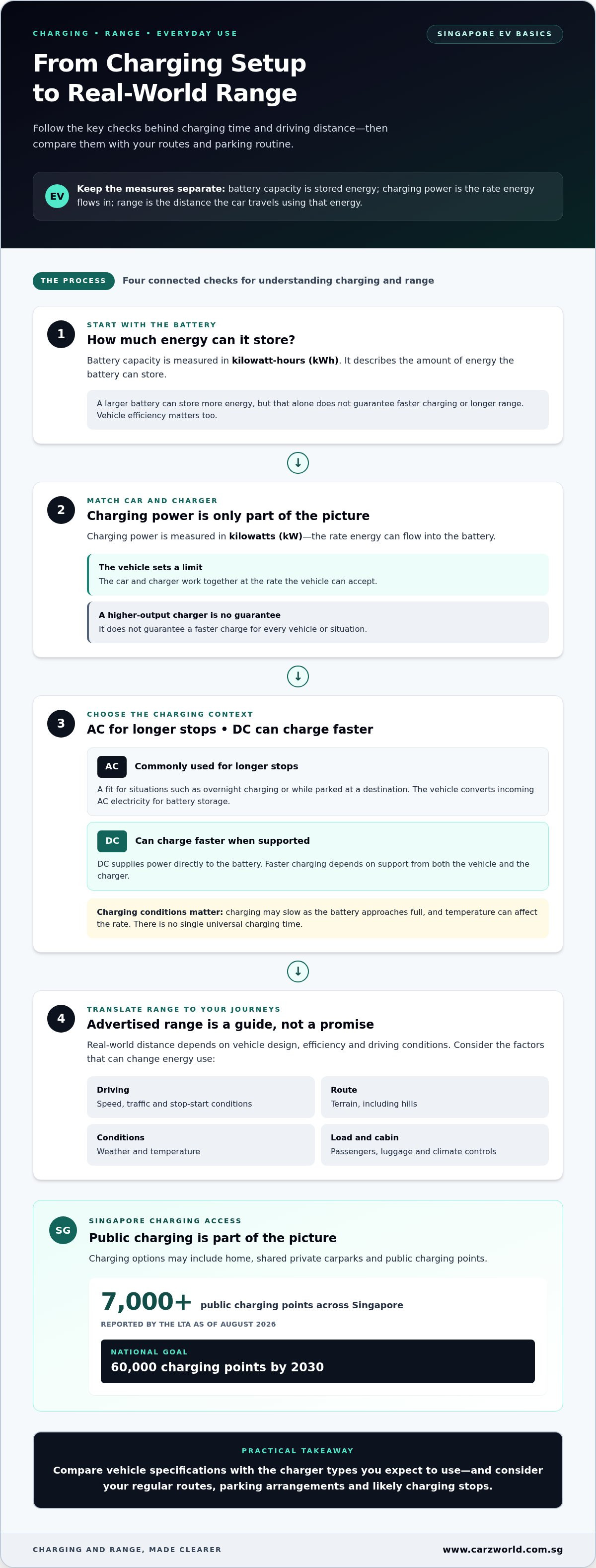
Two measurements make charging specifications easier to compare: battery capacity, shown in kilowatt-hours (kWh), and charging power, shown in kilowatts (kW). Think of kWh as the amount of energy the battery can store and kW as the rate at which energy can flow into it. A larger battery can store more energy, but it doesn’t automatically mean faster charging or longer range. Vehicle efficiency matters too.
Charging access in Singapore isn’t limited to private homes. Drivers may use chargers at home or in shared private carparks, as well as public charging points. The Land Transport Authority reported more than 7,000 public charging points across Singapore as of August 2026, with a national goal of 60,000 by 2030. The LTA’s information on Singapore's EV incentives and roadmap provides further context on the country’s electric vehicle plans.
What affects electric vehicle charging time?
Charging time depends on the car’s maximum charging capability, the charger’s output, the battery’s current level and charging conditions. The car and charger work together at the rate the vehicle can accept, so a higher-output charger doesn’t guarantee a faster charge for every model or situation.
AC charging is commonly used for longer stops, such as overnight or while parked at a destination. The vehicle converts incoming AC electricity for battery storage. DC charging supplies power directly to the battery and can charge faster when both the vehicle and charger support it. Charging may slow as the battery approaches full, and temperature can affect the rate. Rather than assuming one universal charging time, compare the vehicle’s specifications with the charger type you expect to use.
What changes an electric vehicle’s real-world range?
Advertised range is a guide, not a promise: your journey’s speed, traffic, weather, terrain, load and use of cabin climate controls can change how far a charge takes you. Faster driving, carrying extra passengers or luggage, and running air conditioning can affect energy use. Stop-start traffic, hills and weather conditions can also influence the result.
Battery capacity and driving range are related, but they aren’t interchangeable. Capacity describes stored energy; range describes the distance a vehicle can travel using that energy. Efficiency, driving conditions and vehicle design all contribute to the distance achieved.
Consider your regular routes, parking arrangements and likely charging stops instead of relying on a single headline figure. Comparing your needs with vehicle specifications can help you assess both pre-owned car options and brand-new choices.
Electric Vehicle vs Hybrid vs Petrol Car: Singapore Ownership Trade-Offs
There’s no single powertrain that suits every Singapore driver. A fully electric car can fit well if charging is convenient and your regular journeys are predictable. A hybrid or petrol car may feel simpler if you often travel longer distances or don’t have dependable charging access. Start the comparison with your routine, not a blanket claim that an electric vehicle is always better or less practical.
Is an electric vehicle practical for everyday driving in Singapore?
Map a typical week before deciding. Note your daily routes, occasional longer trips, where the car is parked, and how long it stays there. Then identify whether charging is available at home, work or a carpark you use regularly. Don’t assume every HDB, workplace or private residential carpark has a charger, or that a charging point will always be convenient to access.
Reliable charging access can matter more to daily convenience than a headline range figure. If you can charge while parked as part of your normal routine, an EV may fit without requiring frequent special stops. If charging means changing your schedule or travelling out of your way, the routine may feel less straightforward. Consider longer trips separately and identify where you could charge along the route.
When might a hybrid or petrol car fit better?
A petrol car can suit drivers who prefer refuelling rather than planning around charging. A conventional hybrid also uses petrol, while a plug-in hybrid offers battery-powered driving that can be replenished by plugging in, alongside its petrol engine. A PHEV may be a middle ground, but it still requires charging to use its rechargeable battery and combines two power systems.
Use this routine-based comparison as a starting point. Vehicle design, efficiency and individual driving needs vary, so the table describes general ownership patterns rather than a promise about every model.
| Powertrain | Routine and access to consider |
|---|---|
| Fully electric | Plan around charging access. Can suit regular journeys if charging fits naturally into parking time. |
| Plug-in hybrid | Can use electric power and petrol. Plug in to recharge the battery; petrol provides another way to power journeys. |
| Conventional hybrid | Uses petrol and doesn’t plug in for external charging. Consider it if you want an electrified powertrain without a charging routine. |
| Petrol | Refuel at petrol stations. May suit drivers who value familiar refuelling and don’t want to depend on charging access. |
Compare ownership costs in context, too. Charging, fuel use, road tax and the vehicle’s purchase terms can affect the overall picture. If you’re weighing different priorities, browse pre-owned car options to consider EVs and other powertrains side by side.
How to Assess Electric Vehicle Ownership Before Buying in Singapore
A practical assessment starts with your everyday routine, then checks the charging setup, ownership details and vehicle itself. Use this checklist to compare an electric vehicle with your needs instead of relying on a single range figure or general impression.
- Start with your driving habits. Note your usual daily distance, how often you make longer trips, and whether your schedule is predictable or changes frequently.
- Map your typical routes. Include regular destinations and occasional journeys. Consider where you could stop to charge if a trip extends beyond your usual routine.
- Assess charging access. Identify chargers you can realistically use at home, work or nearby. Don’t assume your residence or workplace has a suitable charger available.
- Check parking arrangements. Consider where the car stays for the longest periods, whether you can access charging while it’s parked, and whether shared-carpark arrangements affect convenience.
- Account for passengers and luggage. Think about how often you carry people, child seats or bulky items. Compare cabin and boot space with how you actually use a car.
- Review Singapore ownership rules and costs. COE, road tax, incentives and vehicle requirements can change. Check current information through the LTA’s electric vehicle guidance and other relevant official Singapore sources before making a decision.
- Evaluate the specific model. Compare its range and charging capability with your routes and available chargers. Review the overall vehicle condition and the details that matter to your ownership plans.
What should you review when considering a pre-owned EV?
Look for available battery health information, such as a battery condition or state-of-health report, and review the service history for a record of the vehicle’s care. These details can help you understand the battery’s reported condition and whether the vehicle has a documented maintenance history. Also check its age, mileage, general condition and relevant ownership documentation.
Review charging equipment details as well. Check what equipment is included and whether it suits the charging points you expect to use. For a fuller comparison, browse pre-owned car options alongside brand-new vehicles, using the same checklist for both.
Ready to compare options against your routine? Explore electric and hybrid vehicles and consider which powertrain, charging access and vehicle design best fit your needs.
Explore New and Pre-Owned Electric Vehicles with Carz World
Choosing an electric vehicle is easier when you connect the powertrain to your real routine. Consider four factors together: whether you want a fully electric car or a hybrid, how you’ll access charging, the journeys and passengers you need to accommodate, and how long you plan to own the vehicle. These priorities can help narrow your search before you compare individual models.
Carz World is a Singapore dealership offering brand-new and pre-owned vehicles, including electric and hybrid models. New and pre-owned options can suit different preferences, but neither is automatically the better choice. Focus on the vehicle’s suitability for your needs and the ownership details that matter to you.
Should you consider a new or pre-owned electric vehicle?
A brand-new vehicle may appeal if you’re looking for a new-car purchase and want to compare the latest available model options. Explore brand-new car options by powertrain, body style and intended use, then compare the vehicle’s specifications with your regular routes and charging access.
With a pre-owned vehicle, give careful attention to its condition, age, mileage, available service records and, for an EV, any available battery health information. Consider how the car has been used and whether its condition and documentation align with your priorities. You can also review pre-owned car options as part of your comparison. In either case, weigh the vehicle against your budget and ownership horizon rather than choosing by powertrain alone.
What is a practical next step for Singapore EV shoppers?
Start with a shortlist. Compare suitable body styles and powertrains, then check the details that affect everyday use: charging capability, range, seating and luggage space. If you’re considering a pre-owned EV, include its available condition and history information in the comparison. For a new vehicle, focus on the specifications and features that matter for your routine.
Carz World also offers vehicle financing and insurance as related services, which can form part of your broader ownership considerations. Take your time to compare options and identify questions about the models you’re considering. A clear shortlist makes it easier to decide what best fits your needs.
Explore Carz World vehicle options when you’re ready to take the next step.
Choose a Vehicle That Fits Your Routine
The right choice starts with how you drive and where you can charge. Compare fully electric, plug-in hybrid and conventional hybrid powertrains, then consider your regular journeys, parking and access to charging. Battery capacity and advertised range are useful reference points, but your day-to-day needs should guide the decision.
Before choosing a model, review the details that shape ownership in Singapore, including current vehicle requirements, taxes, incentives and COE information. If you’re considering a pre-owned electric vehicle, factor in its condition, available battery health information and service records. A new vehicle may suit different preferences, so compare both routes against your priorities and ownership horizon.
Carz World offers new and pre-owned electric and hybrid vehicles in Singapore, with vehicle financing and insurance available as related services. Take a measured approach, shortlist vehicles that fit your routine, and explore the options at your own pace.
Explore vehicles at Carz World and take a confident next step towards finding a vehicle that works for you.
Frequently Asked Questions
What is an electric vehicle?
An electric vehicle uses an electric motor to move the car. A battery electric vehicle (BEV) runs on electricity stored in a rechargeable battery and has no petrol engine. Hybrids also use an electric motor, but combine it with a petrol engine. Plug-in hybrids can be charged externally, while conventional hybrids aren’t plugged in. Knowing which powertrain a car has helps you understand its charging or refuelling needs.
Is an electric vehicle suitable for driving in Singapore?
It can be suitable if charging access fits your routine. Consider where you park, whether you can use a charger at home, work or nearby, and how predictable your regular journeys are. Don’t assume every residential or workplace carpark has charging. Think through occasional longer trips as well. An EV isn’t automatically right or wrong for every driver; convenience depends on how charging and driving fit into your daily life.
How long does it take to charge an electric vehicle?
Charging time varies by vehicle, charger output, battery level and charging conditions, so there’s no single duration that applies to every model. AC charging is commonly used when a car will be parked for longer, while DC charging can provide faster charging if the vehicle supports it. Charging may slow as the battery fills. Check the specific vehicle’s charging capability and factor in the charger you’ll actually use.
Can I charge an electric vehicle without a home charger?
Yes. Drivers without a home charger can use public charging points or chargers at places they regularly visit, where available. Before choosing an EV, consider the locations, charging types and parking time that fit your routine. A charger nearby may still be inconvenient if it doesn’t suit your schedule or the vehicle. Map realistic charging options for regular journeys instead of assuming you’ll always find a convenient point.
What happens if an electric vehicle runs out of charge?
If the battery runs out, the vehicle will eventually be unable to continue driving. Pay attention to the remaining range and charging warnings, and plan a charging stop before the battery is depleted. If you’re stranded, move to a safe location if possible and arrange roadside assistance or recovery. Follow the vehicle’s owner manual for model-specific instructions, as recovery and transport procedures can differ between vehicles.
Are pre-owned electric vehicles worth considering?
They can be worth considering if the vehicle’s condition, history and specifications suit your needs. Review available battery health information, service records, age, mileage and ownership documentation. Check the charging equipment details and compare the vehicle’s range and charging capability with your regular journeys. Battery condition is one part of the assessment, not the only one. Carz World sells pre-owned electric and hybrid vehicles in Singapore.
Do electric vehicles need less maintenance than petrol cars?
Battery electric vehicles have fewer moving parts in their powertrain than petrol cars, so some routine servicing needs may differ. That doesn’t mean they require no maintenance. Tyres, brakes, cabin filters and other vehicle systems still need attention, and requirements vary by model. For a pre-owned EV, review its service history and the manufacturer’s recommended maintenance schedule. Compare the vehicle’s documented care rather than assuming every EV has identical upkeep needs.
Disclaimer
This content is provided for general informational purposes only. Readers are encouraged to independently verify important information.
In Same Category
- Calculating the Breakeven Point for COE Renewal in Singapore
- Financial Checklist Before Committing to a Car Purchase in Singapore (2026)
- COE Renewal Conditions and Eligibility in Singapore: 2026 Guide
- Balloon Scheme Car Loan in Singapore: Pros and Cons for 2026
- Getting Car Finance with a New Business in Singapore: A Practical Guide
Related by Tags
- Used Electric Cars in Singapore: 2026 Buyer's Guide
- Electric Vehicle Guide 2026: Types, Charging and Buying in Singapore
- COE Results Singapore: How to Read the Latest Bidding Outcomes in 2026
- Singapore Car Loan Guide for EP Holders (2026)
- Calculating the Real 5-Year Cost of Car Ownership in Singapore (2026 Guide)
- Parallel Import Singapore: The Ultimate 2026 Buyer’s Guide
- How to Buy a Car in Singapore: The Ultimate 2026 Step-by-Step Guide