Car Subscription vs Ownership in Singapore (2026): Which Wins the Value Race?

Would you still sign a 10-year contract if you knew the upfront entry fee alone could cost more than a luxury condo downpayment? Most Singaporeans grew up believing that buying a car was a necessary rite of passage. Today, with COE premiums frequently crossing the S$100,000 mark, that dream often comes with significant depreciation anxiety and inflexible financial commitments. We understand the pressure of making the right choice when so much capital is at stake. This guide provides a data-backed breakdown of car subscription vs ownership singapore to show you exactly where your money goes over a five-year period.
We have crunched the numbers on the 2026 market to compare every hidden fee from ARF to road tax. You will discover a clear cost comparison and learn how to maximize your value through PARF rebates or the freedom of a monthly subscription. By the end of this article, you will have the clarity needed to choose the most cost-effective path for your lifestyle and budget.
Key Takeaways
- Understand how record-high COE and ARF hikes in 2026 are reshaping the financial feasibility of traditional car ownership in Singapore.
- Analyse the upfront costs and monthly cash flow of car subscription vs ownership singapore to determine which model best protects your liquid capital.
- Learn the truth about "dead money" by calculating how PARF and COE rebates impact your vehicle's long-term paper value compared to subscription fees.
- Discover why 3- to 5-year-old pre-owned cars represent a strategic "middle path" for drivers looking to avoid the steepest part of the depreciation curve.
- Get a data-backed roadmap to help you transition seamlessly to your next vehicle while securing the best possible value in a high-cost market.
The Singapore Driving Dilemma: COE, ARF, and the Rise of Alternatives
Car ownership in Singapore has reached a critical tipping point in 2026. The Land Transport Authority (LTA) continues to enforce its zero-growth policy for private cars, a regulation that has been in place since February 2018. This policy ensures that the car population remains stagnant, making every new registration a fierce competition. For many residents, the debate over car subscription vs ownership singapore is no longer a luxury of choice but a necessary financial strategy to stay mobile.
The traditional route to the driver's seat requires navigating the complex Certificate of Entitlement (COE) system. With premiums frequently hovering at six-figure sums, the financial burden is immense. While owning a vehicle provides a sense of permanence, the rise of "asset-light" alternatives offers a way to bypass the heavy debt associated with traditional purchases. This creates a core conflict for drivers: committing massive upfront capital for a depreciating asset or opting for monthly flexibility without the long-term liability.
To better understand this concept, watch this helpful video:
The High Cost of Entry in 2026
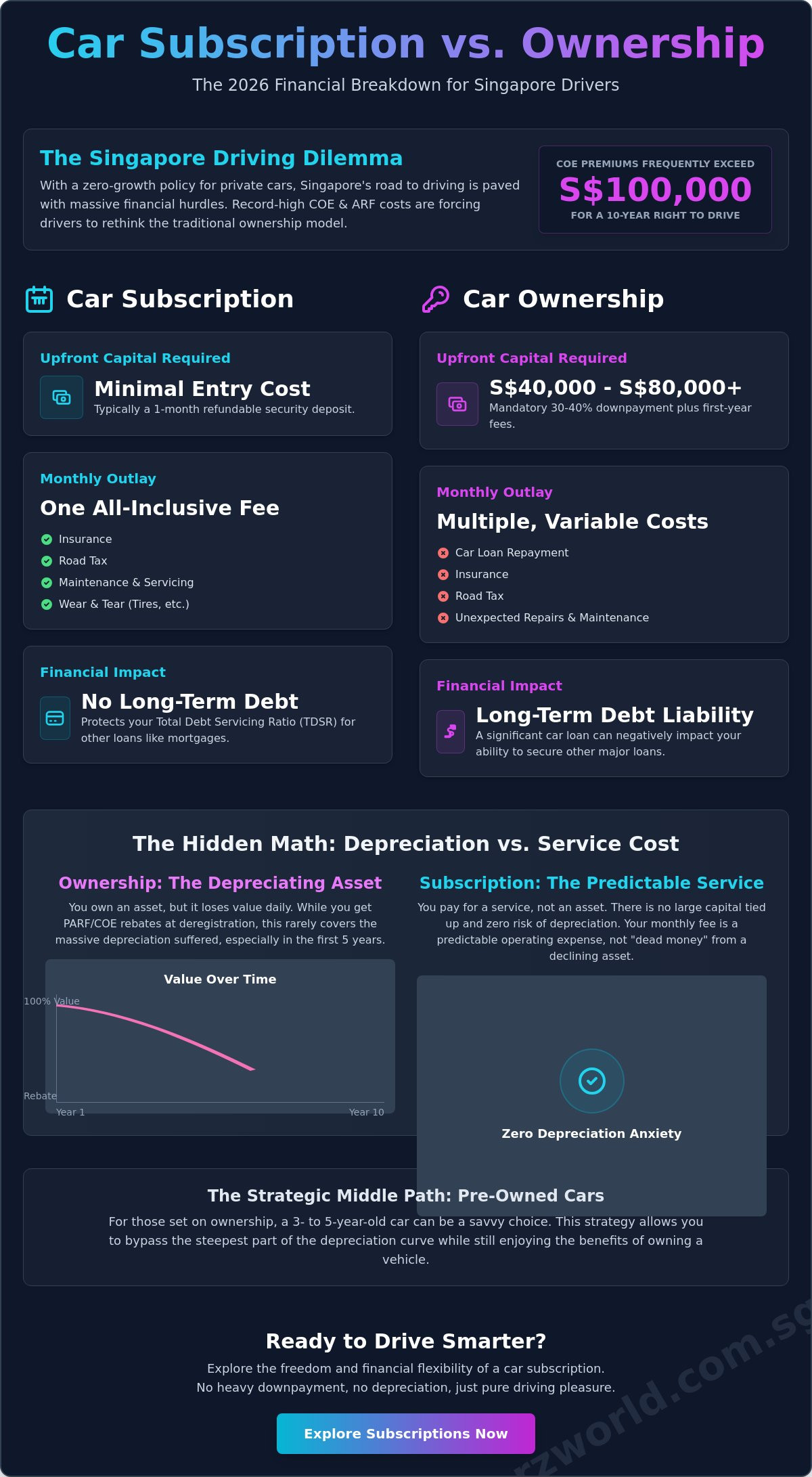
Getting behind the wheel of a new car requires a staggering amount of liquid cash. Under current Monetary Authority of Singapore (MAS) rules, car loans are capped at 60% or 70% of the purchase price. This means you must provide a 30% downpayment for cars with an Open Market Value (OMV) of S$30,000 or less, and 40% for anything above that. For a mid-sized sedan, this often translates to an upfront cash outlay exceeding S$80,000.
The Additional Registration Fee (ARF) tiers also add significant weight to the price tag. Since the 2023 budget changes, luxury models face ARF rates as high as 320% for the portion of OMV exceeding S$80,000. These aggressive tax structures mean that by the time you pay for the COE and the ARF, the actual value of the metal you're driving is only a fraction of the total price. It's a high-stakes investment that ties up capital that could otherwise be used for property or investments.
What is a Car Subscription Exactly?
A car subscription is a modern, all-in-one service that bundles every cost of driving into a single monthly fee. Unlike traditional rental cars that focus on short-term needs, or long-term leasing that often requires multi-year commitments, subscriptions offer a middle ground of flexibility. The monthly payment typically covers insurance, road tax, regular maintenance, and even wear-and-tear items like tires and batteries.
One of the biggest advantages is the impact on your financial health. Because a subscription is a service fee rather than a loan, it doesn't appear as a long-term debt on your credit profile. This keeps your Total Debt Servicing Ratio (TDSR) healthy, which is vital if you're planning to apply for a mortgage. It's a seamless way to enjoy the latest models without the administrative headaches or the risk of sudden, expensive repair bills.
Subscription vs. Ownership: A Direct Comparison of Mechanics
Choosing between a car subscription vs ownership singapore requires a look at how money moves through your bank account over time. While owning a car is a traditional milestone, the mechanics of the two models differ fundamentally in terms of liquidity and long-term commitment. In Singapore's high-cost environment, these differences are magnified by government regulations and the unique COE system.
The Upfront Capital Requirement
Ownership in Singapore is defined by high entry barriers. Under current Monetary Authority of Singapore (MAS) regulations, car loans are capped at 60% or 70% of the purchase price depending on the Open Market Value (OMV). This means you must provide a cash downpayment of at least S$40,000 to S$60,000 for a mid-range sedan. You'll also need to pay for the first year of insurance premiums and various registration fees immediately.
In contrast, a subscription model functions more like a service. You typically pay a small security deposit, often equivalent to one month's fee, along with the first month's payment. This lowers the initial barrier to entry and keeps your cash liquid. Investing S$50,000 into a diversified portfolio or a 3.2% p.a. fixed deposit instead of locking it into a depreciating asset like a car represents a significant opportunity cost for owners.
Operational Hassle and Maintenance
The subscription model is built on the "peace of mind" factor. Your monthly fee is inclusive of road tax, insurance, and all scheduled maintenance. If the car breaks down or needs a battery replacement, the provider handles it. This removes the administrative burden of tracking expiry dates and managing unexpected repair bills. It's an ideal setup for those who want a hassle-free driving experience without the technical worries.
Ownership places the full burden of upkeep on you. You're responsible for:
- Finding and vetting a reliable workshop for regular servicing.
- Managing the replacement of wear-and-tear items like tires and brake pads.
- Renewing road tax and shopping for competitive insurance quotes annually.
- Handling the logistics of repairs if the vehicle is involved in an accident.
The "exit strategy" also differs. Owners must navigate the used car market, deal with dealers, or manage the complexities of PARF and COE rebates when they want to change vehicles. Subscriptions offer a simpler path; you simply return the keys at the end of your term and walk away or upgrade to a newer model. If you're looking for a dependable partner to guide you through these choices, talk to our team for expert advice on your next vehicle move.
The Hidden Math: Depreciation vs. PARF Rebates
The most common argument against car subscriptions is that they represent "dead money." You pay every month and have nothing to show for it at the end of the term. Ownership, by contrast, feels like building equity in an asset. However, in the unique Singapore market, this comparison isn't quite so simple. To decide between car subscription vs ownership singapore, you need to calculate the Total Cost of Ownership (TCO) against the guaranteed rebates the government provides.
While a subscriber's monthly fee is a pure expense, an owner's monthly repayment is only part of the story. You have to factor in the "paper value" that stays with the car. This value acts as a buffer, but it also ties up significant liquidity that could be used elsewhere. Understanding how these rebates function is essential for any driver looking to maximize their S$100,000+ investment.
Understanding Your Car’s Scrap Value
Every car in Singapore has a Paper Value that consists of the PARF (Preferential Additional Registration Fee) rebate and the COE rebate. You can think of PARF as the "forced savings" of car ownership. It's a portion of the Additional Registration Fee you paid upfront that the Land Transport Authority (LTA) returns to you when the car is deregistered. If you buy brand new cars and scrap them at the five-year mark, you receive 75% of the ARF back. This "pay back" at the end of your ownership period can significantly lower your actual annual depreciation.
- PARF Rebate: A tiered refund of the ARF based on the age of the car at deregistration.
- COE Rebate: The pro-rated value of the remaining months left on your 10-year COE cycle.
- Total Paper Value: The sum of PARF and COE rebates, representing the minimum cash you get back.
Subscription: The Cost of Flexibility
Subscription fees are a 100% expense with 0% recovery at the end. You pay for the right to drive and nothing more. However, ownership involves a "net loss" that often exceeds a subscription's cost during periods of high COE volatility. If you buy a car when the COE is S$105,000 and the market corrects to S$75,000 two years later, your resale value drops much faster than your loan balance. When you eventually sell your car, you might find that the "equity" you thought you were building has been swallowed by market shifts.
Consider a 5-year outlook. An owner pays for the car, insurance, road tax, and servicing. After five years, they receive a PARF rebate and a resale balance. A subscriber pays one flat fee. While the subscriber's total outlay might be higher over 60 months, they avoid the S$50,000 to S$80,000 down payment required for ownership. That capital remains free for other investments. Subscription allows you to pivot without being anchored to a depreciating asset when Singapore's car policies change.
Strategic Ownership: Why Pre-Owned Cars Are the Middle Path
Many drivers feel stuck between the high cost of a new car and the recurring fees of a subscription. There's a middle ground that often provides the best financial outcome. Buying a high-quality used car, specifically one that's three to five years old, allows you to bypass the most aggressive phase of depreciation. It's a smart play for those who want the benefits of an asset without the "new car smell" tax.
In Singapore, a brand-new car can lose up to 25% of its value within the first year alone. By choosing a pre-owned vehicle, you let the previous owner absorb that initial loss. This lowers your entry price significantly while you still enjoy a modern, reliable vehicle. When weighing car subscription vs ownership singapore, the used car option often presents the lowest total cost of transport over a long horizon.
Consider the monthly outlay. A subscription for a mid-sized sedan can exceed S$2,800 per month. In contrast, financing a 5-year-old model often results in monthly loan repayments closer to S$1,400. Even after adding S$450 for insurance, road tax, and servicing, the total monthly cost of ownership remains much lower than a subscription. You're also building equity in an asset you can eventually sell or trade-in.
The 5-Year-Old Used Car Advantage
The first owner pays the highest Additional Registration Fee (ARF) and the full Certificate of Entitlement (COE) premium. By the five-year mark, the car's price reflects its actual market value rather than just government taxes. You benefit from a car that still has five years of COE remaining at a fraction of the original cost. You can explore our Carz World used cars inventory to see current market valuations for these high-quality, well-maintained vehicles.
Decision Matrix: Which is Right for You?
- Scenario A: The Expat on a 2-year contract. Subscription wins here. It avoids the hassle of selling a car quickly when leaving the country; the flexibility justifies the higher monthly cost.
- Scenario B: The Local Family planning for 5+ years. Used car ownership wins. The total interest paid on a loan is significantly less than the cumulative "convenience fee" built into subscription pricing over 60 months.
- Scenario C: The Business Owner needing fleet flexibility. Leasing wins. It allows for tax deductions and keeps the company's debt-to-equity ratio clean while providing the ability to scale the fleet up or down.
Choosing the right path depends on your timeline and cash flow needs. If you value long-term savings and asset value, speak with our team today to find a pre-owned vehicle that fits your lifestyle.
Making the Move: How to Secure Your Next Vehicle
The 2026 verdict on the car subscription vs ownership singapore debate depends entirely on your current life stage and financial goals. Subscriptions have become the go-to choice for those seeking short-term agility and zero-downpayment entry. However, traditional ownership still wins the value race for drivers who intend to utilize the full 10-year COE period. Owning a vehicle remains a predictable way to manage long-term transport costs, especially as interest rates and COE premiums stabilize.
Transitioning from your current car to a newer model requires a clear strategy to maximize your return. Whether you choose the flexibility of a subscription or the equity of ownership, the process should be methodical. You'll want to ensure your current financial commitments are settled before stepping into a new contract or loan agreement.
Selling or Trading-In Your Current Ride
Securing an honest valuation is the first step in your transition. Avoid relying on a single quote; instead, look for dealers who provide transparent market data. Many Singaporean drivers now prefer the consignment process because it often yields higher returns than a direct trade-in. By letting a professional handle the marketing and paperwork, you can often secure a price closer to the actual market value. You can sell your car with Carz World to experience a transparent, hassle-free valuation process that prioritizes your interests.
The Carz World Difference: Trust and Transparency
The local automotive market is often criticized for aggressive sales tactics, but your experience doesn't have to be stressful. Choosing a "not pushy" dealership is essential for making a sound financial decision. Testimonials from our clients frequently highlight a "seamless and pleasant" journey, driven by a professional and patient approach from consultants like Ryan, Carson, and Adam. We believe in providing the facts and letting you decide at your own pace.
For those who have crunched the numbers and decided that ownership is the superior path for their lifestyle, we offer a wide range of brand new cars. These vehicles come with the latest safety features and the peace of mind that only a fresh COE can provide. Our team is dedicated to ensuring that every handover is a smooth process, regardless of whether you are buying your first car or upgrading your family SUV.
Ready to make your move? Don't leave your next vehicle choice to chance. Contact us today for a personalized consultation. We'll help you weigh the costs of car subscription vs ownership in the current 2026 market so you can drive away with total confidence.
Drive Away With Confidence in 2026
Deciding between car subscription vs ownership singapore comes down to how you value flexibility against long-term equity. Ownership remains a strategic move for those who want to leverage PARF rebates, which return 50% of the Additional Registration Fee (ARF) when a car is deregistered at the 10-year mark. Subscription services offer a simpler alternative, removing the heavy upfront burden of COE premiums that have seen significant fluctuations in recent LTA bidding cycles. For many drivers, a well-maintained pre-owned vehicle offers a practical middle ground that balances depreciation with reliable performance.
At Carz World, we believe in a transparent, proof-based approach to every transaction. Our highly recommended sales consultants, including Ryan, Carson, Adam, and Ben, are known for their patient and professional service. We handle everything from local sales to global exports, ensuring your experience is seamless and pleasant from start to finish. You don't have to navigate these complex financial decisions alone when you have a dependable partner by your side. Talk to us today to find your perfect driving solution and let's get you on the road with total peace of mind.
Frequently Asked Questions
Is car subscription cheaper than buying a car in Singapore in the long run?
Ownership is generally more cost-effective if you plan to keep the vehicle for more than five years. When comparing car subscription vs ownership singapore, subscribers pay a premium for flexibility and all-inclusive service. While ownership requires a 30% to 40% downpayment, the total cost of interest and depreciation over a 10-year COE cycle is often 15% to 20% lower than continuous subscription fees.
Do I need to pay for insurance with a car subscription?
You don't need to pay separately for insurance as it's bundled into your monthly subscription fee. This all-in-one cost covers comprehensive insurance, road tax, and regular maintenance. It simplifies budgeting because you won't face sudden premium hikes or annual lump-sum payments. Most providers include 24/7 roadside assistance as part of this package to ensure a seamless experience for every driver.
What happens to my COE rebate if I subscribe instead of buy?
You won't receive a COE rebate because the subscription provider remains the legal owner of the vehicle. When a car is deregistered before its 10-year mark, the Land Transport Authority (LTA) grants a pro-rated rebate on the Prevailing Quota Premium. In a subscription model, the company claims this rebate. Owners, however, can recover thousands of dollars if they choose to scrap their car early.
Can I exit a car subscription early if my situation changes?
You can exit most subscriptions early, but you'll likely face a termination fee or a notice period requirement. Most contracts require at least 30 days of notice to process the return. Some providers charge a penalty equal to one or two months of fees if you break a long-term commitment. It's much faster than selling a car you own, which can take weeks to find a buyer.
Is it better to buy a brand new car or a 5-year-old used car in 2026?
A 5-year-old used car is often the better financial choice in 2026 due to lower annual depreciation. New cars lose about 10% to 15% of their value the moment they're registered. By choosing a well-maintained pre-owned vehicle, you avoid the steepest part of the depreciation curve. You also benefit from a lower loan amount, which reduces your total interest paid over the remaining COE tenure.
How much downpayment is required for a used car in Singapore?
You'll need a downpayment of either 30% or 40% of the car's purchase price. According to Monetary Authority of Singapore (MAS) regulations, cars with an Open Market Value (OMV) of S$20,000 or less require a 30% downpayment. If the OMV exceeds S$20,000, the requirement increases to 40%. This means you must have your cash or CPF funds ready before finalizing the purchase of your vehicle.
Can expats get car loans for ownership in Singapore?
Expats can definitely secure car loans in Singapore if they hold a valid Employment Pass with at least 12 months of validity remaining. Most banks require a minimum monthly income of S$2,500 to S$3,000 for foreign applicants. You'll need to provide your passport, work permit, and recent payslips. It's a professional and straightforward process that our team at Carz World helps navigate for many international clients.
What are the main differences between car leasing and subscription?
The main difference lies in contract flexibility and the duration of the commitment. Traditional leasing usually requires a commitment of 3 to 5 years and often targets corporate clients. Subscriptions offer shorter terms, sometimes as brief as month-to-month. When evaluating car subscription vs ownership singapore, remember that subscriptions include maintenance and insurance, whereas some lease agreements might exclude certain wear-and-tear items or specific servicing costs.
In Same Category
- Calculating the Breakeven Point for COE Renewal in Singapore
- Financial Checklist Before Committing to a Car Purchase in Singapore (2026)
- COE Renewal Conditions and Eligibility in Singapore: 2026 Guide
- Balloon Scheme Car Loan in Singapore: Pros and Cons for 2026
- Getting Car Finance with a New Business in Singapore: A Practical Guide