25 Essential Questions to Ask a Used Car Dealer in Singapore (2026 Checklist)

What if the most expensive mistake you make this year isn't the car you choose, but the three specific questions you forgot to ask at the showroom? With over 116,000 vehicle transfers recorded by the LTA in 2023, the Singapore pre-owned market is fast-moving and often complex. To secure a high quality and well maintained ride, you need a proven list of questions to ask a used car dealer that goes beyond the surface level of "does it drive well?"
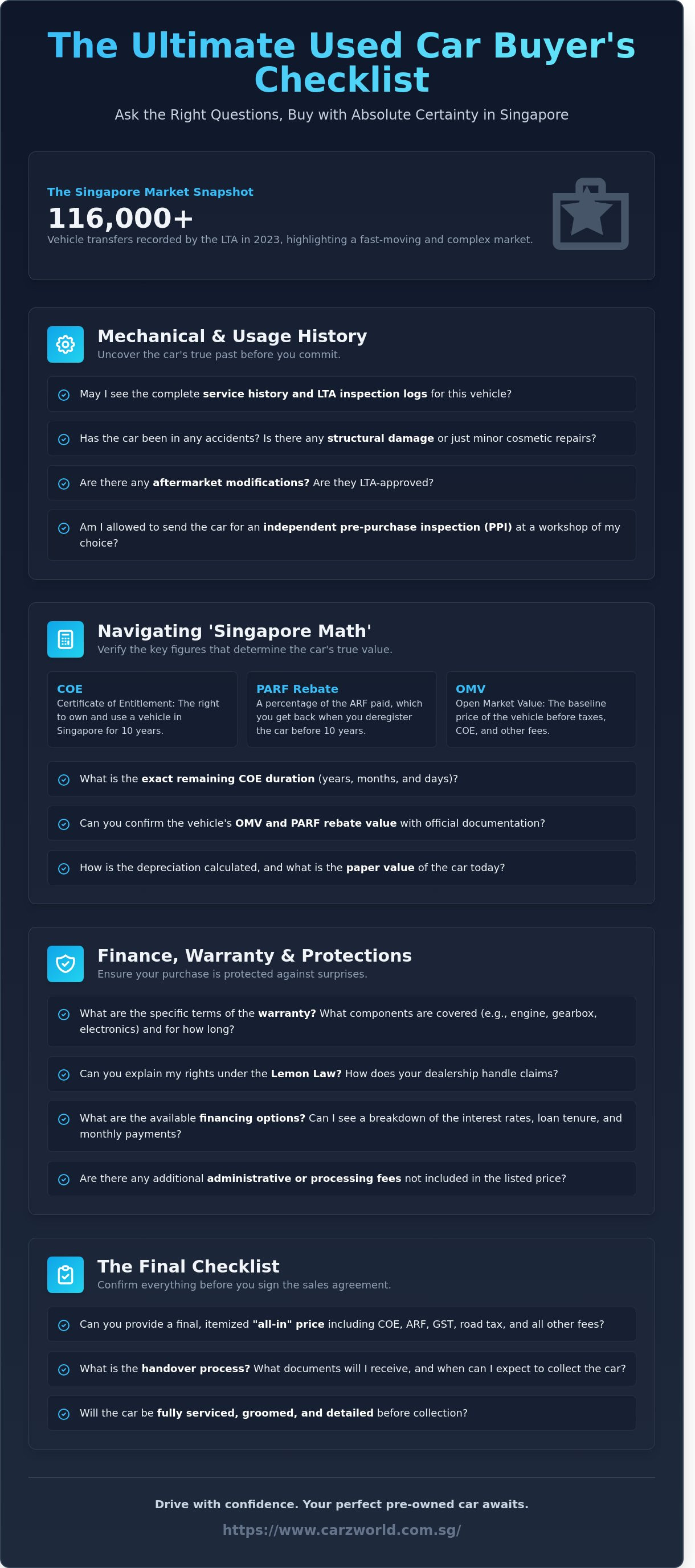
It's natural to want total clarity regarding hidden accident histories or those confusing administrative fees that sometimes appear out of nowhere. You want a seamless and pleasant experience where the PARF rebate values and COE math actually make sense before you commit your hard-earned savings. This checklist of 25 essential questions will give you the tools to verify a vehicle's true condition and financial health. We'll guide you through every step of the process, from checking maintenance logs to finalizing the paperwork, so you can make your final purchase decision with absolute certainty.
Key Takeaways
- Understand why the high cost of Singapore car ownership makes vetting your dealer just as important as inspecting the vehicle itself.
- Master the essential questions to ask a used car dealer to uncover a vehicle’s true mechanical health and hidden accident history.
- Learn how to accurately calculate "Singapore Math" by verifying critical figures like PARF rebates, OMV, and remaining COE duration.
- Protect your purchase with professional tips on navigating Lemon Law protections, warranty coverage, and transparent financing options.
- Follow a precise final checklist to confirm your "all-in" price and ensure a seamless handover process before signing any agreement.
Why asking the right questions is critical in the Singapore used car market
Buying a car in Singapore is a major financial commitment that ranks just below housing for most households. With the price of a Certificate of Entitlement (COE) frequently reaching six figures, the stakes are incredibly high. A "bad buy" isn't just a minor inconvenience; it's a potential financial disaster that can drain your savings. This is why the middle-of-the-funnel (MOFU) stage of your journey is so important. You've already decided which model you want, so now you must determine which dealer deserves your business.
Knowing the specific questions to ask a used car dealer helps you move from browsing to buying with total confidence. These questions act as a filter. They allow you to identify reputable, established businesses and avoid "fly-by-night" operations that might vanish a month after the sale. Transparency is the only way to build real trust between a buyer and a salesperson in a market where information is often lopsided.
To better understand how to approach these conversations on the showroom floor, watch this helpful video:
Identifying 'Lemon' cars before they become your problem
In the local resale context, a "lemon" is a vehicle with chronic defects that appear shortly after purchase. Singapore's Consumer Protection (Fair Trading) Act, or the Lemon Law, provides some recourse, but the legal process is often exhausting. Questioning the dealer about a vehicle's specific history reveals inconsistencies that a glossy exterior might hide. If you ask about previous owners or maintenance schedules and receive conflicting data, you've likely spotted a red flag. Being an inquisitive buyer gives you a psychological advantage. It signals to the dealer that you're well-informed and won't be pressured into a quick, uninformed decision.
The importance of dealer transparency
A reputable dealer like Carz World doesn't just tolerate detailed questions; we welcome them. We believe that providing clear information about our used cars is the best way to ensure long-term customer satisfaction. You should be wary of any salesperson who rushes the process or provides vague, non-committal answers. Look for social proof as part of your vetting. A dealer with a consistent history of positive testimonials, where customers mention consultants like Ryan, Carson, or Adam by name, shows a commitment to individual service. Reputable dealers rely on their long-term reputation rather than short-term sales tactics, making them far more likely to be honest about a car's true condition.
By preparing your questions to ask a used car dealer in advance, you ensure the transaction is professional and methodical. This organized approach is what separates a seamless buying experience from one filled with regret.
Essential questions regarding the vehicle's mechanical and usage history
Buying a car is a significant financial commitment. You need to know exactly what happened under the hood before you commit. These are vital questions to ask a used car dealer to ensure you aren't buying a vehicle with hidden liabilities. Transparency is the foundation of a good deal, and a reputable dealer will have no issues providing this data.
Start by asking to see the full service history and LTA inspection logs. In Singapore, cars older than three years must pass periodic inspections to stay on the road. Reviewing the LTA vehicle registration details helps you verify the car's legal status and historical data. You should also ask if the car has been in any accidents. While minor bumper scuffs are common, structural damage to the chassis can compromise the car's safety and future resale value. Finally, confirm if the vehicle has any modifications. Non-approved exhausts or illegal window tints can lead to heavy fines and failed inspections during your ownership.
Deep dive into ownership and usage history
The number of previous owners is a strong indicator of a car's reliability. A vehicle that has changed hands four times in just 48 months often suggests persistent mechanical issues that previous owners didn't want to handle. You should also clarify if the car was used for private hire (PHV) or as a rental. A typical private car in Singapore covers about 12,000km to 15,000km annually. In contrast, a PHV might clock 45,000km or more in a single year, leading to accelerated wear on the engine and suspension. If the odometer shows a low number but the driver's seat and steering wheel are heavily frayed, the mileage might not be genuine.
Service records and major replacements
Don't just look at the exterior shine. Ask specifically about the timing belt, battery, and tyres. A timing belt usually requires replacement every 100,000km, and failing to do so can result in catastrophic engine failure. Check the battery's age; most lead-acid batteries in our tropical climate last only 18 to 24 months. If the tyres were manufactured more than 36 months ago, they've likely hardened and lost grip. Ask the dealer for the date of the last major service. A well-maintained car should have fresh fluids and filters, saving you from immediate maintenance costs after your purchase. If you're looking for high-quality pre-owned vehicles with transparent histories, our team is ready to provide all the documentation you need.
Navigating the 'Singapore Math': COE, PARF, and OMV questions
Buying a pre-owned vehicle in Singapore involves more than just checking the odometer. You're essentially trading in a complex financial instrument tied to government certificates. One of the most critical questions to ask a used car dealer is: "What is the exact OMV and the current PARF rebate?" The Open Market Value (OMV) is the price actually paid for the car before taxes. It's the foundation for your future scrap value. If you don't know the OMV, you can't accurately calculate the car's true depreciation.
You also need to pin down the Certificate of Entitlement (COE) details. Don't just settle for the year. Ask for the specific expiry date. A car with 18 months left on its COE carries different financing options and resale risks than one with 5 years remaining. You should also verify if the vehicle is a "PARF car" or a "COE car." A PARF car is still within its initial 10-year cycle and qualifies for a rebate of the Additional Registration Fee (ARF). A COE car has already had its life extended. It's cheaper to buy but offers zero rebate when you eventually scrap it.
Transparency regarding the vehicle's history is vital. Always ask if there are outstanding finance liens. You don't want to discover later that the previous owner's debt hasn't been settled. For a comprehensive look at your rights and the technicalities of local car ownership, the Automobile Association of Singapore's used car guide provides a reliable framework for these specific 2026 regulations.
Understanding the COE and PARF relationship
The "paper value" is the total cash you'd receive from the Land Transport Authority (LTA) if you deregistered the car today. It's the sum of the pro-rated COE balance and the PARF rebate. Since the OMV determines the ARF, and the ARF determines your rebate, these numbers are inseparable. Most cars registered in recent years offer a 50% PARF rebate of the ARF value at the 10-year mark. Knowing this helps you see past the sticker price to the actual cost of ownership per year.
Financial transparency and hidden costs
Request a line-by-line breakdown of the on-the-road price. This should clearly separate the car's base price from the 9% GST, transfer fees, and any administrative charges. Some dealers might add "processing fees" that exceed $1,000. It's better to identify these early in the negotiation. If you're looking for a straightforward buying experience with no hidden surprises, feel free to explore our used cars collection for transparently priced options. We believe honesty is the only way to build long-term trust with our drivers.
Vetting the dealer: Finance, warranty, and Lemon Law protections
A professional dealer provides more than just a vehicle; they provide peace of mind through clear legal and financial frameworks. Knowing the right questions to ask a used car dealer ensures you don't overlook protections that save you thousands in future repairs or interest charges. In the 2026 market, where vehicle electronics and hybrid systems are increasingly complex, these vetting steps are non-negotiable.
Start by asking about the warranty's specific scope. Does it cover the high-voltage battery in a hybrid or just the mechanical engine? Many third-party warranties have claim limits, so ask for the "Total Aggregate Limit" to see the maximum amount the insurer will pay. Next, clarify the financing. While in-house loans offer convenience and 24-hour approval, they often carry higher interest rates than direct bank loans. Ask for a breakdown of the effective interest rate (EIR) and any early settlement penalties. Finally, insist on an independent pre-purchase inspection (PPI). A trustworthy dealer will allow you to take the car to VICOM, STA, or your preferred workshop to verify its structural integrity.
Singapore's Lemon Law: Your safety net
The Consumer Protection (Fair Trading) Act, commonly known as the Lemon Law, protects you against defective goods. Under the 6-month rule, any defect that surfaces within six months of purchase is presumed to have existed at the time of delivery. The dealer is legally obligated to repair or replace the car. If they can't do so within a reasonable timeframe, you can claim a partial or full refund. To ensure this protection holds, always document the car's condition during the handover. Use a detailed checklist to note existing scratches or minor issues, as this prevents the dealer from claiming a major defect was "pre-existing and accepted" by you.
Financing and insurance options
Comparing dealer-linked bank loans against your own bank's offers is vital. Dealers often have preferred partnerships that might include service credits or insurance rebates. However, you must look at the total cost of borrowing over the entire loan tenure. Ask specifically about "Rule of 78" penalties for early repayment, which can make switching cars difficult later. If you find the financial commitment of a 10-year COE cycle daunting, you might consider car rental options to maintain flexibility while you wait for the right market conditions. This approach allows you to drive the latest models without the long-term liability of a car loan.
Our team at Carz World believes in total transparency for every transaction. If you're ready to find a vehicle backed by professional service, talk to us today to explore our certified inventory.
The final checklist: What to ask right before signing the sales agreement
You've found the right vehicle and the test drive went well. Before you put pen to paper, there are critical questions to ask a used car dealer to ensure the transaction is transparent. Rushing this final stage can lead to unexpected costs or administrative headaches later on. Follow these four steps to secure a fair deal.
- Step 1: Confirm the final all-in price. Ask the dealer to provide a written breakdown of every cost. This includes the vehicle price, GST, administrative fees, and LTA transfer fees. In Singapore, some dealers might add "agreement fees" at the last minute. Ensure the figure you see is the absolute total you will pay.
- Step 2: Verify all physical items. Check that both sets of keys are present. Replacing a modern transponder key can cost between $300 and $800 depending on the car brand. Confirm the owner's manual and service booklet are in the glovebox.
- Step 3: Set a date for the LTA ownership transfer. The legal transfer of ownership on the OneMotoring portal should happen promptly. Ask exactly which day the dealer will initiate this. You should receive an SMS from LTA to confirm the transfer within 7 days of the handover.
- Step 4: Conduct a final feature walkthrough. Don't drive off the lot until the consultant shows you how to operate the infotainment system, safety features, and electronic parking brakes. This ensures everything is in working order at the moment of delivery.
The importance of the Pre-Purchase Inspection (PPI)
Never skip a third-party evaluation at a reputable centre like VICOM or STA. These inspections provide an unbiased Grade A to D rating of the car's condition. Usually, the buyer pays the inspection fee, which typically ranges from $150 to $250. If the report uncovers hidden defects, you can use it as a tool to negotiate a lower price or insist that the dealer rectifies the issues before you sign the agreement. It's the most effective way to validate the questions to ask a used car dealer regarding the vehicle's history.
Closing the deal with confidence at Carz World
At Carz World, we believe the car buying journey should be a seamless and pleasant one. Our team focuses on being helpful and patient, ensuring you feel no pressure during the final handover. We maintain a high standard for our pre-owned inventory, ensuring every vehicle is well maintained before it reaches our showroom. If you're looking to upgrade, we also offer professional car consignment and sell services to help you get the best value for your current ride. Our goal is to build long-term trust through honesty and excellent service. Talk to our friendly consultants today to find your next reliable vehicle.
Drive Away With Confidence in 2026
Navigating the Singapore used car market requires more than just a quick test drive. You'll need to master the specifics of COE lifespans and PARF rebates while ensuring the vehicle's mechanical history aligns with its OMV. By keeping this list of questions to ask a used car dealer handy, you protect yourself under Singapore's Lemon Law and avoid unexpected maintenance costs down the road. It's about being thorough before any paperwork is signed.
At Carz World, we believe transparency is the foundation of every successful sale. Our patient and non-pushy consultants, like Ryan and Adam, focus on providing a seamless experience backed by hundreds of verified customer testimonials. Whether you're looking for a local family sedan or leveraging our expertise in global car exports, we're here to help you make an informed decision. Our team is dedicated to a smooth process from the first inquiry to the final handover. We take pride in being a dependable partner for every driver.
Discover our high-quality, well-maintained used car inventory and start your journey with a partner you can trust. You're ready to find a vehicle that perfectly fits your lifestyle and budget.
Frequently Asked Questions
Is it better to buy a used car from a dealer or a direct seller in Singapore?
Buying from a reputable dealer offers more consumer protection than buying from a direct seller. Under the Consumer Protection (Fair Trading) Act, dealers are legally bound to disclose defects, whereas private sales are "as-is" transactions. Dealers like Carz World provide high quality, well maintained vehicles that undergo professional inspections before the sale. This ensures a smooth process and reduces the risk of mechanical failure shortly after purchase.
What is the 'Lemon Law' and how does it protect used car buyers?
The Lemon Law is a consumer protection statute in Singapore that allows buyers to make claims against defective products within 6 months of delivery. If a used car develops a fault that wasn't disclosed at the time of purchase, the dealer must repair, replace, or refund the vehicle. This law applies specifically to transactions between consumers and registered businesses. It provides a legal safety net that isn't available in person-to-person private sales.
Can I negotiate the price of a used car with a Singapore dealer?
You can negotiate the price of a used car with most Singapore dealers to find a mutually beneficial deal. While prices are often based on the prevailing COE rates and the car's condition, there's usually a 5 percent to 10 percent margin for discussion. When preparing your questions to ask a used car dealer, inquire about the last serviced date or upcoming maintenance needs. These factors provide leverage to justify a lower offer or request additional service credits.
What documents should I receive when I buy a second-hand car?
You should receive the Log Card, Transfer of Ownership notification, and a valid Sales Agreement upon completing the purchase. The Log Card, accessible via the OneMotoring portal, confirms the car's engine number, chassis number, and remaining COE duration. You also need a copy of the vehicle's service history and the LTA transfer confirmation. Keeping these records ensures you have proof of legal ownership and a clear trail of the car's maintenance history.
How much is the typical down payment for a used car in Singapore?
The typical down payment for a used car in Singapore is 30 percent or 40 percent of the purchase price depending on the vehicle's Open Market Value (OMV). According to Monetary Authority of Singapore (MAS) regulations, if the OMV is $20,000 or less, you can borrow up to 70 percent. If the OMV exceeds $20,000, the maximum loan is 60 percent. This means you must pay the remaining balance upfront in cash or through a trade-in.
Should I buy a car that is nearing its 10-year COE expiry?
Buying a car nearing its 10-year COE expiry is a viable option if you want a low-commitment vehicle for a short period. These "COE cars" often have lower upfront costs but require more frequent maintenance as parts reach their end-of-life cycle. You must decide whether to scrap the vehicle or pay the Prevailing Quota Premium (PQP) to renew the COE for another 5 or 10 years. It's a strategic choice for budget-conscious drivers.
How long does the car ownership transfer process take at the LTA?
The car ownership transfer process at the Land Transport Authority (LTA) typically takes 3 to 7 working days to finalize. Once the buyer and seller initiate the transfer via the OneMotoring website using Singpass, the new owner has 36 hours to accept the transfer. After acceptance, the system updates the records almost instantly. Professional dealers handle this entire administrative flow to ensure the transition is a seamless and error-free process for the customer.
Are there hidden fees when buying from a parallel importer or used dealer?
You should watch for administrative charges, agreement fees, and high interest rates that aren't always included in the list price. Some sellers might add a service fee of $500 to $1,000 for handling paperwork or LTA transfers. When preparing questions to ask a used car dealer, always request a full breakdown of the total "on-the-road" cost. This clarity prevents unexpected expenses from appearing on your final invoice during the handover and ensures total transparency.
In Same Category
- Compare car financing options with no credit history in SG
- Find reliable low maintenance second hand cars in Singapore by mileage
- Car Trade-In Services in Sengkang for Comparing Offers
- Car Loan Hidden Fees: Which Application and Setup Charges Are Reasonable
- What to Do If Your Car Loan Is Rejected and Find Options