Should I Renew My COE in 2026? The Ultimate Singapore Car Owner’s Guide

What if the S$15,000 PARF rebate you are protecting is actually the very thing stopping you from saving S$40,000 over the next decade? As your vehicle nears its tenth anniversary, you are likely feeling the pressure of a volatile market where Cat A and Cat B prices have swung by massive margins since 2023. It is a stressful position to be in, especially when you are asking yourself, should I renew my COE in 2026 or cut your losses now? We understand that balancing rising maintenance costs against unpredictable PQP rates feels more like guesswork than professional financial planning.
At Carz World, we believe in making these complex transitions seamless and transparent for every driver. This guide provides the exact financial framework you need to compare the total cost of ownership between a COE extension and a fresh upgrade. You will get a clear breakdown of projected PQP costs, a methodical way to find your specific breakeven point, and a checklist to see if your car is mechanically sound enough to last until 2031 or 2036.
Key Takeaways
- Understand how the 2026 quota supply affects PQP and why the "hidden" loss of your PARF rebate is a critical factor in your total financial calculation.
- Compare the annual depreciation of a renewed vehicle versus a newer model to determine if "should I renew my COE in 2026" is the most cost-effective path for you.
- Learn to identify the "future-proof" signs of your current car, including mileage thresholds and how older engines might face higher road taxes in the coming years.
- Explore how professional valuation services and seamless trade-in options can help you offset the costs of your next vehicle for a smooth and pleasant transition.
What Does COE Renewal Look Like in 2026?
Renewing your car's life in Singapore involves extending its legal right to stay on the road beyond its initial decade. This process is governed by the Certificate of Entitlement (COE) system, which manages the total vehicle population. As your vehicle nears its 10th year, you must decide whether to scrap it or pay the Prevailing Quota Premium (PQP) to keep it. Many drivers asking "should I renew my COE in 2026" are watching the market closely, as a large batch of cars from the 2016 peak registration period will soon reach their expiry dates.
To better understand how these costs are calculated, watch this helpful video:
The 2026 landscape looks promising for supply. Because the Land Transport Authority (LTA) follows a 10-year cycle, the high number of deregistrations expected in 2026 should increase the quota. While more supply often helps stabilize prices, you'll need to weigh this against the rising costs of maintenance for an older vehicle. It's a balance between the PQP cost and the price of brand new cars available in the market.
Understanding the PQP (Prevailing Quota Premium)
The PQP is the moving average of the last three months of COE bidding results. This means your renewal cost isn't tied to a single "spike" in bidding but rather a quarterly trend. If you're wondering "should I renew my COE in 2026," you'll need to monitor the bidding results from late 2025. If Category B prices remain near the S$100,000 mark, your PQP will reflect that high average. We've seen PQP figures fluctuate by over S$10,000 in just a few months, so timing your renewal is vital for your budget.
The Statutory Life of Your Vehicle
Once a car passes the 10-year mark, its statutory life is determined by your renewal choice. For Category A cars, owners often choose a 5-year renewal to save on upfront costs. However, a 5-year renewal is a "one-time" deal; you cannot renew it again, and the car must be scrapped at the 15-year mark. A 10-year renewal is more flexible, allowing you to extend the car's life indefinitely in 10-year increments.
- Category A (Small Cars): Often more practical for renewal if the mileage is low and the engine is well-maintained.
- Category B (Large Cars): These often face higher PQP costs, making a 10-year renewal a massive financial commitment.
- Deadlines: You must renew by the expiry date. LTA offers a one-month grace period with a late fee, but if you miss that, your car is automatically de-registered.
Calculating the Real Cost: PQP and the Hidden 'PARF Loss'
When you ask yourself, "should I renew my COE in 2026", the Prevailing Quota Premium (PQP) is usually the first number you look at. However, the PQP is only half the story. To find the true cost, you must include the "hidden" loss of your PARF rebate. The Preferential Additional Registration Fee (PARF) rebate is the cash value you receive if you deregister your car before its 10th year. The moment you renew your COE, this rebate vanishes. It's a cash forfeit that many owners overlook. If your car has a S$15,000 PARF rebate and the PQP is S$90,000, your actual cost to keep the car is S$105,000. This is capital you could otherwise use as a down payment for high quality pre-owned cars that offer better reliability.
The PARF Rebate Formula
To start your analysis, log into the OneMotoring portal to check your car's current PARF value. High-ARF cars, particularly continental models from brands like BMW or Mercedes-Benz, often carry PARF rebates exceeding S$20,000. These are frequently the worst candidates for renewal because the "opportunity cost" is too high. Your Total Forfeit is calculated as: PQP + PARF Rebate + Remaining Pro-rated Road Tax. Before committing your hard-earned savings, ask yourself: Is Your Current Car Actually Worth Saving? or is the cash better spent elsewhere?
Maintenance: The 10-Year Itch
Mechanical reliability becomes a major concern once a vehicle hits the decade mark. Common failures in cars over ten years old include gearbox malfunctions, cooling system leaks, and degraded suspension components. These aren't just minor fixes; they often cost thousands of dollars in parts and labor. A car's maintenance cost typically increases by 20-30% once it crosses the 10-year threshold. You should budget at least S$2,500 to S$4,000 annually for a "COE car" to cover wear and tear. In contrast, a newer pre-owned car often requires only basic servicing, saving you both money and time at the workshop.
Deciding "should I renew my COE in 2026" requires a cold, hard look at these numbers. If your breakeven point-the time it takes for the renewal to be cheaper than buying a new car-is more than six years, renewal might be a financial trap. Our team can help you compare these costs against our latest inventory of well maintained vehicles to ensure you make the right choice.
COE Renewal vs. Buying a Used or Brand New Car
Deciding should I renew my COE in 2026 requires a cold look at the hard numbers. A renewed COE car, typically 10 years old, carries an annual depreciation driven almost entirely by the Prevailing Quota Premium (PQP). If the PQP sits at S$90,000, your yearly cost is S$9,000 plus maintenance and road tax. Compare this to a 3-year-old used car where the steepest depreciation has already occurred. While the upfront cost is higher, the newer vehicle retains its Preferential Additional Registration Fee (PARF) value. You forfeit this rebate the moment you start the official COE renewal process at the 10-year mark.
Technology moves fast. By 2026, safety features like autonomous emergency braking and lane-keep assist will be standard in most late-model vehicles. Older cars from 2016 lack these tools and suffer from lower fuel efficiency compared to modern hybrids. Financing also differs significantly. COE renewal loans are usually capped at 7 years and carry interest rates between 3.25% and 4.75%. Standard car loans for newer models often hover around 2.48% to 2.78%. A renewed car is a "zero-value" asset. At the end of its life, you only get the scrap metal value, whereas a 2023 model sold in 2026 still commands a resale price in the secondary market.
Why Buying Pre-Owned Often Wins in 2026
Choosing a pre-owned vehicle avoids the massive 20% to 30% value drop seen in the first year of a new car's life. In 2026, you'll find plenty of high-quality 2023 and 2024 models with existing manufacturer warranties. These cars are available for immediate delivery, bypassing the 3-month to 6-month wait times often associated with new factory orders. You can browse our latest collections of used cars to see how their monthly installments compare to your projected PQP payments.
The Case for Brand New Cars
Brand new cars offer the ultimate peace of mind with 5-year or 10-year warranties that cover major mechanical failures. When asking should I renew my COE in 2026, consider that new EVs and hybrids often qualify for VES rebates of up to S$15,000 or S$25,000. These incentives directly lower your purchase price and offset the higher COE. Banks also reserve their best interest rates for brand new cars, making the long-term cost of ownership more manageable than it seems at first glance.
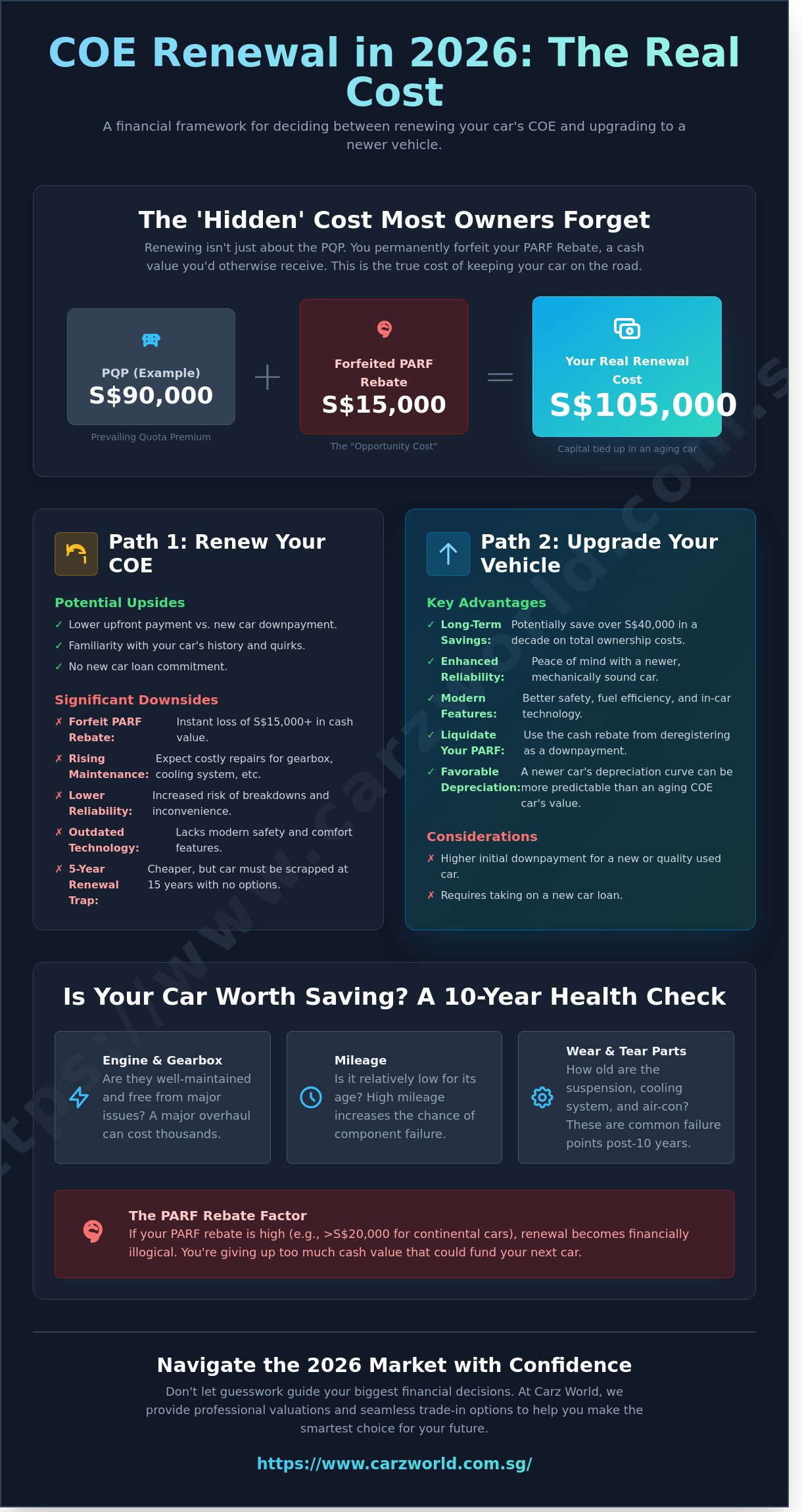
Is Your Current Car Actually Worth Saving?
Before you commit to a six-figure sum, look at the odometer. A car with 200,000km on the clock might have served you well, but asking it to last another decade is a significant gamble. When deciding should I renew my COE in 2026, you aren't just paying for the legal right to drive. You're betting on the mechanical integrity of a machine that's already survived ten years of Singapore's humid, stop-start traffic. Spending S$100,000 to keep a car that requires S$5,000 in annual repairs is rarely a sound investment.
The "Future-Proof" test is equally vital. Older petrol models face a road tax surcharge that increases by 10% every year after the tenth year, capping at 50% by year 15. If your vehicle isn't Euro 6 compliant, you might face stricter usage restrictions as Singapore moves toward its 2040 goal of phase-out for internal combustion engines. Don't let sentimental value cloud your judgment. Your first car holds memories, but it shouldn't hold your bank account hostage. If the cost of ownership exceeds the utility, it's time to let go.
Avoid the 5-year COE renewal trap. While the upfront cost is 50% of the Prevailing Quota Premium, you forfeit the right to renew ever again. You also lose your entire PARF rebate. This often results in the highest annual depreciation because the car has zero paper value at the end of the five years. It's frequently the most expensive way to own a vehicle.
Condition Assessment Checklist
A professional inspection is mandatory before renewing. Focus on these three areas:
- Engine and Transmission: Check for oil consumption or gear slips. A major overhaul can cost S$5,000 or more.
- Chassis and Suspension: Singapore's humidity causes hidden rust in wheel wells. Replacing worn bushings and shock absorbers can easily exceed S$2,000.
- Interior Degradation: If the roof lining is sagging or the dashboard is cracking, the cabin experience won't justify the high renewal cost.
The Exit Strategy: Selling or Exporting
If the math doesn't add up, you need an efficient exit. You can often get more than the basic scrap value by using car export services, especially for popular Toyota or Honda models that retain high body value in overseas markets. For local sales, consignment is usually better than a direct dealer trade-in. It allows you to set a higher price while professionals handle the paperwork and viewing schedules. This ensures you recover the maximum capital to put toward your next vehicle.
Navigating the 2026 Market with Carz World
Deciding should I renew my COE in 2026 requires more than just a glance at the LTA portal. It's a strategic financial choice that impacts your bank account for the next decade. At Carz World, we provide professional valuation services that break down the true value of your vehicle. We help you weigh the guaranteed PARF rebate you'd lose upon renewal against the current market resale price. This clarity is essential for any car owner. Our trade-in process is designed to be seamless, effectively using your car's value to lower the barrier for your next purchase. With our flexible financing and insurance assistance, we ensure your transition to a newer, more efficient vehicle is entirely painless.
Get a Professional Second Opinion
Our sales consultants, such as Ryan and Carson, have earned a reputation for providing honest, patient advice. They understand that every driver's situation in Singapore is unique. They'll help you calculate the exact trade-offs between paying a high PQP and the rising maintenance costs of an older car. If you want to know what your vehicle is worth right now, visit our sell your car page for a free valuation. We pride ourselves on being transparent and never applying pressure. Our commitment is to give you the facts so you can make the best decision for your lifestyle and budget.
Explore Your Options at Carz World
Whether you're looking for a high-quality pre-owned sedan or a brand new parallel import, our inventory is curated to meet strict standards. Every pre-owned car we offer is well-maintained and thoroughly inspected to ensure reliability. We also provide the latest brand new models for those who want the newest safety features and better fuel efficiency. Our team is dedicated to making the car buying process a smooth and pleasant one. Ready to make a move? Talk to us today for a comprehensive car ownership consultation. We'll help you navigate the 2026 market with an expert's perspective, ensuring your next step is the right one.
Secure Your Motoring Future in 2026
Deciding if you should I renew my COE in 2026 requires a clear look at your car's remaining PARF rebate and the projected PQP. With a significant number of vehicles registered in 2016 reaching their 10 year limit, the 2026 supply cycle could offer more stability for owners. You'll need to weigh a potential S$10,000 or S$20,000 PARF loss against the cost of a new 10 year COE. It's a high stakes financial choice that impacts your bank account for the next decade. At Carz World, our professional and patient consultants have earned the trust of hundreds of Singaporean drivers by providing honest, data driven advice. We don't believe in pushy sales; we believe in finding the right path for your specific budget. Whether you're looking for a seamless trade-in or a high value export service, we ensure the entire transition is a pleasant one. Let's look at your car's current health and market value together. Our team is ready to help you make an informed choice that keeps you on the road affordably.
Get a Free Car Valuation & COE Consultation
Frequently Asked Questions
Can I renew my COE for 5 years and then change it to 10 years later?
No, you can't extend a 5-year COE renewal to 10 years at a later date. Once you choose the 5-year option, the car must be deregistered and scrapped at the end of that period. It's a one-time renewal. If you want the flexibility to keep the car for more than five years, you should opt for the 10-year renewal instead.
What happens to my PARF rebate if I renew my COE in 2026?
You'll lose your entire Preferential Additional Registration Fee (PARF) rebate the moment you renew your COE. This rebate is only paid out if you scrap or export your car before its initial 10-year cycle ends. When you pay the Prevailing Quota Premium (PQP) in 2026, that PARF value, which can be S$10,000 or more, is forfeited forever.
Is it better to renew COE for 5 years or 10 years in the current market?
A 10-year renewal is usually the better financial choice if you plan to keep the car long-term. While a 5-year renewal costs 50% of the PQP, it prevents any further renewals. If you're asking "should I renew my COE in 2026" for a high-quality vehicle, the 10-year option provides better depreciation value and the chance to renew again in 2036.
Can I get a bank loan for COE renewal in Singapore?
Yes, you can apply for a COE renewal loan from most major banks or licensed moneylenders in Singapore. Interest rates typically hover between 2.8% and 4% per annum. Most financial institutions offer a maximum loan tenure of 7 years for a 10-year renewal. You'll need to ensure your monthly repayments fit within the 55% Total Debt Servicing Ratio (TDSR) limit.
How early can I renew my COE before it expires in 2026?
You're allowed to renew your COE up to one month before its actual expiry date. If your COE expires on August 15, 2026, you can complete the renewal starting from July 15, 2026. The PQP you pay is determined by the moving average of COE prices from the 3 months prior to your renewal month. Early renewal helps you avoid last-minute administrative delays.
If I renew my COE and then scrap the car after 2 years, do I get money back?
You'll receive a pro-rated rebate for the remaining months of your COE if you scrap the car early. If you paid S$90,000 for a 10-year renewal and scrap it after 24 months, you'll get back approximately S$72,000. However, you won't receive any PARF rebate, as that was already forfeited when you first renewed. This makes the COE rebate your only remaining cash asset.
What are the road tax implications for cars over 10 years old?
Road tax for cars older than 10 years includes an annual surcharge that increases by 10% every year. This surcharge peaks at 50% in the 15th year of the car's life. For a 1,600cc car with a base road tax of S$744, you'll pay S$818.40 in the 11th year. By the 15th year, that annual cost rises to S$1,116.
Should I renew the COE for a Category B continental car?
Deciding "should I renew my COE in 2026" for a Category B car depends on its mechanical health and your projected maintenance costs. Category B PQP prices are often S$25,000 higher than Category A. If your continental car requires specialized parts or frequent repairs, the 50% road tax surcharge and higher PQP might make buying a new car more economical in the long run.
In Same Category
- Pros and Cons of Buying a High PARF Car in Singapore
- Car Valuation Services in Bukit Merah: A Seller’s Guide
- Scrapping Your Car Before 10 Years in Singapore: What Happens?
- Calculating the Breakeven Point for COE Renewal in Singapore
- Financial Checklist Before Committing to a Car Purchase in Singapore (2026)