Getting Car Finance with a New Business in Singapore: A Practical Guide

Can a new business get car finance in Singapore without years of accounts to show? Getting car finance with a new business in singapore can be more challenging when trading history is limited, but lenders may assess the applicant, available business information and intended vehicle use together. The key is to choose a finance route that fits the business, not just the monthly payment.
It’s understandable to be unsure whether to apply personally or through the company, especially when loan terms and repayment commitments can be difficult to compare. This guide covers practical options for a new business, information lenders may ask to review and ways to prepare before applying. It also explains how private-car loan limits differ from commercial-vehicle financing, and what to consider when comparing hire purchase, bank loans and dealership financing.
Gathering business records and a vehicle quotation, then comparing the total repayment with your cash flow, can make the decision clearer. You’ll be better placed to choose a vehicle that suits the work and a loan commitment the business can manage.
Key Takeaways
- Getting car finance with a new business in singapore starts with matching the finance route to the vehicle’s use, your business situation and the lender’s assessment.
- Organise the company, applicant and vehicle details you have before applying. Preparation helps present a clear picture, but doesn’t guarantee approval.
- Compare business, personal and dealer-arranged finance by deposit, repayment structure, tenure and ownership implications.
- Review written terms for the full repayment commitment, fees and early-settlement conditions before choosing a proposal.
- Define what the vehicle needs to do for your business, then compare suitable new, pre-owned or commercial vehicles with your cash flow and ownership plan in mind.
Getting car finance with a new business in Singapore: start with the right route
Limited trading history can make a first vehicle-finance decision feel uncertain. A company’s age alone, however, doesn’t determine whether an application will be accepted or declined. Lender criteria vary, and an assessment may consider who is applying, how the vehicle will be used, the vehicle type and the information available about the applicant and business.
First, distinguish vehicle finance for business use from general business borrowing. A vehicle loan or hire-purchase arrangement is tied to acquiring a vehicle, while a working-capital facility is intended to fund broader business needs. The right route depends on the purchase, planned use and ownership arrangement. Applying through the company or personally is not automatically preferable for every new venture.
Should the vehicle be financed for business or personal use?
Consider who is expected to own the vehicle and make the repayments. A company application may involve details about the business and the vehicle’s intended use. With a personal application, the individual applicant’s responsibility is central, even if the vehicle supports business activity. Documents, obligations and the assessment can differ by arrangement. For a basic explanation of how hire purchase works, understand the structure before comparing proposals.
Ask yourself who will drive the vehicle, how regularly it will be used for work and whether it will also serve personal needs. A car used occasionally for client visits raises different practical questions from a vehicle used daily to carry tools or goods. Be clear about the intended use before deciding which route to explore.
Which vehicle type fits the business requirement?
Choose a vehicle based on the work it needs to support. A passenger car may suit staff travel or client meetings. A commercial vehicle may be more appropriate when the job involves transporting equipment, goods or a team. Matching the vehicle type to everyday use keeps the purchase decision grounded in business needs.
Then compare new and pre-owned options based on condition, expected use and how long you plan to keep the vehicle. A new vehicle may suit a business planning to own it for longer, while a pre-owned option may better fit a different purchase plan. Consider suitability alongside the finance commitment, not in isolation. If your work calls for a purpose-built work vehicle, include commercial vehicles in your assessment.
This section focuses on financing a vehicle for business use, not borrowing for general operating expenses. Once you’ve defined the intended owner, regular users and vehicle’s role, you can prepare relevant application information and compare finance proposals.
How a new Singapore business can prepare a car finance application
Once you’ve settled on a likely finance route and vehicle type, organise the information that can help explain the application. Records may be limited for a new company, so gather what’s available rather than waiting for a long trading history. Requirements differ by finance provider and by whether the application is made by the business or an individual.
Being application-ready helps a lender assess your position, but it doesn’t determine the final credit decision. Treat preparation as a way to present a clear, consistent picture, not as a guarantee of approval.
What information should a new business organise?
Start with the company’s registration and ownership details, then gather relevant applicant and vehicle information. Depending on the provider and application structure, useful items may include:
- ACRA business profile and details of directors or owners
- Available business bank statements and accounts
- Income tax or Notice of Assessment references, where relevant
- Identification details for the applicant and, if requested, a guarantor
- A vehicle quotation and a short explanation of its intended business use
These are preparation prompts, not a universal document list. Providers may request particular records or statement periods, or assess a different set of information. Review the requirements for your application and label files clearly so the details are easy to follow.
If the company has only recently started trading, organise available financial projections alongside actual records. Make clear which figures reflect completed trading and which are estimates. A simple summary of revenue, operating expenses and existing commitments can help explain the business position without overstating its track record.
How can the founder explain repayment capacity?
Explain how the vehicle will support the work. For example, state whether it will be used for regular client visits, deliveries or carrying equipment, and how that use fits the business’s activities. Then compare expected cash flow with the proposed repayment, day-to-day operating expenses and existing financial obligations. Use realistic estimates, including quieter periods, rather than relying only on projected growth.
Some providers may request a director’s personal financial information or a personal guarantee, particularly when the business has a short operating history. The requirement depends on the provider and application, so don’t assume it applies in every case. If the vehicle is a private car, consult the Monetary Authority of Singapore’s Singapore loan rules. Commercial vehicles are exempt from those car-loan limits.
As you organise a vehicle quotation and business-use explanation, you can also explore Carz World’s vehicle options and compare them with the work the vehicle needs to support.
Compare car finance options, repayments and Singapore loan rules
When getting car finance with a new business in singapore, compare the full commitment, not just the first repayment figure. The route may affect who applies, who is responsible for repayment and who owns the vehicle during the agreement. Terms vary by provider and application, so use the table as a guide to questions, not as a promise of available terms.
| Route | What to compare | Ownership and responsibility |
|---|---|---|
| Business vehicle finance | Deposit, repayment structure, tenure, fees and total payable amount | The business applies or enters the agreement, subject to provider terms. A director’s guarantee or personal information may be requested. |
| Personal finance | Deposit, monthly repayments, tenure and any early-settlement terms | An individual applies and carries the repayment responsibility. Consider how personal and business use will be handled. |
| Dealer-arranged finance, where available | Who provides the finance, the full repayment schedule, fees and any final payment | Ownership and liability depend on the underlying agreement, not simply where the proposal is arranged. |
Advertised financing terms are provider-specific, not guaranteed offers. Request proposed terms in writing and compare the deposit, repayment amount and frequency, tenure, fees, total commitment and early-settlement conditions. A smaller regular payment may still leave a larger final amount to plan for.
How do hire purchase and other repayment structures differ?
With hire purchase, the customer pays instalments under an agreement, and ownership generally transfers only after the agreement’s conditions are met. Read the contract to confirm when ownership passes and what happens if payments are missed or the agreement ends early. A balloon structure can reduce regular instalments while leaving a larger final payment. It shifts, rather than removes, the cash-flow commitment, so compare the complete schedule before deciding.
No structure is automatically cheaper or better suited to a new business. Consider whether the payment pattern fits expected cash flow throughout the agreement.
What do MAS motor vehicle loan rules mean for a business?
For regulated private-car loans, MAS sets maximum loan-to-value limits of 70% for cars with an OMV of S$20,000 or less and 60% for cars with an OMV above S$20,000. The maximum tenure is seven years. These rules don’t apply to commercial vehicles. Check the current MAS car-loan rules and confirm how the vehicle’s classification and purchase details affect the application. A regulatory limit is not an approval or a promise that a lender will offer the maximum.
For a separate business-financing avenue, review Enterprise Financing Scheme details, including current eligibility and use-of-funds terms. Don’t assume it replaces a vehicle loan. Compare the applicable requirements and repayment obligations.
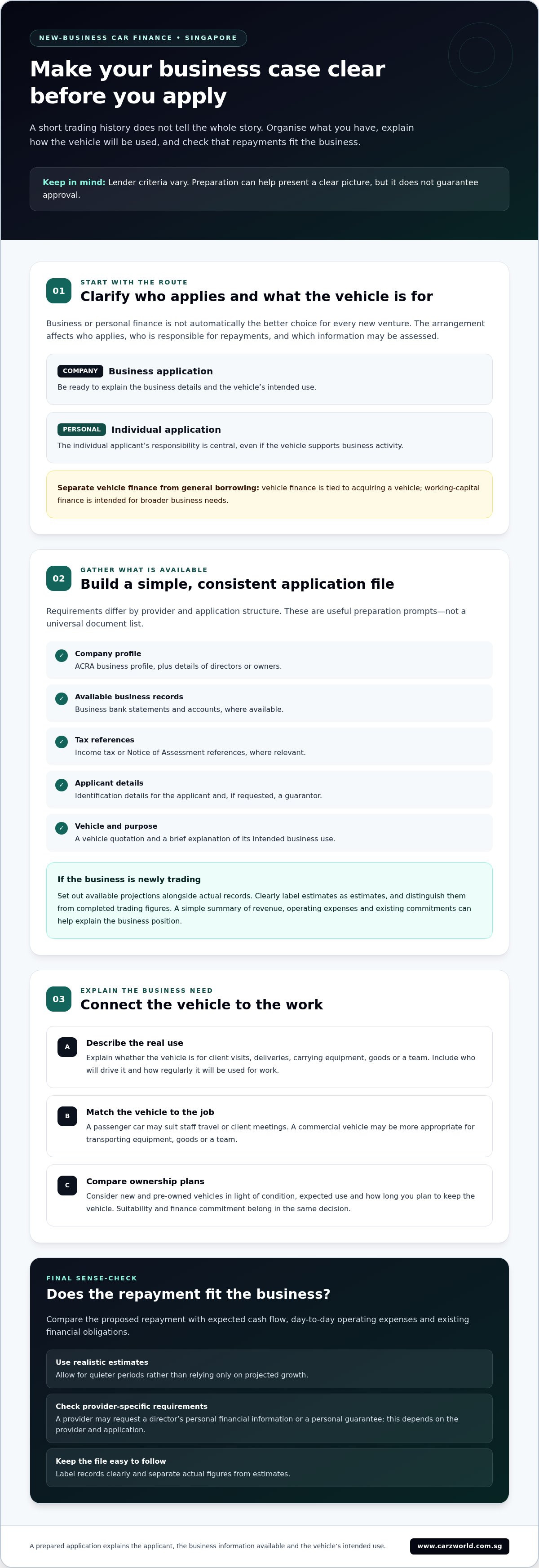
Follow these steps before submitting a new-business car finance application
A clear process helps you compare a vehicle’s business value with the commitment involved. Before submitting an application for getting car finance with a new business in singapore, work through these four steps:
- Define the vehicle need. Identify the work it will support, who will use it and how often. Decide whether a passenger car or commercial vehicle best fits those tasks.
- Prepare your records. Organise available company, applicant and financial information, along with a vehicle quotation and a clear explanation of its business use.
- Compare written proposals. Review the same details across each proposal, including deposit, repayment schedule, fees and total payable.
- Review the commitment. Check the full repayment obligation and early-settlement conditions against realistic business cash flow before proceeding.
Vehicle suitability involves more than the purchase price. In Singapore, consider how COE details, vehicle age and your planned ownership period affect how long the vehicle can serve the business. Verify current vehicle and COE information before deciding, and compare the vehicle’s expected useful period with the proposed loan tenure.
Assess affordability against real business cash flow
Build your repayment view around realistic revenue, not an optimistic forecast. Set out expected repayments alongside operating expenses and existing commitments. Include ownership costs such as insurance, fuel, parking and maintenance, using figures relevant to the vehicle and business rather than assuming a single typical amount.
A less expensive or pre-owned vehicle may change the amount financed and the repayment commitment, but it doesn’t guarantee savings overall. Consider condition, intended use and planned ownership period together. If you’re weighing a pre-owned option, browse used cars in Singapore as part of your comparison.
Compare every written proposal line by line
Check the deposit, amount financed, repayment frequency and schedule, total payable and any final payment. Then read the provider’s terms for fees, late-payment consequences and early settlement. A lower regular instalment can involve a longer commitment or a larger final payment, so compare the complete repayment structure rather than focusing on one figure.
If a new vehicle better suits the business’s needs or planned ownership period, compare it with the pre-owned option using the same affordability and usage criteria. You can view new cars in Singapore as another point of reference.
Once you’ve set your budget and vehicle requirements, explore vehicle options with Carz World and compare them with your business’s intended use and cash-flow plan.
Explore business vehicle options with Carz World
The right vehicle and finance structure should work together. A car that suits day-to-day tasks but strains cash flow may not be practical. Focusing only on the repayment can also lead to choosing a vehicle that doesn’t meet the business’s needs. For getting car finance with a new business in singapore, weigh the vehicle’s purpose, realistic cash flow and intended ownership period together.
Match the vehicle to the business before choosing finance
Start with the work. A passenger car may suit regular staff travel or client visits, while a commercial vehicle may be more relevant for transporting equipment, goods or a team. Compare new and pre-owned vehicles based on expected use, condition and how long you plan to keep the vehicle. Choose for suitability, not simply because a higher-priced option appears to offer more.
Carz World is a Singapore dealership offering brand-new and pre-owned cars, as well as commercial vehicles. If a pre-owned car fits your requirements, browse used cars in Singapore alongside other suitable vehicle options. Consider how each choice aligns with the business’s work and ownership plan before comparing finance terms.
Take the next step with a clear application plan
Before moving forward, bring together the details that explain the purchase: business information, available financial records, the vehicle’s intended use and your ownership requirements. Compare written finance terms carefully, including the full repayment obligation, fees and early-settlement conditions. For regulated private-car loans, review the Monetary Authority of Singapore’s current car-loan guidance and check which rules apply to your vehicle.
A clear plan can help you discuss your purchase requirements and assess vehicle choices with confidence. Financing remains subject to the relevant provider’s assessment, so don’t treat an indicative proposal as approval.
Explore vehicles at Carz World and consider which option best fits your business use, cash flow and ownership plans.
Make your next vehicle decision with confidence
Getting car finance with a new business in singapore starts with a clear view of what the vehicle must do, who will apply and what the business can reasonably repay. Limited trading history can make the process feel uncertain, so organise available business and applicant information before applying. Then compare written proposals by total repayment, fees, repayment structure and early-settlement terms instead of focusing on one monthly figure.
The vehicle matters as much as the finance route. Match a passenger car or commercial vehicle to the work, and weigh new and pre-owned options against condition, cash flow and how long you plan to keep the vehicle. Lender criteria differ, and every application remains subject to the provider’s assessment.
Carz World is a Singapore dealership offering new, pre-owned and commercial vehicles, and provides vehicle financing. Explore vehicles at Carz World and find options that fit your business requirements and ownership plans. Compare your vehicle needs and finance requirements, then take the next step with Carz World.
Frequently Asked Questions
Can a new business get car finance in Singapore?
Yes, a newly established business may apply for vehicle finance in Singapore. Approval depends on the lender’s assessment of the applicant, business information, intended vehicle use and repayment capacity. Limited trading history can make assessment more challenging, but company age alone doesn’t automatically mean acceptance or rejection. Getting car finance with a new business in singapore is easier to approach with clear records, realistic cash-flow information and a vehicle quotation. Requirements vary by provider.
What documents are needed for a new business car loan in Singapore?
Providers may request an ACRA business profile, business bank statements, available accounts, and information about the director or owner. A vehicle quotation and details of its intended business use may also be relevant. Some applications may require income tax or Notice of Assessment information, or identification details for a guarantor. There isn’t one document list for every application, so prepare what’s available and follow the specific provider’s requirements.
Is it better to apply for car finance under the business or personally?
Neither route is automatically better. Compare the applicant’s responsibility, intended ownership and vehicle use. A business application may require company records and information about how the vehicle supports business activity. With personal finance, the individual applicant carries the repayment responsibility. Some providers may request a director’s personal information or guarantee for a business application. Review the proposed agreement and consider who will use the vehicle and who will make repayments.
What do MAS rules limit for motor vehicle loans in Singapore?
For regulated private-car loans, MAS limits the loan amount to 70% of the car’s Open Market Value (OMV) when OMV is S$20,000 or less, and 60% when OMV is above S$20,000. The maximum loan tenure is seven years. These limits don’t apply to commercial vehicles. They set regulatory boundaries, not a promise of approval or the terms a lender will offer. Check current MAS guidance for your vehicle and purchase.
Can a business get finance for a used car in Singapore?
A business may apply for finance for a used car, subject to the finance provider’s criteria and assessment. Compare the vehicle’s condition, expected use and planned ownership period with the proposed repayment term. Check the written proposal for the deposit, repayment schedule, total commitment and any fees or early-settlement conditions. A pre-owned vehicle may change the amount financed, but it doesn’t guarantee lower overall costs or approval.
How can a new business improve its chances of car finance approval?
Present a clear, consistent application. Organise available company and applicant information, bank statements or accounts, a vehicle quotation and an explanation of how the vehicle supports the business. Prepare a realistic cash-flow view that includes operating expenses and existing commitments. Distinguish actual trading figures from projections. These steps can help a provider assess the application, but they can’t guarantee approval, which remains subject to the provider’s assessment.
Should a startup choose a commercial vehicle loan or a car loan?
Choose based on the vehicle’s classification and the work it needs to support. A commercial vehicle may suit regular transport of goods, equipment or a team, while a passenger car may fit staff travel or client visits. Financing rules and provider terms can differ by vehicle type. MAS motor vehicle loan limits apply to regulated private-car loans, not commercial vehicles. Check the vehicle classification and compare the applicable written terms before deciding.
Disclaimer
This content is provided for general informational purposes only. Readers are encouraged to independently verify important information.
In Same Category
- Calculating the Breakeven Point for COE Renewal in Singapore
- Financial Checklist Before Committing to a Car Purchase in Singapore (2026)
- COE Renewal Conditions and Eligibility in Singapore: 2026 Guide
- Balloon Scheme Car Loan in Singapore: Pros and Cons for 2026
- Getting Car Finance with a New Business in Singapore: A Practical Guide