PARF Value Explained: The Ultimate Guide to Singapore Car Rebates in 2026

What if the pre-owned sedan you're eyeing is actually hiding a S$12,500 valuation gap because of a simple rebate miscalculation? Most Singaporean drivers find the shifting numbers between OMV and ARF more confusing than a peak-hour ERP gantry. It's natural to feel uneasy when you aren't sure if you're overpaying or if you're about to lose thousands by scrapping at the wrong time. We believe every car owner deserves a transparent process based on facts rather than guesswork.
In this guide, you'll find the PARF value explained clearly so you can calculate your vehicle's true market value with total confidence. We'll help you master the 2026 rebate formulas and accurately track your annual depreciation down to the last dollar. You'll also learn how to identify the specific 6-month window to sell or export your car for the maximum possible return. By the end of this article, you'll have the expert knowledge needed to make a smarter, more profitable decision for your next car transaction.
Key Takeaways
- Understand how the Preferential Additional Registration Fee (PARF) works as a strategic rebate system to encourage the de-registration of vehicles under 10 years old.
- Get the complexities of your PARF value explained by learning how the OMV and ARF form the "Chain of Value" that determines your car's final paper worth.
- Compare the financial trade-offs between PARF cars and COE cars to identify which option offers the best balance of upfront costs and annual depreciation for your budget.
- Learn the master formula to accurately calculate your total deregistration value in 2026, ensuring you capture every S$ of your PARF and pro-rated COE rebates.
- Discover how to maximize your returns by exploring professional export and trade-in options that often yield higher values than traditional scrapping.
What is PARF Value? Understanding Singapore’s Car Rebate System
PARF stands for Preferential Additional Registration Fee. It's a financial rebate that the Singapore government returns to you when you de-register a car before it reaches 10 years of age. Think of it as a built-in savings account for your vehicle. When people look for the PARF value explained, they're usually trying to calculate the "paper value" of their car. This paper value is the actual cash you receive from the authorities when your car's life on the road ends. It's a crucial figure that determines your car's true cost of ownership.
Understanding the difference between your PARF rebate and your COE rebate is vital for every owner. These two components make up the total sum you get back. While the COE rebate is a pro-rated refund of the amount you paid into the Certificate of Entitlement (COE) system, the PARF rebate is based on your Additional Registration Fee (ARF). The ARF is a tax paid when the car is first registered, and the PARF system allows you to recover a percentage of that tax. If you de-register your car between its 9th and 10th year, you typically receive 50% of the ARF back in cash.
The Role of the Land Transport Authority (LTA)
The Land Transport Authority (LTA) uses these financial incentives to keep Singapore's vehicle population young and efficient. By offering a significant rebate, they encourage drivers to scrap older cars rather than keeping them on the road indefinitely. This strategy helps manage road congestion and ensures that the fleet meets the latest environmental and safety standards. For 2026, a car is eligible for a PARF rebate only if it has never been laid up and is de-registered within its initial 10-year COE period. These structures are tied directly to vehicle quotas, as every scrapped car allows for a new COE to be released into the market.
Why PARF Value Matters to Every Singaporean Driver
Every driver in Singapore should view the PARF value as a guaranteed minimum resale price. It provides a financial safety net that protects you from market volatility. Even if the used car market stays flat, your PARF value remains a fixed number based on your original ARF payment. This is why having the PARF value explained is so important during the buying process. It helps you understand the "floor price" of your asset at any given month of its lifespan.
Monthly loan repayments and insurance premiums are also influenced by this figure. Lenders often look at the projected scrap value when determining loan amounts and interest rates. If a car has a high ARF, its PARF value will be higher, which can lead to better financing terms. There's also a significant psychological comfort in knowing your car's exact scrap value. You aren't just driving a depreciating machine; you're driving a vehicle with a known cash reserve that you can unlock at any time by de-registering.
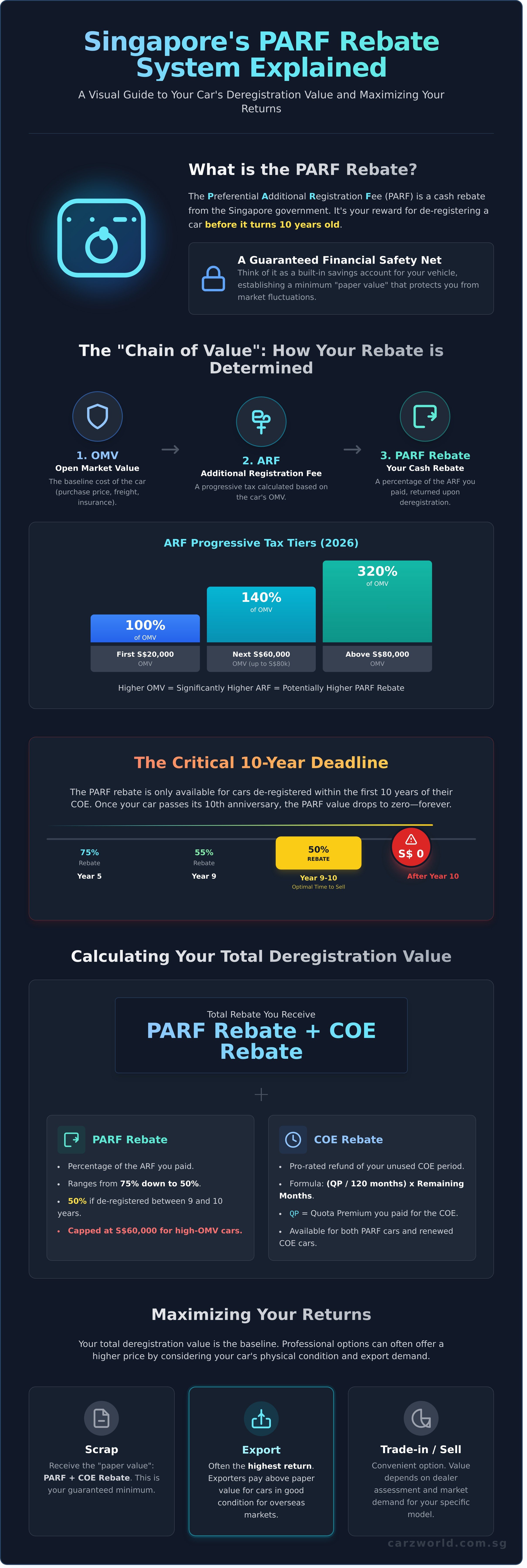
The 10-year rule is the most critical deadline to remember. Once your car hits its 10th anniversary, the PARF value drops to exactly S$0. Even if you renew your COE for another five or ten years, that initial ARF rebate vanishes forever. This steep drop-off is why many owners choose to sell or scrap their vehicles at the 9-year and 11-month mark. In 2026, with the S$60,000 cap on PARF rebates for high-end models still in effect, calculating your exit strategy early is more important than ever to avoid losing thousands of dollars in potential returns.
The Financial Foundation: How OMV and ARF Determine Your PARF
Having the PARF value explained requires a look at the "Chain of Value" that governs Singapore's vehicle taxation system. Your eventual rebate isn't a random figure; it's the final result of a calculation that begins the moment a car reaches Singapore's docks. This chain starts with the Open Market Value (OMV), which acts as the base price. This OMV then determines the Additional Registration Fee (ARF), a substantial tax that represents the largest portion of a car's upfront cost. Because your PARF rebate is a percentage of that ARF, any change in the initial purchase price or tax tiers directly impacts what you'll receive back a decade later.
The ARF is a progressive tax, meaning cars with a higher OMV are taxed at significantly higher rates. For 2026, the tax tier breakdown remains a critical factor for buyers. The current structure applies the following rates to a car's OMV:
- First S$20,000: 100% of OMV
- Next S$60,000 (up to S$80,000): 140% of OMV
- Amounts exceeding S$80,000: 320% of OMV
Recent policy shifts have highlighted the impact of the PARF rebate changes, particularly for high-end luxury vehicles. In 2026, the government has maintained a cap on the maximum rebate amount to ensure the system remains equitable. This means even if you pay a massive ARF on a supercar, your rebate might be capped at a specific threshold, currently set at S$60,000 for many models. Understanding these caps is essential for a complete PARF value explained overview, as it prevents surprises during the deregistration process.
Decoding Open Market Value (OMV)
OMV is the actual price of the car before any local taxes are applied. It's not just the manufacturer's invoice price; it includes the purchase price, freight costs, insurance, and all delivery charges incurred during the shipping process to Singapore. You might notice two identical models in a showroom have different OMVs. This happens because of variations in manufacturing years, differing trim levels, or even fluctuations in currency exchange rates at the time of import. To find your specific vehicle's OMV, you can log into the LTA’s OneMotoring digital services using your Singpass. If you're planning your next upgrade, you can get a professional appraisal to see how these figures impact your trade-in value.
The PARF Rebate Percentage Schedule
The amount of ARF you get back follows a strict sliding scale based on the car's age. If you deregister your car at 5 years or less, you're eligible for 75% of the ARF. After the fifth year, the rebate drops by 5% annually. At 6 years, you get 70%; at 7 years, it's 65%; and this continues until it hits 50% at 10 years. The exact age of the vehicle at the moment of its deregistration, calculated down to the day, serves as the primary multiplier applied to the original ARF paid to determine the final rebate amount. This schedule makes the timing of your car's disposal a high-stakes financial decision, as deregistering just a few days late could drop you into a lower percentage bracket.
PARF Cars vs. COE Cars: Which is the Smarter Investment?
Choosing between a PARF car and a COE-renewed vehicle depends on your long-term financial goals. A PARF car is a vehicle under 10 years old that still carries its original Certificate of Entitlement. These cars are often seen as a safer bet for those who prioritize reliability and a guaranteed return on investment. On the other hand, COE cars are vehicles older than 10 years that have had their lifespan extended. While the entry price is lower, the financial dynamics change significantly once the original PARF rebate is forfeited.
When you have the PARF value explained in the context of depreciation, the math becomes clearer. A PARF car typically sees higher annual depreciation, often ranging from S$12,000 to S$20,000 for a standard executive sedan in 2026. However, it retains a high "paper value." This means if you deregister the car early, you recover a substantial portion of your Additional Registration Fee (ARF). To understand the specific tiers of these returns, you can refer to this guide on What is the PARF Rebate? which details the percentage breakdowns based on the car's age.
The Case for Buying a PARF Car
PARF cars offer peace of mind through modern engineering. These vehicles usually feature Euro 6 emission standards and the latest fuel-efficient engines, which helps lower your annual road tax and petrol bills. Owners also benefit from advanced safety technology like autonomous braking and lane-keep assist that older COE cars lack. Because these vehicles are often still under manufacturer warranty or have been well maintained in Carz World’s pre-owned PARF car collection, the risk of major mechanical failure is low. If your lifestyle changes and you need to sell within two years, the high PARF rebate acts as a financial safety net, ensuring you aren't left with a total loss.
The Risks and Rewards of COE Renewed Cars
COE cars attract the budget-conscious commuter because of their low upfront cost. You might find a renewed COE sedan for S$60,000, whereas its PARF counterpart costs S$140,000. The trade-off is the total loss of the PARF rebate. Once a car enters its 11th year, its scrap value is purely the Body Value, which might only be S$500 to S$2,000. Additionally, banks often charge higher interest rates for COE car loans. While a PARF car loan might sit at 2.78%, a COE car loan can exceed 3.5%. These cars are best for drivers who plan to use the vehicle until its very last day, as early termination results in zero rebate recovery.
To decide which path fits you, identify your driver profile:
- The Value-Focused Owner: You prefer a car with the latest tech and want to ensure your PARF value explained in your sales agreement translates to a high resale price in 3 to 5 years.
- The Budget-Conscious Commuter: You need a functional tool to get from point A to B. You're comfortable with higher maintenance schedules in exchange for a significantly lower monthly loan repayment.
Maintenance is the final pivot point. A PARF car under 10 years old generally requires only routine oil changes and brake pad replacements. A COE car, having crossed the 120,000km to 150,000km mark, will likely require expensive overhauls of the cooling system, suspension, and transmission. Our team at Carz World ensures that every car, regardless of its PARF status, undergoes a professional inspection to provide a seamless and pleasant experience for every buyer.
Calculating Your Car’s Deregistration Value in 2026
Calculating what you'll get back when you say goodbye to your vehicle doesn't have to be a guessing game. The math follows a specific LTA formula. Your total deregistration value is the sum of your PARF rebate and your COE rebate. This figure represents the "paper value" of your car. It's the minimum amount you're guaranteed to receive from the government, provided you don't renew your COE and forfeit the PARF component.
The master formula is: Deregistration Value = [PARF Rebate] + [COE Rebate] + [Body Value] .
The COE rebate is strictly pro-rated. If you paid S$90,000 for your 10-year COE, you're essentially paying S$750 every month to keep the car on the road. If you deregister with exactly 36 months left, you'll get S$27,000 back. This calculation is precise down to the day. If you've renewed your COE using the Prevailing Quota Premium (PQP), the same pro-rated logic applies to that new amount. However, once you renew for a 5-year or 10-year period, your PARF eligibility vanishes instantly.
Let's look at a concrete example. Consider a 7-year-old Toyota Corolla with an ARF of S$25,000. If you deregister it in 2026 after it completes its 7th year but before it hits its 8th, your PARF rebate is 65% of the ARF, which equals S$16,250. If the remaining COE value is S$22,500, your total paper value is S$38,750. This PARF value explained simply shows that your car's financial worth is often tied more to its original registration taxes than its actual mileage or condition.
Timing Your Deregistration for Maximum Return
Timing is everything in the Singapore car market. PARF rebates drop in 5% increments every year after the fifth year. Deregistering at 6 years and 11 months yields a 70% rebate, but waiting just one more month drops that to 65%. On a S$60,000 ARF SUV, that one-month delay costs you S$3,000. The 10th-year cliff is the most critical; the moment you renew your COE, that 50% ARF rebate disappears forever. Always use professional valuation tools to verify your specific dates rather than relying on rough estimates.
Common Misconceptions About Scrap Value
Many owners confuse "scrap value" with the total deregistration payout. In reality, the physical body of a Toyota Corolla might only fetch S$500 to S$900 from a scrap yard in 2026. This body value is a tiny fraction of a S$35,000 total return. Another common myth is that PARF is always a cash payout. While you can receive cash, it often takes weeks to process. Understanding this PARF value explained helps you realize that the "metal" is the least valuable part of the transaction compared to the paper rebates.
Ready to see the exact numbers for your vehicle? Our team provides transparent, real-time valuations so you can sell your car at the peak of its rebate value.
Maximizing Your Returns: Selling, Exporting, or Trading In
Many Singaporean car owners assume that "scrapping" a car at the 10-year mark is the only way to close their vehicle's lifecycle. This is often the least profitable path. When you choose a basic scrap yard, you usually receive the base paper value plus a nominal sum for the metal weight. In the 2026 market, where COE prices and vehicle costs remain high, leaving money on the table is a mistake. Having the PARF value explained in the context of market demand allows you to see your car as a financial asset rather than just a depreciating machine.
Deciding whether to export, sell, or trade in requires a look at your next steps. If you need immediate cash to fund a new down payment, a direct sale is best. If you have 30 to 45 days to spare, consignment might net you a slightly higher return. However, for most drivers, the goal is a balance of speed and profit that minimizes the time spent on paperwork and LTA transfers.
Unlocking Global Value Through Car Export
Certain Japanese models like the Toyota Corolla Altis or Honda Vezel maintain incredible utility in developing markets long after their 10-year COE expires in Singapore. These regions value mechanical reliability over age. By leveraging our export networks, you can often secure a premium of S$2,500 to S$6,000 above your car's PARF rebate. Export value is determined by global supply and demand, not just LTA rebates. For instance, a well-maintained SUV might be worth 20% more in an overseas market than its local scrap value suggests.
The Seamless Selling Experience with Carz World
Our team at Carz World prioritizes a "no-pushy" approach that focuses on transparency. We provide valuations based on real-time auction data and international demand trends. Before you commit to a scrap yard, you should get a professional valuation to see the true market potential of your vehicle. Our consultants, including experts like Ryan and Carson, ensure the process is methodical and honest, so you aren't surprised by hidden administrative fees during the handover.
Trading in your vehicle remains the most efficient way to upgrade. We can apply your PARF value and any additional trade-in premium directly toward your brand new car purchase. This single-transaction approach reduces your total loan amount and eliminates the "gap period" where you might be left without a vehicle. It's a structured, reliable method to ensure your PARF value explained in previous chapters translates into a lower monthly installment for your next ride.
- Direct Sale: Best for instant cash and 24-hour processing.
- Export: Ideal for high-demand Toyota and Honda models to maximize returns beyond paper value.
- Trade-In: The most convenient way to offset the cost of a new vehicle purchase.
- Consignment: Suitable if you aren't in a rush and want to test the highest possible retail price.
Carz World makes these complex transitions a smooth process. We handle the LTA documentation, the settlement of outstanding bank loans, and the final rebate encashment. This level of professional service ensures you walk away with the highest possible return while avoiding the stress of private negotiations or low-ball offers from traditional scrap yards.
Master Your Car's Financial Future in 2026
Navigating Singapore's car rebate system doesn't have to be a headache. You've now seen how your OMV and ARF percentages dictate exactly what you'll get back when you deregister. Having this PARF value explained helps you decide whether to drive your car for the full 10 years or look for an early exit strategy. Market conditions in 2026 will fluctuate; staying informed is the only way to protect your hard-earned S$ investment.
Don't settle for a low-ball scrap offer when your car might be worth significantly more in the international market. Our team at Carz World has helped over 1,000+ happy customers secure the best possible prices through our direct export capabilities. You'll work with professional, non-pushy consultants like Ryan and Carson who prioritize your interests. They'll guide you through the valuation and paperwork to ensure your transition is seamless and profitable.
Talk to our experts today for a transparent valuation of your car’s PARF and export value.
We're ready to help you make the smartest move for your vehicle today.
Frequently Asked Questions
What is the difference between PARF and COE rebates?
PARF rebates are based on the Additional Registration Fee (ARF) paid when the car was first registered, while COE rebates represent the pro-rated unused portion of your Certificate of Entitlement. You only receive a PARF rebate if the car is deregistered within its first 10 year cycle. In contrast, the COE rebate applies whenever you scrap your car before its current COE expires, calculated by the exact number of days remaining on the 10 year or 5 year period.
Can I still get a PARF rebate if I renew my COE for 5 or 10 years?
You lose your PARF rebate entirely if you choose to renew your COE for either 5 or 10 years. Once a car passes the 10 year mark, it's no longer eligible for PARF benefits. Most owners find this a crucial factor when deciding whether to scrap their vehicle or extend its life. This loss can be significant, as the rebate often amounts to S$10,000 or more depending on the original ARF paid at the time of purchase.
How do I check my car’s current PARF value online?
You can check your car's exact PARF value through the LTA OneMotoring website by logging in with your Singpass. Navigate to the "Vehicle Hub" section and select "Enquire Rebates" to see the real-time valuation. This digital tool provides a clear breakdown of both PARF and COE rebates based on your intended deregistration date. It's the most reliable way to get accurate figures for your financial planning before you visit a dealership.
Is the PARF rebate paid in cash or as a credit?
The LTA pays the PARF rebate in cash via bank transfer to the registered owner's bank account. After you deregister your vehicle and submit the application, it typically takes 7 to 14 working days for the funds to arrive. Alternatively, you can use the rebate as a credit to offset the upfront costs of registering a new vehicle. This PARF value explained guide helps you see that the rebate is a flexible asset you can use for your next car purchase.
Why did my PARF value decrease suddenly on my car’s birthday?
Your PARF value drops because the rebate percentage is tiered according to the car's age. For example, a car deregistered before 5 years receives 75% of its ARF, but this drops to 50% once the car is between 9 and 10 years old. Having the PARF value explained in this way clarifies why the rebate decreases at specific annual milestones. These steps occur every 12 months, reducing the amount you get back as the car gets older.
Does the PARF value include the body price of the car?
The PARF rebate doesn't include the body price of the car. The rebate is a government payout based strictly on the ARF, while the body price is the scrap or export value paid by a car dealer or scrapyard. Depending on the car model and market demand in 2026, a body price might range from S$500 for a basic sedan to S$3,000 for a popular SUV. You receive both the government rebate and the body price when scrapping.
What happens to the PARF rebate if my car is involved in a total loss accident?
You're still entitled to the PARF rebate if your car is declared a total loss after an accident. The vehicle must be officially deregistered with the LTA to trigger the payout. While your insurance company handles the market value claim, the PARF and COE rebates are separate components that contribute to your total settlement. This ensures you recover the remaining paper value of the car even if it can't be repaired or sold.
Can I transfer my PARF rebate to another person or car?
You can transfer your PARF rebate to another person or use it for a different car under your own name. This is a common practice when selling a rebate to a dealer or another buyer who wants to offset their new car purchase. The process is handled through the OneMotoring portal for a small administrative fee of S$10 to S$20. It's a useful option if you don't plan on buying a new car immediately after scrapping your old one.
In Same Category
- How to Prepare Your Car for Sale in Singapore: The Ultimate 2026 Checklist
- When to Sell Your Car in Singapore: The Strategic 2026 Guide to Maximizing Returns
- Car Dealership Financing vs Bank Loan in Singapore: The 2026 Comparison Guide
- Used Car Warranty in Singapore: The Ultimate Guide to Protection in 2026
- Used Car Service History Check Singapore: The 2026 Ultimate Buyer’s Guide