Justifying a Second Car in Singapore: A Strategic Guide for 2026
What if the six-figure investment in a Certificate of Entitlement (COE) actually pays for itself in reclaimed hours and reduced daily stress? You likely agree that with Category A COE prices staying above S$90,000 throughout much of late 2024, the thought of adding another vehicle to your household feels daunting. It's frustrating to face S$50 surge pricing on ride-hailing apps or wait 20 minutes for a driver while your children are late for tuition. When you calculate the cost of lost productivity and missed family moments, justifying a second car in singapore becomes a matter of logic rather than just luxury.
We promise to show you how to evaluate the true ROI of a second vehicle by focusing on time-saving benefits and logistical freedom. You'll discover how choosing high-quality, well-maintained pre-owned cars can significantly lower your initial ARF and depreciation costs compared to buying brand new. This guide provides a clear, professional framework to help you decide if a second set of wheels is the right strategic move for your family's needs in 2026.
Key Takeaways
- Analyze the 2026 COE landscape and LTA regulations to determine how current market trends impact your household's logistical and financial health.
- Calculate your personal "Surge Price Threshold" to identify the exact point where car ownership becomes more cost-effective than relying on daily private-hire services.
- Master the financial framework for justifying a second car in singapore by comparing the depreciation curves of brand-new models against high-quality pre-owned alternatives.
- Identify the specific lifestyle triggers, such as dual-career island-wide commutes or "sandwich generation" caregiving needs, that make a second vehicle a practical necessity.
- Discover how professional sourcing and competitive financing through Carz World can provide a seamless, hassle-free path to acquiring a reliable second vehicle.
The 2026 Reality: Why Singaporeans Are Reconsidering a Second Car
By 2026, the Land Transport Authority (LTA) continues to enforce a 0% annual growth rate for the private car population. This strict cap keeps the Certificate of Entitlement (COE) system highly competitive and prices volatile. For many families, justifying a second car in singapore is no longer about luxury. It's a calculated decision to balance complex family logistics against long-term financial health. While the upfront costs are high, the reliability of a personal vehicle often outweighs the rising unpredictability of alternative transport.
The landscape of private hire vehicles has changed significantly. In 2024, surge pricing and driver shortages became frequent pain points during peak hours. By 2026, these costs have stabilized at a higher baseline, making daily ride-hailing for two working parents a heavy monthly expense. This shift has introduced the concept of "Time Autonomy" as the primary driver for two-car households. It's the ability to move without waiting for a ride-hail app or navigating transit delays, which is essential for families managing school runs, eldercare, and professional commitments.
The Evolution of the Singaporean Commute
Singapore's public transport network is world-class, but it doesn't always solve "last-mile" needs for growing families. Carrying groceries, strollers, or sports equipment on a feeder bus isn't efficient for a busy household. The full implementation of ERP 2.0 in 2026 also changes how families plan their travel. With distance-based congestion charging now active, owning a second car allows a household to split their mileage. One parent might take the electric vehicle to avoid higher peak-hour charges, while the other uses a secondary car for shorter, local trips. Flexible work arrangements haven't reduced the need for cars; they've simply changed the patterns of usage. Households now require vehicles that can handle spontaneous errands and diverse schedules that public transport routes don't always cover.
COE Categories and Your Household Strategy
A smart household strategy involves understanding how different COE categories affect your bottom line. Cat A is generally for cars with engines up to 1,600cc and 130bhp, while Cat B covers larger, more powerful vehicles. Cat E remains the open category, usable for any vehicle type but usually commanding the highest premiums. The Prevailing Quota Premium (PQP) determines the cost of extending your current vehicle's lifespan, which is a critical factor when deciding whether to renew a COE or buy a replacement.
A second car often falls into a different category than the primary vehicle to maximize utility. For example, a family might own a large Cat B SUV for weekend outings and a compact Cat A car for daily city driving. This diversification helps manage fuel costs and road tax. You can explore our range of brand new cars or high quality used cars to find the right balance for your family's specific needs.
Economic Justification: Calculating the Time vs. Money Equation
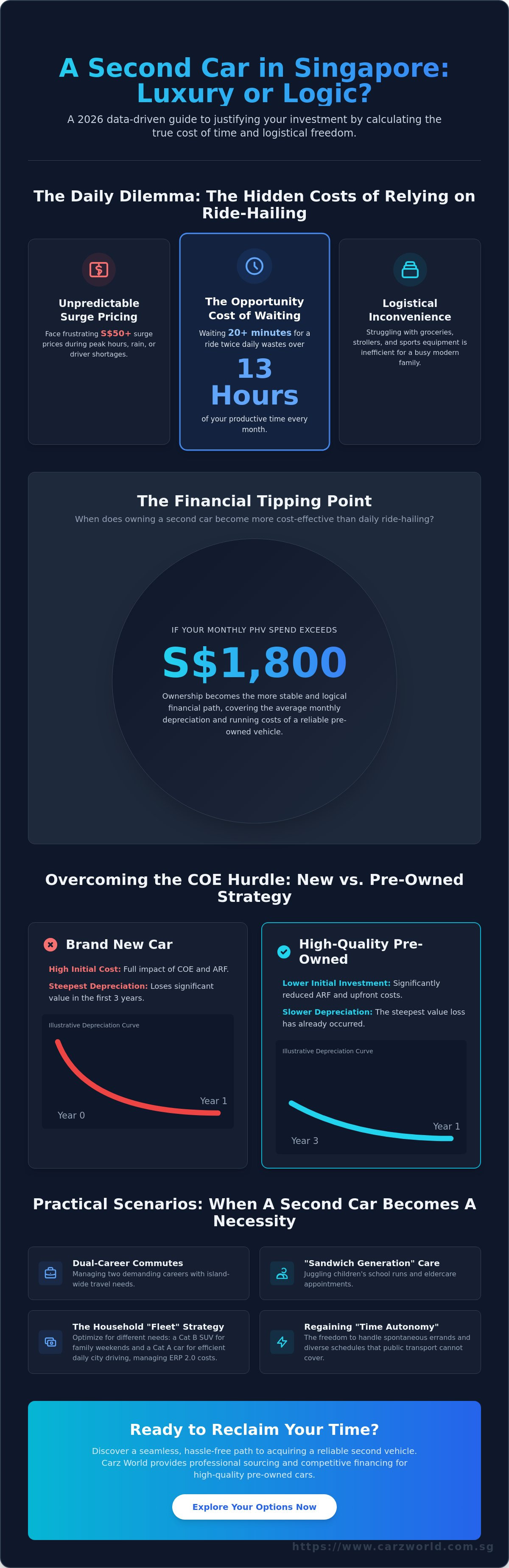
Deciding on a second vehicle often feels like a luxury choice, but the math for 2026 tells a different story. To move beyond gut feelings, you must calculate the "Real Cost" of relying on private hire vehicles (PHVs) like Grab or Gojek. While PHVs remove the need for parking fees, they introduce the volatility of surge pricing. For many households, the surge price threshold is the tipping point. If your family spends more than S$1,800 per month on PHVs, ownership often becomes the more stable financial path. This figure covers the monthly depreciation and running costs of a reliable used vehicle.
Before committing, it is vital to review a comprehensive breakdown of 2026 car ownership costs to understand how COE and ARF impact your monthly budget. By comparing these fixed costs against the rising commissions and platform fees of ride-hailing services, the case for justifying a second car in singapore becomes clearer for high-utilization families.
The Opportunity Cost of Waiting
Time is a finite resource that ride-hailing often wastes. During the monsoon months of November and December, or peak rush hours, wait times for a PHV in Singapore frequently exceed 20 minutes. If you face this twice daily, you lose over 13 hours every month just standing on a curb. Recovering this time allows for 60 to 90 minutes of extra professional productivity or, more importantly, quality family time. Consider the "3-stop morning routine": Home to School, School to Office, and then a quick stop for a work meeting. In a private car, this is one continuous, efficient journey. With PHVs, it requires three separate bookings, three wait times, and three sets of surge prices, often doubling the time spent in transit.
Hidden Financial Benefits of Ownership
Ownership provides a mobility hedge against future transport price hikes. While bus and MRT fares see periodic adjustments, a car with a secured COE locks in your primary transport cost for a decade. High-demand Japanese models from brands like Toyota or Honda, and certain Continental cars, maintain strong resale value in the Singapore market. This residual value acts as a buffer, reducing the total cost of ownership when it's time to trade in. For business owners, choosing a commercial vehicle as a second transport option can offer significant tax benefits and capital allowances. These vehicles serve a dual purpose, handling business logistics during the day and providing a "mobility insurance" for the family when the primary car is unavailable. If you want to explore your options, you can discover well maintained pre-owned cars that offer excellent value retention.
Whether you are managing school runs or back-to-back client meetings, the reliability of a second set of wheels eliminates the stress of "no drivers available" notifications. Our team is here to help you find a vehicle that fits your specific logistical needs. You can talk to us today for a transparent consultation on your next purchase.
Overcoming the COE Hurdle: New vs. Pre-Owned Strategies
High Certificate of Entitlement (COE) prices remain the biggest barrier for families considering an additional vehicle. When premiums for Category A and B fluctuate around the S$100,000 range, the financial commitment feels heavy. However, justifying a second car in singapore becomes much more manageable when you move away from the "new car" mindset. A brand new vehicle suffers its most aggressive depreciation during the first three years, often losing 20% to 30% of its value. By targeting a car that is five years old, you avoid this steep drop and pay a price that more closely reflects the vehicle's actual utility.
Parallel imports also offer a strategic way to reduce your initial capital outlay. These cars often feature different specifications or sourcing routes that allow for more competitive pricing than authorized dealer units. For a second vehicle that focuses on utility rather than status, these savings are significant. It's a professional approach to asset management: why pay a premium for a "new" badge when a high-quality alternative serves the same purpose for thousands of dollars less?
The Used Car Advantage for Second Vehicles
A pre-owned car in Singapore is often the perfect candidate for a household's second set of wheels. These vehicles are usually tasked with practical duties like school runs or short commutes to the MRT. You don't need the 2026 flagship features for a 15-minute drive to the enrichment center. Instead, focus on the remaining COE life versus the upfront cash requirement. A car with four years of COE left provides a low-cost entry point without a decade-long debt commitment. Choosing a "Certified Pre-Owned" unit is essential here; it ensures the car has passed professional inspections, so you don't face sudden repair costs that offset your savings.
COE Renewal: Is it Better to Extend or Buy New?
If you already have a car reaching the end of its 10-year cycle, you must decide between renewing the COE or buying a different used model. Renewing for five years requires a lower cash outlay but means the car must be scrapped at the end of that term with no further extensions. Based on the 2026 PQP trends, which reflect the moving average of the previous three months of bidding, timing your renewal is everything. You should monitor these trends closely to commit when the PQP dips. Deciding to renew means you will face the PARF rebate loss, which is the forfeiture of the cash return you would have received from the government for scrapping the car at age 10. For many, justifying a second car in singapore is about calculating if the low cost of renewal outweighs the loss of this rebate and the increased maintenance of an older engine.
Practical Scenarios: When a Second Car Becomes a Necessity
Singapore's public transport is world-class, but it doesn't solve every logistical puzzle for a growing family. For many households, justifying a second car in singapore is about reclaiming time. If one spouse works in the Jurong Industrial Estate while the other is based at Changi Business Park, the 40-kilometer gap makes a single-car arrangement nearly impossible. Relying on ride-hailing for such distances during peak hours often results in high surge pricing and long wait times, which can disrupt a professional schedule.
Business flexibility is another major driver. Professionals managing site visits or client meetings across multiple districts, such as Tuas and Woodlands, need the agility that only a personal vehicle provides. This isn't just about convenience; it's about the ability to respond to client needs without the friction of transport delays. On weekends, that same vehicle transforms into a tool for the "Weekend Warrior." Whether it's transporting bulky golf sets to the club or planning a regional road trip across the Causeway, a second car facilitates hobbies that simply don't fit into a bus or train cabin.
School Runs and Primary 1 Registration
The logistics of education in Singapore are demanding. While the Primary 1 registration process often focuses on the 1km or 2km radius, many parents choose enrichment classes in specialized hubs like Bukit Timah or Marine Parade. A commute from Choa Chu Kang to Tampines can take over 75 minutes by MRT, but only 35 minutes via the KJE and TPE. A second car ensures children arrive at school or tuition centers refreshed rather than drained by a long commute. During the intense monsoon seasons between November and January, the safety and comfort of a private vehicle protect young children from the elements, ensuring they stay dry and focused on their studies.
Caregiving and Multi-Generational Support
Members of the "Sandwich Generation" often find justifying a second car in singapore a matter of duty rather than luxury. Managing elderly parents' medical appointments at major clusters like SGH, NUH, or TTSH requires a reliable transport solution. Transporting a parent who uses a wheelchair or walker is difficult in a standard private hire car, where boot space may be limited or drivers may be untrained in assisting passengers with mobility aids. Having a dedicated vehicle parked at home serves as a vital "Emergency Vehicle," providing the peace of mind that you can reach a hospital or clinic at a moment's notice without waiting for an available driver on an app.
If your family's needs have outgrown a single vehicle, we can help you find a reliable and high-quality addition to your household. Discover our latest brand new car models to see which one fits your lifestyle.
Making it Work: Smart Financing and Sourcing with Carz World
Owning two vehicles in Singapore is a major lifestyle decision. Partnering with a professional dealership is the most effective way of justifying a second car in singapore while ensuring the experience remains hassle-free. Carz World acts as a strategic partner, offering a range of brand new car options that serve as competitive alternatives to traditional Authorized Dealers. We provide the latest models in pristine condition, often with shorter waiting periods and more personalized service. Our goal is to make every transaction a seamless and pleasant one for your family.
Tailored Financing for Multi-Car Households
Managing the costs of two vehicles requires careful financial planning, especially with MAS loan restrictions. For a second car, you'll need to account for the Total Debt Servicing Ratio (TDSR) and specific downpayment requirements. Currently, these are 30% for cars with an OMV of S$20,000 or less, and 40% for those above. Our in-house financing experts specialize in creating flexible loan tenures that align with your monthly cash flow. To offset the initial cost, you can sell your current car through our streamlined valuation process. This allows you to upgrade your fleet efficiently while securing a fair market price for your trade-in.
Trust and Reliability: The Carz World Signature
Reliability is the cornerstone of our business model. We don't believe in aggressive sales tactics. Instead, our consultants like Ryan and Ben adopt a patient, helpful approach to help you find the right fit. This methodical style ensures you're justifying a second car in singapore based on actual needs and data, not impulse. We maintain a high standard for our inventory, ensuring every vehicle is high quality and well maintained. Our "Smooth Process" guarantee means we handle the complex paperwork and inspections, so you don't have to. Key benefits of choosing our team include:
- Professional and honest advice from experienced consultants who understand the SG market.
- Thoroughly inspected pre-owned vehicles that meet strict quality benchmarks.
- Clear communication throughout the entire buying or selling journey.
- Access to a community of satisfied owners who've shared their positive experiences through testimonials.
By focusing on transparency and customer satisfaction, we help you manage the complexities of a multi-car household with total confidence. We value long-term reputation over short-term sales, which is why our process is designed to be thorough and honest. Talk to us today or request a quote to discover how we can help you find the perfect addition to your driveway without the stress.
Navigating Your Next Move in the 2026 Automotive Market
Owning an additional vehicle in Singapore is no longer just a luxury. It's a calculated decision based on productivity and family needs. By focusing on the hours saved during peak commutes and the flexibility of a dedicated transport option, justifying a second car in singapore becomes a clear equation of value over cost. Smart buyers are increasingly looking toward the pre-owned market to bypass the steepest depreciation curves of brand-new units. This strategy allows you to maintain mobility without the full weight of 2026 COE premiums.
At Carz World, we've helped thousands of drivers find this balance. With over 500+ positive customer testimonials, our specialists at Vertex and Alexandra Central focus on making the transition effortless through seamless trade-ins and tailored financing. We ensure every vehicle is high quality and well maintained so you can focus on the road ahead. Our professional consultants are ready to help you find a vehicle that fits your lifestyle and budget perfectly.
Discover our curated selection of high-quality pre-owned cars today
Your journey toward better mobility starts with a partner who values your time and trust as much as you do.
Frequently Asked Questions
Is it better to buy a used car or a new car as a second vehicle in Singapore?
Buying a used car is generally the more strategic choice because it avoids the steepest period of depreciation. New cars typically lose 10% to 20% of their value within the first year of registration. By choosing a high quality pre-owned vehicle, you ensure your investment stays stable while justifying a second car in Singapore for your family's needs.
Pre-owned cars also come with lower upfront costs and smaller loan requirements. At Carz World, we focus on well maintained vehicles that provide the reliability of a new car without the premium price tag. This approach allows you to allocate your budget more efficiently across two sets of household wheels.
What are the additional costs of owning a second car besides COE and the car price?
You must budget for recurring expenses like Road Tax, insurance premiums, and Electronic Road Pricing (ERP) charges. Road tax for a standard 1,600cc petrol engine currently costs S$744 per year. You also need to account for the S$220 Registration Fee and tiered Additional Registration Fee (ARF) payments that apply to every vehicle.
Maintenance and fuel costs will double your existing transport overheads. It's vital to consider the 0.5% to 1% increase in monthly household expenditure that these smaller, hidden fees represent. Keeping a detailed log of these costs helps maintain a clear picture of your total cost of ownership over time.
Can I get a 70% loan for my second car in Singapore?
You can qualify for a 70% loan only if the car's Open Market Value (OMV) is S$20,000 or less. If the OMV exceeds S$20,000, the Monetary Authority of Singapore (MAS) caps your maximum loan amount at 60% of the purchase price. These rules are strictly enforced for both new and used car purchases across all financial institutions.
The loan tenure is also capped at a maximum of seven years. When you apply for a second car loan, banks will assess your Total Debt Servicing Ratio (TDSR). This means your total monthly debt obligations, including your first car and home loan, cannot exceed 55% of your gross monthly income.
How does the ARF (Additional Registration Fee) affect the cost of a second car in 2026?
The ARF significantly inflates the cost of luxury vehicles through a tiered taxation system. For cars with an OMV above S$80,000, the highest tier is taxed at 320% of the value. This progressive tax structure means that high end second cars are disproportionately more expensive than entry level models.
In 2026, these tiers remain a critical factor in vehicle valuation and your eventual PARF rebate. Since the ARF is calculated based on the OMV, choosing a car with a lower OMV can save you tens of thousands of dollars. It's a professional way to manage your capital while expanding your household's mobility.
Is car leasing or rental a better alternative to buying a second car?
Leasing is better for residents who prefer a fixed monthly cost without worrying about depreciation or maintenance. It's an excellent short term solution if you only need a second vehicle for a specific two year period. However, leasing doesn't build equity and you won't receive any PARF or COE rebates at the end of the term.
Buying a high quality used car often proves cheaper over a five year horizon. When you own the vehicle, you retain the asset's residual value, which can be significant in a high COE environment. For most long term users, the math favors purchasing a well maintained pre-owned car over continuous rental payments.
What happens to my insurance NCD (No Claims Discount) for a second car?
Your existing NCD applies only to a single vehicle and cannot be shared between two cars. You'll generally start with a 0% NCD on your second car policy even if you have a 50% discount on your first. This is a common surprise for owners who expect their good driving record to transfer automatically.
Some insurers offer a "loyalty discount" or a "second car discount" of 10% to 15% to help lower the initial premium. Over time, you'll build a separate NCD for the second vehicle for every year you drive without making a claim. It's a methodical process of earning trust with your insurance provider once again.
How much should I budget for monthly maintenance and parking for a second vehicle?
You should budget approximately S$350 to S$550 per month for maintenance, parking, and minor repairs. HDB season parking for a second car costs between S$80 and S$110 depending on the car park type. Private condominium parking is often free for the first car but may cost S$100 to S$200 for a second lot.
Regular servicing typically costs between S$200 and S$400 every six months or 10,000km. It's wise to set aside an additional S$50 monthly for a "wear and tear" fund. This ensures you're prepared for larger expenses like tire replacements or battery changes without disrupting your monthly cash flow.
Which car models hold the best resale value for a 5-year ownership period?
Japanese models from Toyota and Honda consistently lead the market in resale value retention. The Toyota Corolla Altis and Honda Civic are top performers, often retaining 55% to 65% of their paper value after five years. This makes them highly recommended choices when justifying a second car in Singapore for practical daily use.
Continental brands like BMW or Mercedes-Benz tend to experience steeper depreciation after their initial warranty expires. If you value long term financial stability, sticking to mass market Japanese or Korean brands is a helpful strategy. These cars benefit from a large pool of buyers in the secondary market, ensuring a smooth and fast selling process later.
In Same Category
- Calculating the Breakeven Point for COE Renewal in Singapore
- Financial Checklist Before Committing to a Car Purchase in Singapore (2026)
- COE Renewal Conditions and Eligibility in Singapore: 2026 Guide
- Balloon Scheme Car Loan in Singapore: Pros and Cons for 2026
- Getting Car Finance with a New Business in Singapore: A Practical Guide