Common Mistakes Buying a Used Car in Singapore: Avoid These Costly Pitfalls in 2026

In 2026, a single oversight when checking a vehicle's history can cost a Singaporean buyer upwards of S$15,000 in unforeseen repairs and lost PARF rebates. Avoiding common mistakes buying used car options is now more critical than ever because record-high COE premiums leave no room for financial error. You likely feel the pressure of balancing a strict budget against the fear of hidden mechanical issues. It's understandable to feel overwhelmed by the technical jargon and complex regulations governing the local market.
The good news is that you can secure a reliable, high quality vehicle with a clear history by following a professional roadmap. This guide helps you master the market by highlighting the financial and regulatory traps that catch 40% of buyers. You'll learn how to demand transparency, identify technical red flags, and ensure a smooth handover. We'll show you how to transform a complex transaction into a predictable, pleasant experience that puts you in the driver's seat with total confidence.
Key Takeaways
- Master the financial nuances between PARF and COE vehicles to protect your scrap value and claim every dollar of your entitled rebates.
- Factor in the 2026 road tax and insurance adjustments to avoid the trap of looking only at monthly loan instalments.
- Learn to look beyond a polished exterior by using independent inspections to identify hidden mechanical issues or past accident history.
- Avoid common mistakes buying used car deals by prioritizing a dealership’s after-sales track record over suspiciously low prices found in online listings.
- Discover how a transparent, curated approach to pre-owned vehicles can ensure a seamless and worry-free transition to your next car.
The Financial "Math" Mistakes: PARF vs. COE Cars
Buying a vehicle in Singapore involves a unique set of financial calculations that don't exist in other markets. One of the most common mistakes buying used car shoppers make is failing to distinguish between a PARF car and a COE car. While the history of used cars globally focuses on mileage and wear, the Singapore market is driven by the 10-year statutory lifespan of the Certificate of Entitlement. If you don't understand the "paper value" of the vehicle, you might end up overpaying by thousands of dollars for a car that has zero scrap value at the end of its life.
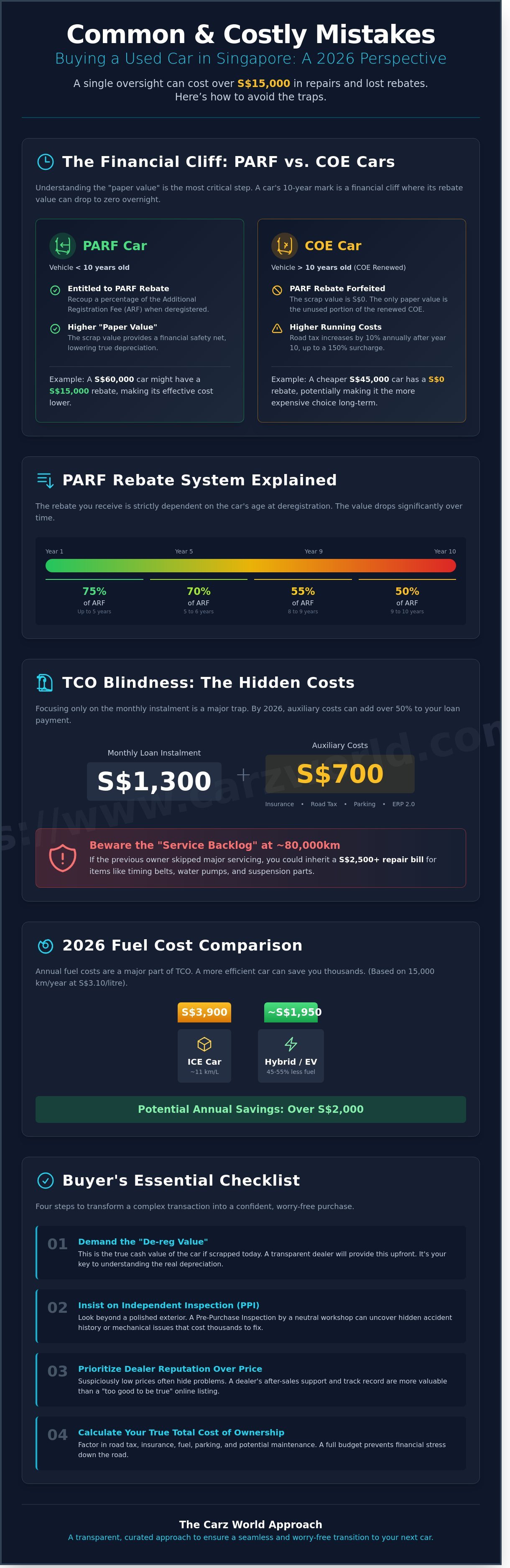
The 10-year mark is a financial cliff. A PARF (Preferential Additional Registration Fee) car is a vehicle that's still in its first 10-year cycle. When you deregister this car before its 10th year, you're entitled to a rebate on the Additional Registration Fee (ARF) paid at the time of first registration. However, once a car passes the 10-year mark and the owner renews the COE, it becomes a COE car. At this point, the PARF rebate is forfeited forever. Buyers often fall into the "Paper Value" trap where they only look at the selling price, ignoring that a S$60,000 PARF car might have a S$15,000 rebate waiting, while a S$45,000 COE car has a rebate value of exactly S$0.
Decoding the PARF Rebate System
The PARF rebate is your financial safety net. It allows you to recoup a percentage of your ARF when you scrap the car or export it. According to 2024 LTA regulations, the rebate tiers are strictly age-dependent. If you deregister a car before it hits 5 years, you get 75% of the ARF back. This drops to 50% if the car is between 9 and 10 years old. For a mid-sized sedan with an ARF of S$30,000, deregistering at year 9 yields a S$15,000 return. PARF cars are often better maintained because the high upfront cost attracts owners with higher servicing budgets, but you must verify the ARF amount on the log card to calculate the true depreciation accurately.
When Does a COE Car Make Sense?
A COE car is a vehicle that has had its COE renewed for another 5 or 10 years. These cars are often cheaper upfront, but they carry different risks. Avoiding common mistakes buying used car listings requires looking at the annual depreciation rather than the total price. A COE car might depreciate at S$9,500 per year, which is significantly lower than the S$14,000 annual depreciation of a newer PARF model. However, you must account for higher road tax surcharges, which increase by 10% each year after the 10th year, capping at 150%. You should also evaluate the "unused portion" of the COE; if you buy a car with 3 years of COE left for S$30,000, your paper value is essentially S$10,000 per year of remaining life.
Don't let a low price tag blind you to the underlying math. Always ask for the vehicle's "De-reg value" before signing any agreement. This figure represents the actual cash you'll receive if the car is scrapped today. If the dealer can't provide this number, it's a red flag. Professional dealerships like Carz World ensure this data is transparent, helping you avoid the hidden costs that turn a "good deal" into a financial burden. It's not just about the drive; it's about the exit strategy.
Total Cost of Ownership (TCO) Blindness in 2026
One of the most common mistakes buying used car shoppers commit is underestimating the Total Cost of Ownership (TCO). By 2026, Singapore's automotive landscape will look different. Road tax incentives for older electric vehicles will begin tapering, and the transition to the ERP 2.0 system will be fully integrated. Looking only at a S$1,300 monthly instalment while ignoring the S$700 in auxiliary costs is a recipe for financial stress. You must account for parking, insurance, and road tax before even turning the ignition.
Many 4-year-old cars reach the 80,000km milestone just as they hit the second-hand market. This "Service Backlog" involves high-ticket items like timing belts, water pumps, and suspension bushings. If the previous owner skipped the 70,000km specialized maintenance, you'll likely inherit a S$2,500 repair bill within months. Using a used car inspection checklist helps you spot these neglected areas before you sign the Sales Agreement. At Carz World, we believe in full transparency regarding these figures. You can explore our pre-owned inventory where we provide detailed history logs to help you calculate your true TCO accurately.
Fuel efficiency will define your daily overhead in 2026. An Internal Combustion Engine (ICE) car averaging 11km/L costs roughly S$3,900 annually in fuel at S$3.10 per litre for a 15,000km mileage. A comparable Hybrid or EV can slash that by 45% to 55%, potentially saving you S$2,000 every year. Another common mistakes buying used car buyers make is choosing a heavy SUV for city driving without calculating the 2026 carbon emission surcharges that might affect future resale values.
The Interest Rate and Loan Term Trap
Long-term loans are a financial mirage. MAS regulations cap car loans at 7 years, but stretching to this maximum term can see you paying S$18,000 more in interest on a S$110,000 loan compared to a 5-year term. Avoid "In-House" financing that advertises "low monthly" but hides 4.5% interest rates when banks offer 2.78%. Always check the LTV (Loan-to-Value) limits, which are 70% for cars with an OMV of S$20,000 or less, and 60% for anything above that threshold.
Maintenance and Road Tax Realities
Road tax for a 2,000cc engine is S$1,214 per year, whereas a 1,600cc engine is only S$744. That is a S$470 difference annually that adds up over a five-year ownership period. Our stop-start traffic in Singapore places immense stress on cooling systems and brake rotors. Budgeting for a "Major Service" costing between S$1,200 and S$2,800 for European models is essential. Ensure your budget includes a S$1,500 emergency fund for unexpected wear and tear items like the air-conditioning compressor or alternator, which often fail after 5 years of local humidity.
Skipping the Pre-Purchase Inspection (PPI) & History Check
A shiny exterior is the easiest thing for a seller to fix, but it's often a mask for deeper mechanical or structural issues. You might see a car with flawless paintwork, yet underneath that coat lies a chassis weakened by a major collision in 2022 or engine components corroded by flash floods. One of the most common car-buying mistakes is assuming that visual appeal equals mechanical health. Professional sellers know how to detail a car to look "showroom ready," but only a trained mechanic can spot the tell-tale signs of a hard life.
Relying solely on a dealer's in-house workshop report is another trap. While many dealers are honest, an internal report creates a clear conflict of interest. The workshop's primary client is the dealership, not you. They might overlook a minor oil leak or a worn suspension bushing to facilitate a faster sale. Always insist on an independent assessment to ensure you're getting an unbiased view of the car's true condition. This transparency is what separates a reliable purchase from a costly regret.
Verification doesn't stop at the engine bay. You must check the vehicle's Log Card via the LTA OneMotoring website using your Singpass. This document reveals the exact number of previous owners. If a car has changed hands four times in just three years, it's a massive red flag. It suggests recurring problems that previous owners couldn't solve. Similarly, a missing service booklet is a deal-breaker. A complete service history proves the car received oil changes and filter replacements at the recommended 10,000km intervals. Without this paper trail, you're gambling on the engine's longevity.
How to Conduct a Professional PPI in Singapore
First, book an appointment with an independent third-party centre like STA Inspection or VICOM. These centres provide a comprehensive "Evaluation Report" that grades the car from A to C. Second, ensure the technician performs a diagnostic scan. Modern cars store "hidden" electronic fault codes that don't always trigger a dashboard light. Finally, have them inspect the chassis rails for welding marks or kinks. Structural damage often voids the car's safety rating, making it a "death trap" in a future accident. These steps are essential to avoid common mistakes buying used car shoppers often make in haste.
Verifying Car History and Mileage
Mileage tampering remains a reality in the used car market. To spot this, compare the odometer with physical wear. A car showing only 40,000km shouldn't have a steering wheel with peeling leather or heavily worn foot pedals. You should also check for outstanding LTA fines or liens. If the previous owner hasn't cleared their S$300 speeding ticket, you might face administrative hurdles during the transfer. Remember, Singapore's Lemon Law protects you for the first 6 months after delivery. If a significant defect appears that wasn't disclosed, you have the legal right to demand a repair, replacement, or refund. This law is your safety net, but a thorough history check prevents you from needing it in the first place.
Falling for "Price Traps" vs. Dealer Reputation
Sorting by the lowest price on online car listings platforms is a natural instinct for many buyers, yet it remains one of the most common mistakes buying used car in Singapore. A listing priced S$3,000 to S$5,000 below the market average for a 2018 Honda Civic isn't always a bargain. These "price traps" often hide high-interest loan packages or mechanical issues that require immediate, expensive repairs. If a deal seems significantly cheaper than five other similar listings, the dealer is likely recouping that margin elsewhere.
Hidden costs often lurk in the fine print of the loan agreement. Some sellers advertise a "No Admin Fee" promotion to lure customers, only to add a S$1,000 "processing fee" or "agreement fee" back into the total loan amount. Over a five-year loan tenure at a 2.78% interest rate, these hidden additions increase your monthly commitment without providing any value. You aren't just buying a vehicle; you're entering a financial contract. Transparency in these numbers is the hallmark of a professional dealership.
Professional dealerships distinguish themselves from "Car Cowboys" through their physical presence and accreditation. A "Car Cowboy" might operate out of a temporary space with no workshop ties, making it impossible to claim on warranties later. In contrast, established showrooms invest in 160-point inspections before a car even hits the floor. They value their long-term reputation over a quick, one-time sale. This commitment ensures that your "new" used car doesn't end up in a workshop within the first 14 days of ownership.
The Importance of Social Proof and Reviews
Social proof serves as your best defense against poor service. When browsing reviews, look for specific mentions of consultants like Ryan, Carson, or Adam. Authentic testimonials often describe a "seamless and pleasant" experience rather than just generic praise. A trustworthy dealer fosters a non-pushy environment where you can spend 45 minutes inspecting the vehicle without feeling pressured. This patience allows you to make a rational decision based on the car's condition, not a salesperson's quota. This transparency is vital because another of the common mistakes buying used car is rushing the process due to sales pressure.
Transparent Paperwork and Handover
Documenting the deal correctly is the final step in avoiding a price trap. Ensure the Sales Agreement (SA) includes every verbal promise made during the viewing, such as a fresh coat of paint or a specific tyre replacement. A reputable dealer manages the heavy lifting of the LTA Transfer of Ownership via Singpass, which usually takes less than 15 minutes when done correctly. They also ensure the road tax is updated and the insurance transition is smooth, preventing any legal gaps when you drive out of the showroom. This methodical approach eliminates the headache of administrative errors that often plague "cheap" private deals.
Ready to experience a transparent and professional car buying journey? Discover our high-quality pre-owned collection at Carz World today.
The Carz World Approach: Worry-Free Pre-Owned Buying
Buying a vehicle in Singapore represents a major financial commitment that requires more than just a casual glance at a listing. Many buyers fall into the trap of the common mistakes buying used car shoppers often face, such as ignoring mechanical history or failing to account for total depreciation. Carz World eliminates these risks by offering a curated inventory of high-quality used cars that are strictly vetted for local road conditions. Every vehicle in our 100+ car inventory undergoes a rigorous multi-point inspection. We check for chassis integrity, engine health, and mileage accuracy to ensure you aren't inheriting someone else's repair bills.
Transparency is the foundation of our business model. You won't find hidden "admin fees" or surprise surcharges during the handover process. We provide a clear breakdown of the COE balance, the PQP paid, and the exact annual depreciation of every unit. This clarity prevents the common mistakes buying used car hunters make when they focus only on the sticker price rather than the long-term cost of ownership. Our professional consultants, including senior team members like Ryan and Carson, are known for their patient, "not pushy" style. They focus on building long-term trust rather than securing a quick commission.
Our support doesn't end once the sales agreement is signed. We provide comprehensive assistance for financing and insurance, securing competitive interest rates from a network of over 10 major banks and financial institutions in Singapore. If your current vehicle is still in the workshop or you're waiting for a specific model to arrive, we provide flexible options for even car rental to keep you mobile. This holistic approach ensures that every transition is handled with professional care.
Why Our Customers Recommend Us
Our 4.8-star customer rating is built on a commitment to a "smooth process" from the first viewing to the final drive-away. We handle the complex paperwork, including LTA transfers and insurance renewals, so you don't have to. Our team's expertise extends beyond local sales; we've mastered international car export, moving high-quality Singaporean vehicles to over 20 global markets. If you're looking at selling your current car, our dedicated consignment team helps you fetch the best market price without the stress of managing private viewings yourself. Consultants like Adam and Ben ensure that every seller gets a fair, data-backed valuation.
Your Next Steps to a Better Used Car
Don't leave your next vehicle purchase to chance. Visit our showrooms at Ubi or Alexandra for a professional consultation tailored to your lifestyle and budget. Our doors are open daily, and our staff is ready to provide a transparent, no-obligation quote on any vehicle in our fleet. If you're looking for something with zero mileage, you can also browse our latest arrivals of brand new parallel imports featuring the latest safety technology and fuel efficiency. Contact us today to experience a dealership experience that values your peace of mind above all else.
Drive Home with Certainty and Value
Navigating the 2026 resale market requires more than just a keen eye for a shiny exterior. You've got to master the math of PARF rebates and anticipate how shifting COE premiums affect your long-term Total Cost of Ownership. Skipping a professional Pre-Purchase Inspection is a risk that can lead to S$5,000 or more in unexpected repair bills. By avoiding the common mistakes buying used car seekers frequently encounter, you protect your hard-earned savings and ensure a reliable ride for years to come.
At Carz World, we've refined the buying experience to be methodical and honest. We're highly recommended by hundreds of verified customers because we prioritize a seamless handover process and transparent paperwork. Our professional and non-pushy sales consultants focus on helping you find the right fit rather than hitting a quota. You'll get high-quality, well-maintained vehicles backed by a reputation for excellence. Discover our curated selection of well-maintained used cars today and experience a smoother way to get behind the wheel. It's time to enjoy the road without the stress of hidden pitfalls.
Frequently Asked Questions
Is it better to buy a PARF car or a COE car in 2026?
Choosing between a PARF or COE car in 2026 depends on your cash flow and how long you plan to drive. PARF cars are under 10 years old and entitle you to a rebate of 50% of the Additional Registration Fee (ARF) when scrapped. COE cars have no scrap value but offer lower depreciation. With Cat A COE prices staying near S$90,000, a PARF car is often the safer financial choice for most Singaporean families.
What is the "Lemon Law" in Singapore and how does it protect used car buyers?
Singapore's Lemon Law protects you against defective goods, including second-hand cars, for up to 6 months after delivery. If a fault surfaces within this period, the dealer's legally obligated to repair or replace the vehicle. This law's vital for consumer protection, ensuring that the pre-owned car you buy is of "satisfactory quality" and "fit for purpose" at the time of sale.
How much downpayment is required for a used car in Singapore?
You'll need a minimum downpayment of 30% if the car's Open Market Value (OMV) is more than S$20,000. For vehicles with an OMV of S$20,000 or less, the required downpayment increases to 40% under Monetary Authority of Singapore (MAS) rules. If you're eyeing a S$120,000 SUV, be prepared to pay S$36,000 in cash or through your trade-in value.
Can I check a car’s accident history before buying?
You can verify a car's accident history by requesting the vehicle's service logs or checking for structural repairs during a professional evaluation. One of the common mistakes buying used car options is skipping a chassis inspection. Look for mismatched paint or uneven gaps between panels, as these often indicate the car was involved in a collision costing over S$5,000 in repairs.
What are the most common hidden fees when buying from a dealer?
Common hidden fees include administrative charges ranging from S$500 to S$2,000 and high loan processing fees. Some dealers might also charge a "transfer fee" or a "GST inclusive" price that wasn't clearly stated in the initial advertisement. Always ask for a full breakdown of the Total Purchase Price to ensure there aren't any surprise costs added to your final invoice.
How do I verify the actual mileage of a second-hand car?
To verify mileage, compare the odometer reading with the service history records and the last inspection certificate from VICOM or STA. Most Singaporean cars travel about 15,000km per year. If a 5 year old car shows only 20,000km, check for worn pedal rubbers or a shiny steering wheel. These signs of high usage shouldn't exist on a low-mileage vehicle.
Is a pre-purchase inspection (PPI) really necessary if the car looks new?
A pre-purchase inspection (PPI) is absolutely necessary even if the car looks brand new on the surface. For a small fee of roughly S$180 to S$250, a qualified mechanic can detect internal engine issues or electronic faults that aren't visible during a test drive. Investing in a PPI helps you avoid expensive repairs that could cost you S$3,000 or more later.
What happens to my COE rebate if I scrap my car early?
When you scrap your car early, you receive a pro-rated rebate of the Quota Premium (QP) you paid for your COE. If your COE has 3 years remaining out of a 10 year cycle and you paid S$100,000, you'll get back exactly S$30,000. This rebate is paid out by the Land Transport Authority (LTA) via bank transfer or can be used to offset taxes on your next car.
In Same Category
- Scrap Car vs Export Car in Singapore: How to Choose the Better Option
- Pros and Cons of Buying a High PARF Car in Singapore
- Car Valuation Services in Bukit Merah: A Seller’s Guide
- Scrapping Your Car Before 10 Years in Singapore: What Happens?
- Calculating the Breakeven Point for COE Renewal in Singapore