Buying a Car Without COE in Singapore: What the 'Price Without COE' Really Means in 2026

What if the S$90,000 price tag you see on a car listing is actually for a vehicle you aren't legally allowed to drive? It's easy to feel overwhelmed when browsing parallel import deals that seem too good to be true. Many Singaporean drivers find themselves frustrated by the complex choice between guaranteed and non-guaranteed bids. There is a real fear that a bargain might lead to six months of failed bidding cycles. When you consider buying a car without COE, you're often stepping into a world of hidden fees and administrative hurdles that authorized dealers usually handle behind the scenes.
We'll demystify these parallel import pricing structures to show you the risks, rewards, and legal realities of managing your own certificate. You'll learn exactly how to calculate the total cost of ownership for 2026 and how to avoid getting stuck with a car body that sits idle in a warehouse. This guide helps you decide if the potential savings of a parallel import are worth the extra effort or if a bundled deal is the more reliable path for your next vehicle.
Key Takeaways
- Understand the critical legal difference between parallel import listings and export-only vehicles to ensure your car is road-legal in Singapore.
- Learn how to decode "Basic Cost" pricing by breaking down the Open Market Value (OMV) and dealer margins often seen in digital listings.
- Identify the significant financial risks of buying a car without COE, including potential warehouse storage fees and the "car body" trap.
- Compare the peace of mind offered by guaranteed COE packages against the lower-priced gamble of non-guaranteed bidding strategies.
- Discover how a transparent approach to pricing and personalized bidding can provide a seamless, stress-free experience for your next vehicle purchase.
What Does 'Buying a Car Without COE' Actually Mean?
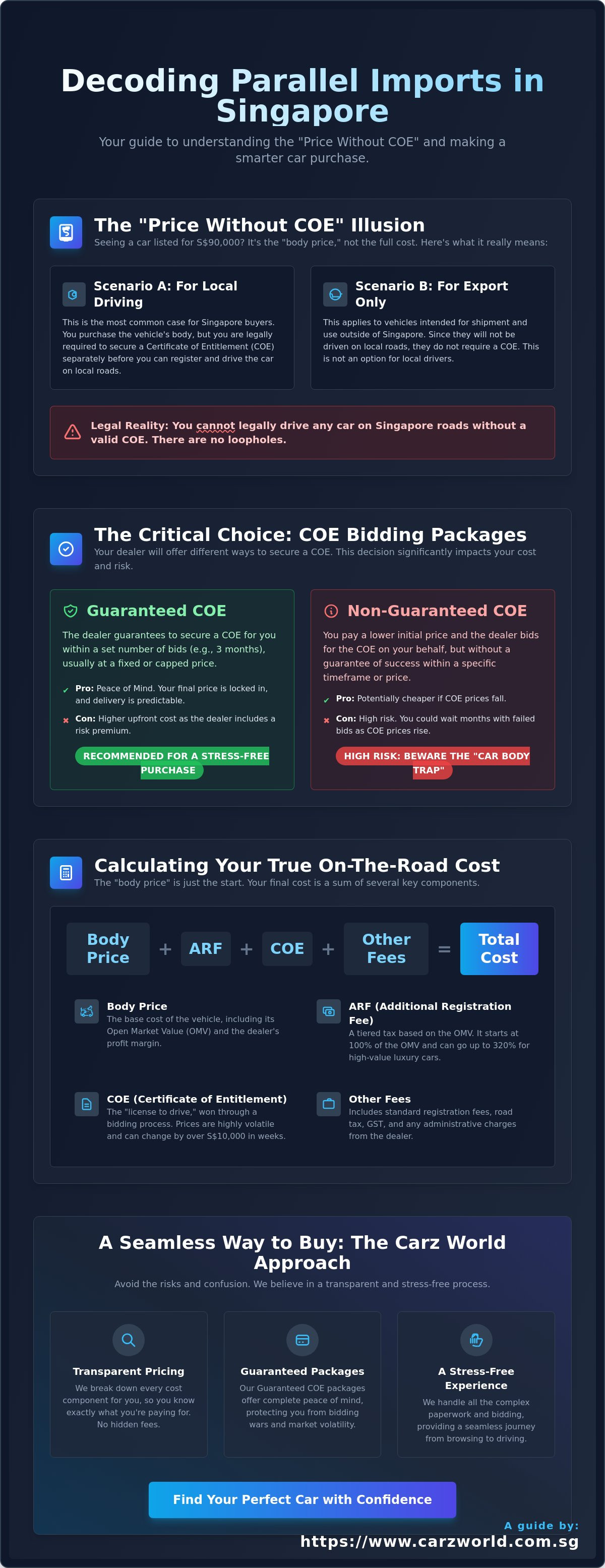
When you browse local listings and see the phrase "buying a car without COE," it usually refers to one of two distinct situations. It's a common sight on Singaporean car portals where a vehicle might be advertised for S$85,000, while similar models are listed for S$195,000. This isn't a clerical error. It's a strategic marketing tactic used by dealers to highlight the "body price" of the vehicle. By stripping away the volatile cost of the Certificate of Entitlement (COE) system, dealers make their prices look more attractive and affordable at first glance.
The legal reality is simple: you cannot drive any car on Singapore roads without a valid COE. There are no loopholes for private car owners. If you're buying for local use, the "price without COE" is just the baseline. This figure typically includes the Open Market Value (OMV), the Additional Registration Fee (ARF), and the dealer's profit margin. It represents the machine itself, not the permission to use it. Understanding this distinction is vital for your 2026 financial planning.
To better understand this concept, watch this helpful video:
Scenario A: The Parallel Import Pricing Model
Parallel importers (PIs) frequently separate the car price from the COE to offer buyers more control. This model allows you to choose your own bidding strategy. If you believe COE premiums will dip in the next two months, you can secure the car at its "body price" and wait for a more favorable bidding window. This transparency helps you see exactly how much you're paying for the vehicle versus the tax. However, it also means your final invoice can fluctuate by tens of thousands of dollars depending on the latest bidding results.
Scenario B: Buying a Car for Export
The second scenario involves buying a car without COE specifically for international shipping. These are export-only vehicles. Since these cars won't be registered for Singapore's roads, they don't require a COE, and they shouldn't have one. This is the primary route for overseas buyers or local dealers moving stock to foreign markets. If you're looking for vehicles to ship abroad, you can browse our export car services to find high-quality units ready for global delivery.
Why Parallel Importers Quote Prices Excluding COE
When you browse for a new vehicle in Singapore, the first price you see from a parallel importer is often surprisingly low. This figure represents the vehicle's cost before the Certificate of Entitlement (COE) is factored in. Dealers use this strategy because COE prices are notoriously volatile. In early 2024, Category A COE prices fluctuated by more than S$10,000 within just a few bidding cycles. By quoting a price without the COE, dealers provide a stable baseline that reflects the Open Market Value (OMV) and their own business margin.
This approach serves as a strategic digital marketing tool. It allows listings to appear more competitive on automotive portals, catching the eye of budget-conscious buyers. While some critics view this as "hook-pricing," it also offers a layer of transparency. It shows you exactly how much you're paying for the machine itself versus the right to drive it. However, you must remember that buying a car without COE means your final "on-the-road" price will be significantly higher once taxes and registration fees are included.
To calculate the total investment, you need to consider several components:
- The Body Price: This includes the OMV and the dealer's profit margin.
- ARF (Additional Registration Fee): A tax calculated based on a percentage of the OMV.
- COE: The prevailing quota premium at the time of successful bidding.
- Registration Fees and Road Tax: Administrative costs to get the car on the road.
Understanding the OMV and ARF Connection
The OMV is the price paid or payable for the vehicle when it's imported into Singapore. The ARF is a tax that scales with this value. For a car with an OMV of S$20,000, the ARF is 100%. If the OMV exceeds S$80,000, the top tier ARF rate reached 320% as of the 2023 budget changes. A higher OMV increases your total "price without COE" because the tax burden scales up quickly. You can explore our latest brand new cars to see how these values compare across different models.
The Flexibility of Bidding Your Own COE
Some buyers choose to bid for their own COE to gain more control over the final price. This is common for individuals who aren't in a rush and want to wait for a dip in the market. It's not without danger, though. There are significant financial risks of COE bidding if you don't secure a quota within the dealer's stipulated timeframe. Your car might sit in a bonded warehouse, potentially accumulating storage fees. Most reputable dealers manage multiple bidding cycles for their clients to ensure a smooth handover process. If you're feeling unsure about the bidding process, our team is always ready to provide a clear breakdown of the current market trends.
Guaranteed vs. Non-Guaranteed COE: The Critical Choice
When you're buying a car without COE, the most significant decision involves choosing between a guaranteed or non-guaranteed package. A guaranteed package offers peace of mind at a higher premium. The dealer commits to securing a COE within a set number of bidding cycles, usually three to six. This is ideal if you need your car by a specific date. In contrast, a non-guaranteed package is a gamble for a lower upfront price. The dealer bids on your behalf, but only up to a certain amount. If the market price exceeds that limit, you won't get your car. If the bidding fails repeatedly, your deposit's fate depends on the contract terms. Most reputable dealers will refund the deposit in full after the agreed bidding period ends, but always verify the "refund clause" before signing. To understand the mechanics of these bids, consult the official government explanation of the COE system.
The Math Behind COE Rebates
The rebate level is a fixed dollar amount defined in your purchase agreement. It represents the maximum amount the dealer is willing to pay for your COE. If the actual price in the next bidding exercise drops below this level, the dealer refunds you the difference. For example, if your rebate is set at S$105,000 and the COE is secured at S$98,000, you receive a S$7,000 refund. However, if the COE price spikes to S$110,000, you'll likely face a "top-up" request to cover the S$5,000 gap. If you refuse to pay, the dealer simply won't bid, and you'll continue waiting through subsequent cycles.
Which Package Fits Your Budget?
Choosing a package depends on your timeline and risk tolerance. Urgent buyers should always opt for guaranteed packages. While you pay more upfront, you avoid the stress of rising prices and delayed delivery. If you're patient and believe prices will trend downward over the next 12 weeks, a non-guaranteed bid might save you significant cash. When buying a car without COE from a parallel importer, scrutinize the sales agreement for specific "bid count" clauses. Ensure the contract specifies the exact number of bids the dealer must perform and the exact conditions for a full deposit refund. This transparency ensures your car buying experience remains professional and predictable.
- Guaranteed Package: Higher price, fixed delivery timeline, protected from price spikes.
- Non-Guaranteed Package: Lower price, uncertain delivery, potential for "top-up" costs.
- COE Rebate: The threshold that determines if you get money back or pay more.
Risks of Buying a Car Without a Secured COE
The biggest danger of buying a car without COE is falling into the "Car Body" trap. This happens when you've paid for the physical vehicle, but it remains a stationary paperweight because you lack the legal right to drive it on Singapore roads. If a dealer fails to secure a bid within the agreed timeframe, you're left owning a depreciating asset that's stuck in a holding yard. You can't insure it for road use, and you certainly can't drive it to work.
Storage is another hidden drain on your wallet. Vehicles waiting for a successful bid must be kept in bonded warehouses or private yards. Many dealers pass these costs to the buyer if the bidding process exceeds two months. These fees often range from S$20 to S$50 per day. Over a long bidding cycle, you could easily spend an extra S$1,500 just for the car to sit idle.
Financial volatility adds another layer of risk. Car loan approvals typically have a validity period of 30 to 90 days. If your COE bid takes longer, your original interest rate offer might expire. If MAS interest rates climb by even 0.5% during that delay, your monthly installments will increase, costing you thousands of dollars over a seven-year loan. You also risk "COE Top-ups." This occurs when the market price climbs above the dealer's "rebate level," and they demand an extra S$3,000 or S$7,000 to continue the bidding process.
Hidden Costs and Administrative Fees
The "cheap" price you see in advertisements often excludes essential expenses. You'll need to account for the S$350 registration fee, IU installation costs of approximately S$160, and number plate embossing. Dealers also charge administrative document fees that can range from S$500 to S$1,000. When these are tallied with the prevailing COE price, the initial figure often balloons by S$10,000 or more. The on-the-road price is the only figure that truly matters because it reflects the total cost of ownership including taxes and registration.
The Danger of Fly-By-Night Dealers
Buying from an unvetted dealer is a gamble with your hard-earned savings. Smaller, non-accredited shops might use your down payment to cash-flow other parts of their business rather than bidding for your COE immediately. To protect yourself, always check for CaseTrust-SVTA accreditation. This certification ensures the dealership maintains a high standard of transparency and provides a clear mechanism for dispute resolution. It's the best way to ensure your deposit is safe while you wait for your vehicle. At Carz World, we focus on a methodical and honest approach to help you find high quality brand new cars without the stress of hidden loopholes.
A Seamless Way to Buy: The Carz World Approach
Understanding the logistics of buying a car without COE in 2026 requires more than just a calculator. It requires a partner who understands the specific rhythm of the LTA bidding cycles and the volatility of the current market. At Carz World, we provide transparent, upfront pricing for both brand new parallel imports and pre-owned cars. We don't just list a base price; we explain exactly how that number interacts with current PQP or COE premiums so you aren't left with unexpected costs at the point of registration.
Our personalized COE bidding strategies are tailored to your specific timeline. If you need a car urgently, we adjust our bidding approach to secure a certificate quickly. If you have the flexibility to wait for a dip in premiums, we'll advise you on the best months to enter the bid. Our no-hidden-fee policy is a core pillar of our business. What we quote in our initial consultation is what you pay. We've eliminated the "administrative surprises" that often plague the car-buying process in Singapore.
Our consultants prioritize your budget over a quick sale. We understand that a vehicle is a major financial commitment, especially with 2026 price points. Our team provides expert guidance based on real-time data, ensuring you make a decision that's financially sustainable for years to come.
Why Trust Carz World for Your Next Vehicle?
Our reputation is built on proof, not just promises. You can find hundreds of positive reviews from Singaporean drivers who highlight the dedication of consultants like Ryan and Carson. These experts are known for their patient, non-pushy approach, helping clients feel at ease while buying a car without COE. We provide comprehensive support that extends far beyond the showroom floor. From securing competitive financing and insurance rates to managing the final handover, we handle every detail. The Carz World Guarantee also provides peace of mind regarding COE delivery timelines, ensuring you aren't left waiting indefinitely for your new vehicle.
Ready to Start Your Car Ownership Journey?
The 2026 automotive market presents unique challenges, but you don't have to face them alone. We invite you to book a free consultation to discuss current COE trends and how they impact your preferred models. Because we manage export, buying, and selling in-house, we offer a streamlined ecosystem that most smaller dealerships can't match. This vertical integration allows us to provide better trade-in values and faster processing times for all paperwork. Talk to our experts at Carz World today for a transparent quote and experience a car ownership journey that's simple, honest, and professional.
Navigate Your 2026 Car Purchase with Confidence
Navigating the Singapore car market in 2026 requires a clear understanding of what "price without COE" actually entails. It's more than just a lower number on a listing. It's a strategic choice between waiting for a successful bid or securing your vehicle immediately. By weighing the risks of non-guaranteed packages against the certainty of a secured COE, you protect your investment from market volatility. Every buyer should prioritize transparency to avoid hidden costs that often surface during the bidding process.
The most effective way to simplify buying a car without COE is to partner with an experienced expert who values honesty over short-term sales. Carz World is a CaseTrust-SVTA Accredited Dealer, ensuring that every transaction meets high industry standards for reliability. Our reputation is built on hundreds of 5-star reviews that highlight our professional, "no-pushy" sales environment. Whether you're looking for a local drive or need specialists in worldwide export, we provide a methodical approach to every handover. Our team focuses on making the complex process of car ownership a pleasant and reliable journey for every customer.
Discover Transparent Car Deals with Carz World and experience a seamless path to your next vehicle today.
Frequently Asked Questions
Can I buy a car without a COE and drive it temporarily?
No, you can't drive any vehicle on Singapore roads without a valid Certificate of Entitlement. According to Land Transport Authority regulations, every car must be registered with a COE before it hits the road. While you can technically complete the purchase of the car's "body," the vehicle must remain in a showroom or bonded warehouse until a COE is successfully secured and the registration process is complete.
What is the difference between a 'body price' and 'on-the-road' price?
The body price refers only to the cost of the vehicle itself, including the Open Market Value and the dealer's margin. The 'on-the-road' price is the total amount you'll pay to actually start driving. This inclusive figure covers the car body, the COE, registration fees, road tax, and the mandatory IU unit. In 2024, the COE often makes up more than 50% of the total on-the-road cost for many popular models.
How many times will a dealer bid for my COE in a non-guaranteed package?
Most standard non-guaranteed packages include 6 bidding attempts, which take place over a period of three months. These bids happen twice a month during the LTA's official bidding windows. If the dealer doesn't secure the COE within these 6 rounds because the market price exceeds your agreed cap, the contract is typically terminated. At that point, a reputable dealer will refund your deposit in full as per the sales agreement.
What happens if COE prices rise significantly after I sign the contract?
If you've signed a non-guaranteed contract and COE prices spike, the dealer might ask for a "top-up" to continue bidding. For example, if the price jumps S$10,000 above your agreed limit, you'll need to pay the difference to secure the car. If you choose not to pay the extra amount, the dealer will continue to bid at your original lower limit. If the price doesn't drop back down within the agreed bidding rounds, the deal won't go through.
Is it cheaper to buy a car without COE and bid for it myself?
It's rarely cheaper for individual buyers to bid personally. When buying a car without COE to bid on your own, you often have to pay the full price of the car body in cash upfront. Dealers usually have access to better registration rates and bundled packages that include servicing or lower interest rates. Bidding yourself also means you carry 100% of the risk if prices suddenly climb during the next auction cycle.
Can I buy a car for export without paying for a COE?
Yes, you can purchase a vehicle specifically for export without ever paying for a COE. These cars are kept in Licensed Or Bonded Warehouses and are never registered for use in Singapore. This is a common service we provide for international clients who want to take advantage of Singapore's well-maintained vehicle stock. You'll save significantly on costs like the COE and Additional Registration Fee, provided the car is shipped out of the country.
What is a COE rebate and how does it protect the buyer?
A COE rebate is a guaranteed amount the dealer promises to return if the actual COE price falls below a specific level. If your contract has a rebate level of S$105,000 and the dealer wins the bid at S$100,000, they must refund you the S$5,000 difference. This mechanism ensures you don't overpay if the market softens. It provides a layer of financial transparency, so you know exactly where your money is going during the bidding process.
Can I use my own bank loan for a car bought without a bundled COE?
You can certainly use your own bank loan, though it requires more coordination. Most banks in Singapore won't release the funds until the COE is secured and the car is ready for registration. You should also check if the dealer charges a "handling fee" for using external financing, which can range from S$500 to S$2,000. Our team always recommends comparing the total cost of your own loan against our in-house packages to see which offers the best value.
In Same Category
- Calculating the Breakeven Point for COE Renewal in Singapore
- Financial Checklist Before Committing to a Car Purchase in Singapore (2026)
- COE Renewal Conditions and Eligibility in Singapore: 2026 Guide
- Balloon Scheme Car Loan in Singapore: Pros and Cons for 2026
- Getting Car Finance with a New Business in Singapore: A Practical Guide