Avoiding Car Buying Regret: The Ultimate 10-Step Checklist for Singaporean Drivers
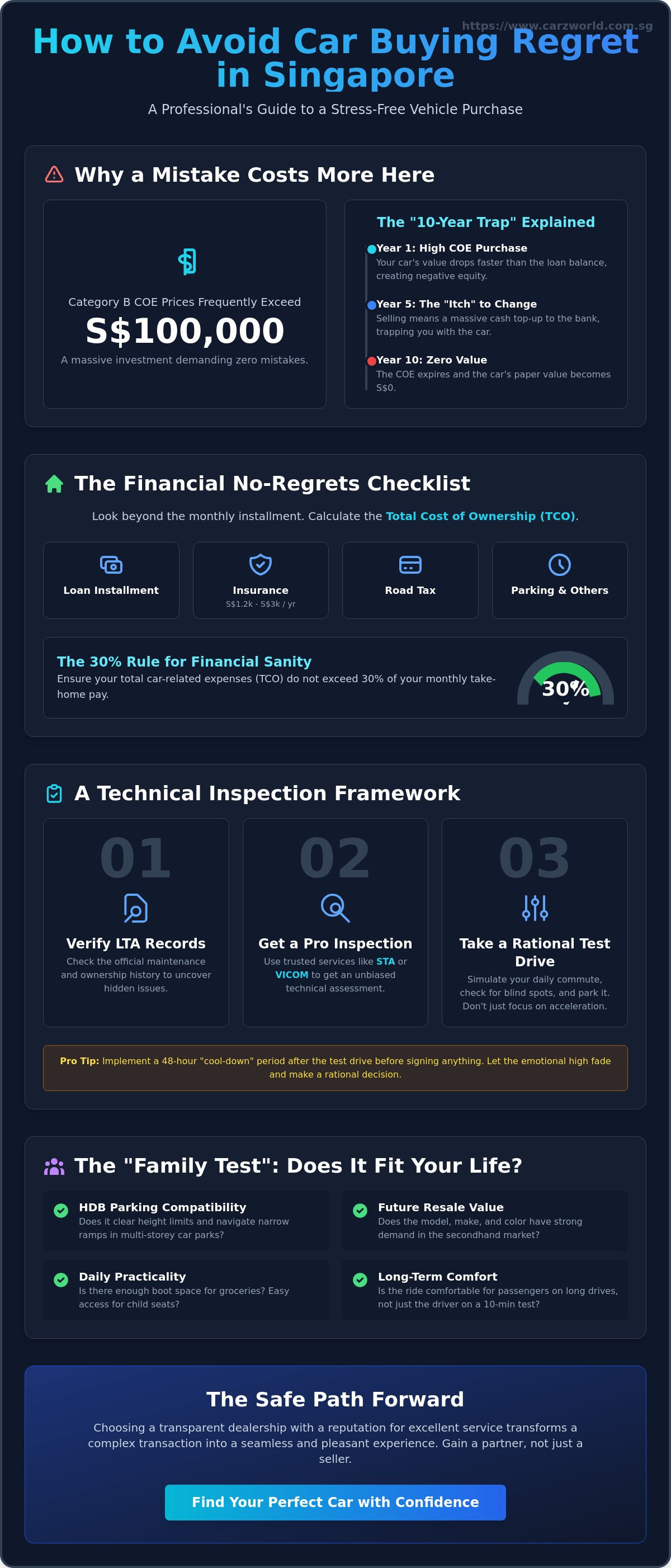
With Category B COE prices frequently crossing the S$100,000 mark in 2024, can you really afford to make a mistake on your next vehicle? What if that massive investment ends up being your biggest source of daily stress instead of your proudest milestone?
We understand the anxiety that comes with navigating Singapore's volatile car market. It's natural to worry about hidden mechanical defects in pre-owned models or the long-term pressure of a heavy loan commitment. You want a car that serves your family, not a debt that drains your bank account. This guide focuses on avoiding car buying regret by giving you the exact tools used by industry experts to vet every purchase.
We've consolidated years of dealership expertise into a professional 10-step checklist that ensures both technical quality and financial sanity. From verifying LTA maintenance records to planning a high-resale value exit strategy, you'll gain the confidence to drive home a vehicle that brings you joy for years to come.
Key Takeaways
- Escape the "10-year trap" by understanding how COE depreciation and the 30% rule for car-related expenses impact your long-term financial freedom.
- Learn to calculate the true Total Cost of Ownership (TCO) in Singapore, accounting for S$ expenses like road tax, insurance, and season parking.
- Master a professional vetting framework—including STA or VICOM inspections—to ensure you are avoiding car buying regret and securing a high-quality vehicle.
- Apply the "Family Test" to evaluate if a vehicle fits your daily lifestyle, considering practicalities like HDB parking height limits and narrow ramps.
- Discover how choosing a transparent dealership with a reputation for excellent service can transform a complex transaction into a seamless and pleasant experience.
Why Car Buying Regret Hits Harder in the Singapore Market
Buying a vehicle in Singapore isn't just a lifestyle choice; it's a massive financial commitment that often exceeds S$150,000 for even basic models. This high entry cost makes avoiding car buying regret essential for your long-term financial health. Unlike other markets, the unique regulatory environment here means a mistake can haunt your bank account for a decade. Every signature on a sales agreement carries the weight of a long-term liability that's difficult to offload without significant loss.
Understanding the nuances of Car ownership in Singapore is vital because the system is designed around controlled growth and high taxation. When prices fluctuate, those who buy during a market peak often find themselves in a position of negative equity almost immediately. This volatility means that the emotional "high" of a new purchase can quickly turn into a financial burden if the timing and vehicle choice aren't perfect.
To better understand why certain vehicle choices lead to dissatisfaction, watch this helpful video:
The Role of COE and Depreciation
The Certificate of Entitlement (COE) is a regulatory permit that represents the right to own a vehicle for ten years, after which its value depreciates to zero. If you secure a COE when premiums are at a record high, like the S$150,001 peak seen in late 2023 for Category B, your car's value drops faster than your loan balance. This creates a "10-year trap" where you're forced to keep a car you dislike because selling it would result in a massive cash top-up to the bank. Many drivers hit the "5-year itch" and want a change, but the math simply doesn't work if the initial buy-in was too high.
Emotional vs. Rational Decision Making
Common emotional triggers like "The New Model Hype" or peer pressure from social circles often lead to impulsive signatures. A test drive provides a sensory high that can cloud your rational judgment, making a cramped sporty coupe seem practical when it's actually a poor fit for your daily commute. We recommend a 48-hour "cool-down" period before signing any sales agreement to ensure your brain, not just your heart, is on board. Taking this time helps you look past the leather scent and focus on the actual utility of the vehicle.
Choosing the lowest-priced option on the market often backfires for many local drivers. A "cheap" car with high mileage or a poor service history frequently leads to mounting repair bills that exceed the monthly installments of a high quality used car. It's important to distinguish between buyer's remorse, which is a temporary feeling of guilt, and a genuinely poor investment where the vehicle's total cost of ownership drains your savings. Avoiding car buying regret starts with recognizing that the cheapest sticker price rarely equals the best value over a ten-year cycle.
The Financial No-Regrets Checklist: Beyond the Monthly Installment
One of the most effective ways of avoiding car buying regret is to look far beyond the monthly installment. Many buyers focus solely on whether they can afford the monthly bank loan, but the Total Cost of Ownership (TCO) in Singapore is significantly higher. A comprehensive budget must include comprehensive insurance, which often ranges from S$1,200 to S$3,000 annually, and road tax. Financial experts often suggest the "30% Rule," where your total car-related expenses don't exceed 30% of your monthly take-home pay. For a full breakdown of the mandatory costs involved in a purchase, you can refer to the LTA's guide to buying a new vehicle.
Loan tenures also play a massive role in your long-term satisfaction. While a 7-year loan reduces monthly pressure, it increases the total interest paid. Singaporean banks typically use the "Rule of 78" for car loans. This method front-loads the interest, meaning if you try to sell or settle the loan early, the remaining principal might be higher than you expect. It's also vital to consider the opportunity cost of your down payment. In a high-interest environment, a S$60,000 down payment could otherwise earn 3.5% to 4% in a fixed deposit or T-bill, representing a "lost" income of roughly S$2,400 per year.
Decoding the OMV and ARF Relationship
The Open Market Value (OMV) is essentially the price of the car before taxes. It's a critical figure because it determines your Additional Registration Fee (ARF) and your eventual PARF rebate. A car with a higher OMV provides a better financial safety net. If you scrap the car at the 10-year mark, you receive 50% of the ARF paid as a rebate. This is why some parallel imports, while cheaper upfront, might have lower scrap values compared to authorized dealer models with higher OMVs. Understanding this balance is key to avoiding car buying regret when it's time to sell or scrap the vehicle.
Hidden Costs: The "Silent" Regret Triggers
Road tax in Singapore scales exponentially with engine capacity, meaning a 3,000cc engine attracts a much higher annual fee than a 1,600cc model. You must also budget for the maintenance of wear-and-tear parts like brake pads, shock absorbers, and tires, particularly for pre-owned cars that are over five years old. Daily drivers should also account for Singapore's ERP charges and potential seasonal parking hikes. These small daily costs can easily add S$300 to S$500 to your monthly expenditure. If you want a clear picture of how these costs fit your lifestyle, our consultants at Carz World can provide a transparent cost breakdown for any model.
Vetting the Vehicle: A Technical Inspection Framework
Mechanical failure is the fastest way to turn a dream purchase into a financial nightmare. A disciplined technical framework is your best defense in avoiding car buying regret. Start by verifying the vehicle service history and mileage authenticity. A legitimate logbook should show regular maintenance every 10,000km or six months. If there are gaps longer than 12 months in the records, the engine might have suffered internal wear that won't show up on a short test drive.
You must evaluate high cost components like the gearbox and hybrid battery. A gearbox overhaul for a continental car can easily exceed S$6,000. For those eyeing hybrids, a battery replacement typically costs between S$2,500 and S$4,500 depending on the model. Understanding these potential liabilities is a core part of any comprehensive guide to car ownership costs. Don't forget to check for chassis damage or signs of flood recovery. Pull back the trunk carpets to look for silt or mismatched paint, as these are telltale signs of a past submerged in water.
The Importance of Third-Party Inspections
Never rely solely on a dealer's internal checklist. Send the car to an independent center like STA or VICOM for a professional evaluation. These reports use a grading system where Grade A or B indicates a healthy vehicle. A Grade C or D report often signals structural issues or significant repair needs. If the inspection reveals worn brake pads or a leaking gasket, use these specific findings to negotiate a price reduction or insist the dealer performs the repairs before you sign the final handover papers.
Vetting the Dealer: Trust over Price
A low price often masks poor after-sales support. Prioritize dealerships with CaseTrust-SVTA accreditation. This certification ensures the business adheres to transparent pricing and ethical sales practices. You'll notice the difference in the showroom; professional consultants are patient and won't use high-pressure tactics to close a deal. They focus on finding a car that fits your lifestyle rather than just hitting a monthly quota.
If you're worried about the hidden history of used vehicles, opting for brand new cars from reputable parallel importers offers the best long-term security. These vehicles come with fresh warranties and the latest safety features, which significantly reduces the risk of avoiding car buying regret later. A dependable dealer acts as a partner, ensuring the paperwork, from LTA transfers to insurance, is handled with absolute precision.
Avoiding the Wrong Fit: Lifestyle and Resale Considerations
Your daily lifestyle dictates whether a car is a dream or a logistical nightmare. In Singapore, physical dimensions matter more than in most cities. A large SUV might look impressive, but it becomes a source of stress if you frequently use older HDB multi-storey car parks with 1.8m or 1.9m height limits. Narrow ramps in buildings like Shaw Centre or Peninsula Plaza require precision. If you find yourself constantly correcting your steering to avoid scratching your rims on tight spiral ramps, the honeymoon phase with your new vehicle will end abruptly. Choosing a car that physically fits your environment is a core part of avoiding car buying regret.
Think about the "Family Test" for the next 3 to 5 years. A sleek two-door coupe fits a single professional today, but it won't accommodate a baby seat or elderly parents with mobility issues tomorrow. Singapore's high car prices and the 10-year COE cycle mean you're often locked into a long-term commitment. If the car cannot grow with your changing needs, you'll face the high cost of an early exit. Balance your desire for driving pleasure with practical necessities like rear legroom and boot capacity for groceries or strollers.
Planning Your Exit Strategy
Every savvy driver looks at the end of the journey before they start. You need to understand when to sell your car to maximize your returns. In Singapore, deregistering a car before its 10th year allows you to recover the Preferential Additional Registration Fee (PARF) rebate, which is 50% of the OMV for a 10-year-old car. Consignment is often better for owners who want a higher price and aren't in a rush, while direct trade-ins offer immediate convenience. For high-OMV luxury models, using professional car export services can often yield a better return than selling locally, as these vehicles are highly valued in overseas markets.
Fuel Type and Future-Proofing
The shift toward sustainability is changing the resale landscape. If you drive more than 20,000km annually, a hybrid model typically reaches its "break-even" point against a pure petrol counterpart within 4 years due to fuel savings. However, don't jump into an EV unless your residence or workplace has reliable charging infrastructure. While the government added over 2,000 charging points in 2023, convenience is still king. Be mindful of the Vehicular Emissions Scheme (VES). Cars in the A1 or A2 bands enjoy rebates, while those in the C1 or C2 bands face heavy surcharges, which will impact your total cost of ownership and future resale value as "Green" taxes evolve.
Ready to find a vehicle that fits your lifestyle perfectly? Consult our experts at Carz World today for professional advice on your next upgrade.
The Safe Path Forward: Partnering for a Seamless Experience
Choosing the right partner is the final, most critical step in avoiding car buying regret. A customer-centric dealership does more than just move inventory; it provides a buffer against post-purchase anxiety. At Carz World, we focus on a "Seamless Process" that manages every detail from competitive financing and insurance to the final handover. Social proof is vital in this journey. We encourage you to look beyond the brand and read reviews for individual consultants like Ryan, Carson, Adam, or Ben. These testimonials reflect a culture of patience and professional service that helps you feel confident in your choice. When you work with an advisor who values your satisfaction over a quick sale, the entire experience becomes pleasant and stress-free.
Why Transparency is the Best Policy
Transparency prevents the "hidden fee" shock that often leads to regret. Carz World ensures every vehicle is high quality and well maintained before it ever reaches the showroom floor. Our sales team takes a patient approach, giving you the space to think without aggressive pressure. We provide clear, professional documentation for every transaction. This ensures you understand exactly what you're paying for, including the base price, prevailing COE, and any administrative fees. There are no surprises, just honest deals.
Your Next Steps to a Regret-Free Purchase
Before you step into a showroom, create a "Must-Have" versus "Nice-to-Have" list. This keeps you grounded when you see a flashy feature that wasn't in your original plan. You should also book a consultation with a trusted advisor to discuss current COE trends. Understanding whether to bid now or wait can save you thousands of S$. Use this 10-point checklist during your next visit to ensure you're avoiding car buying regret:
- Budget: Confirm the total "on-the-road" price including all fees.
- History: Review the vehicle's service history and accident reports.
- COE: Check the remaining COE tenure and its impact on resale value.
- Test Drive: Test the car on both highways and narrow streets.
- Ownership: Verify the number of previous owners for pre-owned models.
- Insurance: Compare at least three insurance quotes for the specific model.
- Condition: Inspect the interior and electronics for any signs of wear.
- Warranty: Clarify exactly what the warranty covers and for how long.
- Reviews: Check the specific consultant's feedback from previous buyers.
- Practicality: Ensure the car fits your home or office parking lot dimensions.
Buying a car in Singapore is a major financial commitment. We are here to make it a smooth, organized, and honest process. Talk to us today to find your perfect, regret-free vehicle and experience a better way to drive.
Drive Home with Total Confidence
Buying a vehicle in Singapore is a major financial milestone. It requires a strategy that looks past the initial shine to account for the total cost of ownership and a rigorous technical inspection. By following this 10-step checklist, you're avoiding car buying regret and ensuring your choice fits your lifestyle for the long haul.
The right partnership makes this complex process simple. Carz World is CaseTrust Accredited, providing a secure environment where transparency is the priority. Our consultants, including Ryan and Carson, have earned hundreds of 5-star testimonials for their helpful and professional approach. We've mastered the intricacies of local sales and global exports to ensure every handover is a smooth success. You don't have to navigate the market alone when you have experts who value your trust.
Ready to find a high-quality vehicle that meets your standards? Discover our highly recommended pre-owned collection and experience a dealership that puts your needs first. Your perfect drive is just a conversation away.
Frequently Asked Questions
How can I tell if a used car mileage has been tampered with?
You can identify mileage tampering by cross-referencing the car's odometer with its official service history and physical wear. Look for "Last Service" stickers on the door frame or windscreen that show a higher mileage than the dashboard. If a car shows 40,000km but the steering wheel and pedals are heavily worn, it's a clear red flag. Professional dealers like Carz World provide high quality, well maintained vehicles with transparent histories to help you in avoiding car buying regret.
What is the most common reason for car buying regret in Singapore?
Underestimating the total cost of ownership is the most frequent cause of regret among Singaporean drivers. Many buyers focus only on the monthly installment and forget about the S$1,200 annual insurance premium or the S$600 biannual servicing costs. Overlooking these recurring expenses leads to financial strain. Planning for parking, road tax, and petrol ensures you don't feel "car poor" six months after your purchase.
Is it better to buy a new car or a used car to avoid regret?
Buying a used car is often the better choice for avoiding car buying regret because you bypass the steep 20% depreciation that occurs in the first year. A high quality pre-owned vehicle allows you to drive a premium model for a fraction of the original price. While new cars offer a full factory warranty, a well maintained used car from a reputable dealer provides a similar sense of reliability without the heavy financial hit.
What happens if I regret my car purchase after signing the agreement?
Once you sign the Sales Agreement and the dealer processes the COE bidding, you're legally bound to the contract. Singapore law doesn't provide a mandatory cooling-off period for motor vehicle sales. If you cancel, you'll likely forfeit your deposit, which typically ranges from S$5,000 to S$10,000. It's vital to review every clause and confirm your financing before putting pen to paper.
How much of my salary should I spend on car installments in Singapore?
You should limit your total car-related expenses to 30% of your monthly gross salary. This percentage must include your loan installment, insurance, road tax, and petrol. If you earn S$6,000 a month, your total monthly spend on the car shouldn't exceed S$1,800. Sticking to this limit protects your ability to save for other goals like housing or retirement while enjoying your new ride.
What are the red flags to look for during a car test drive?
Listen for "clunking" sounds when driving over bumps or high-pitched squeals when braking. These often indicate worn suspension bushings or thin brake pads. If the car pulls to one side on a straight road, the wheel alignment is likely off. A healthy engine should idle smoothly at around 700 to 900 RPM. Any shuddering during gear shifts is a major sign of transmission trouble that requires immediate attention.
Does a higher OMV always mean a better resale value?
A higher OMV doesn't always guarantee a better resale price, though it does ensure a higher PARF rebate at the 10-year mark. The PARF rebate is calculated as 50% to 75% of the OMV. However, market demand for specific brands and the prevailing COE prices at the time of sale have a bigger impact on your actual cash return. A popular model with a lower OMV often sells faster than a niche car with a high OMV.
How does the COE cycle affect my decision to buy now or wait?
The COE cycle determines whether you're buying at a peak or a trough in the market. When the LTA announces a quota reduction, prices usually spike, which increases your upfront cost and monthly installments. Buying during a period of high COE supply can save you S$10,000 or more on the purchase price. Monitoring these trends helps you time your purchase to maximize value and minimize long-term depreciation.
In Same Category
- Calculating the Breakeven Point for COE Renewal in Singapore
- Financial Checklist Before Committing to a Car Purchase in Singapore (2026)
- COE Renewal Conditions and Eligibility in Singapore: 2026 Guide
- Balloon Scheme Car Loan in Singapore: Pros and Cons for 2026
- Getting Car Finance with a New Business in Singapore: A Practical Guide