Continental Car Maintenance Cost in Singapore: 2026 Price Guide & Saving Tips
What if that flashing service light on your BMW dashboard didn't have to mean a mandatory S$1,800 withdrawal from your savings account? Recent data suggests that 60% of European car owners in Singapore cite "unexpected repair bills" as their primary ownership stress. You likely agree that while the handling of a Mercedes or Audi is superior, the lack of transparency regarding the continental car maintenance cost singapore makes budgeting feel like guesswork. It's frustrating to face high quotes for parts and labor that should be manageable with the right expertise and planning.
This 2026 guide provides a detailed price breakdown to help you eliminate "luxury tax" surprises and maintain your vehicle's peak performance. We promise to give you a clear roadmap for your annual servicing budget, whether you're driving a brand new Volvo or a pre-owned Porsche. You'll discover the real price difference between Service A and Service B, learn how to source high-quality parts without the dealer markup, and find out how to identify a reliable specialist workshop that values your trust as much as your business.
Key Takeaways
- Understand the reality of European car engineering to distinguish between necessary precision costs and avoidable "luxury tax" markups.
- Access our 2026 price guide to benchmark the typical continental car maintenance cost singapore owners can expect for Service A and Service B.
- Discover why specialized diagnostic software and proprietary tools are essential for maintaining the complex electronics of brands like BMW, Mercedes-Benz, and Audi.
- Learn smart strategies to reduce your annual bill, including the transition from authorized dealers to independent specialists after your warranty expires.
- Find out why a professional pre-purchase inspection and a transparent service history are your best defenses against high long-term ownership costs.
Understanding Continental Car Maintenance Cost in Singapore
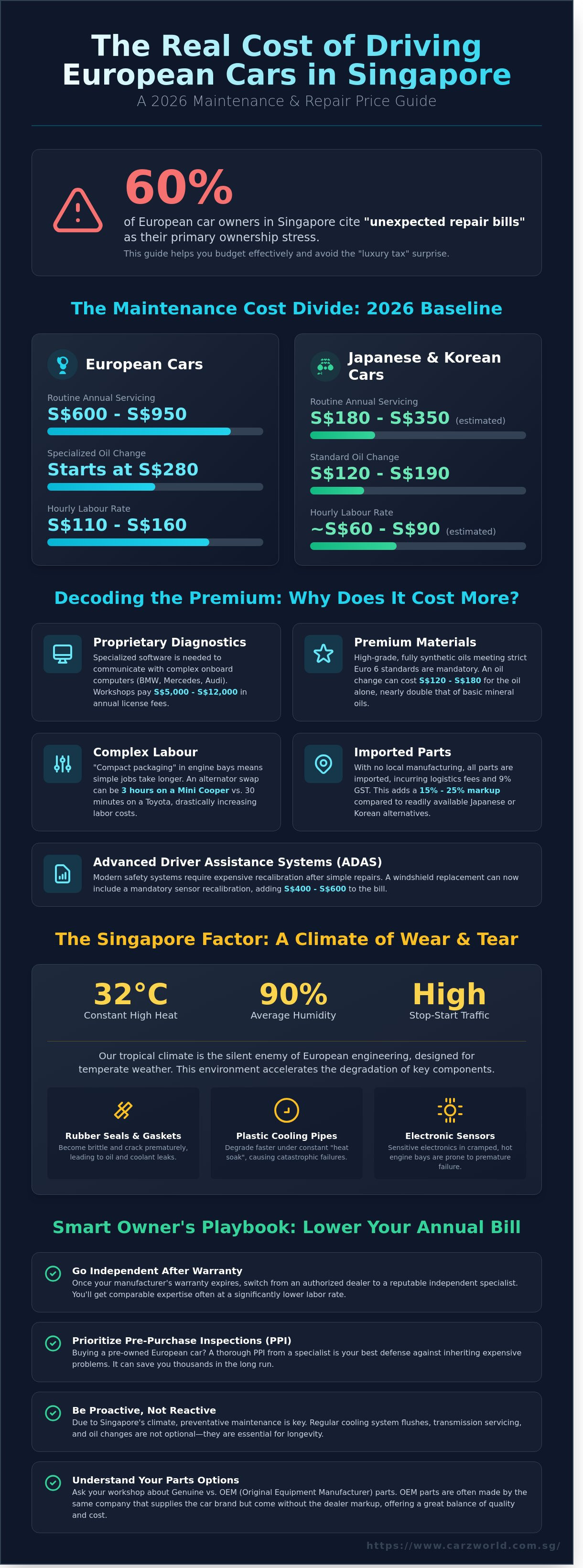
In the Singapore automotive market, "Continental" serves as the catch-all term for European brands like BMW, Mercedes-Benz, Audi, Volkswagen, and Volvo. Many drivers believe a "luxury tax" exists that inflates repair bills, but the reality is tied to high-precision engineering. These vehicles are designed with tighter tolerances and complex electronic systems that require specialized diagnostic tools and calibrated equipment. For 2026, a standard Continental sedan owner should expect a continental car maintenance cost singapore baseline of S$600 to S$950 for a routine annual service. This figure covers high-grade synthetic oils, OEM filters, and the technical expertise required to reset intricate onboard computers.
Singapore car ownership carries a higher price tag than other regions due to our unique economic structure. We don't have local parts manufacturing, so every component is imported, incurring logistics fees and the prevailing 9% GST. When you factor in the high overheads of local workshops and the scarcity of land for service centers, the cost of keeping a European car in peak condition naturally sits higher than in neighboring markets.
Continental vs. Japanese/Korean Maintenance Baselines
The gap between European and East Asian maintenance costs remains distinct in 2026. While a routine oil change for a Japanese sedan might range from S$120 to S$190, a Continental equivalent often starts at S$280. This is partly because European engines typically require a larger volume of specialized, manufacturer-approved lubricants. Additionally, labor rates at reputable Singapore workshops now average between S$110 and S$160 per hour for European marques. If you are browsing brand new cars, it is vital to account for these premium parts that must be shipped from overseas hubs, adding a 15% to 25% markup compared to locally stocked Japanese alternatives.
The "Heat Factor": Why Singapore Accelerates Wear
Our tropical climate is the silent enemy of European engineering. Most Continental cars are designed for temperate climates, but Singapore’s 90% humidity and constant 32°C temperatures cause rubber seals, gaskets, and plastic cooling pipes to become brittle much faster than intended. The stop-start nature of CBD traffic also places immense strain on dual-clutch transmissions and cooling systems, which don't receive the consistent airflow they would on a European motorway.
Heat soak is the process where a car's engine temperature continues to rise after the engine is turned off, often leading to the premature degradation of sensitive electronic sensors and plastic connectors in the cramped engine bays of Continental models. To manage your long-term continental car maintenance cost singapore, proactive cooling system flushes are no longer optional; they are a necessity for survival in our local environment.
Why European Car Servicing in Singapore Carries a Premium
The continental car maintenance cost singapore is often higher than that of Japanese or Korean counterparts because European manufacturers prioritize precision engineering and high-performance thresholds. This complexity starts with the diagnostic process. A standard scan for a BMW or Mercedes-Benz requires proprietary software that costs local workshops between S$5,000 and S$12,000 in annual licensing fees. These costs are naturally reflected in the service bill.
Specialized tools also drive up the price. Many Audi or Volkswagen models require unique torque wrenches or specific bits that generalist workshops don't stock. Beyond tools, the materials themselves are premium. Most European engines require fully synthetic oils that meet Euro 6 emissions standards, costing roughly S$120 to S$180 per oil change. In contrast, basic mineral oils for economy cars might cost half that. Labor is another major factor. European cars often use "compact packaging" to save space, meaning a simple alternator replacement that takes 30 minutes on a Toyota might take 3 hours on a Mini Cooper because the mechanic must remove the front bumper and radiator assembly first.
Advanced Sensors and Modular Engineering
Modern European vehicles have shifted from mechanical components to integrated electronic modules. A single sensor failure in the exhaust system can trigger "Limp Mode," which limits the car to speeds under 40km/h to prevent engine damage. Furthermore, the rise of Advanced Driver Assistance Systems (ADAS) means that even a minor windshield replacement requires sensor recalibration. This calibration process uses specialized laser targets and can add S$400 to S$600 to a repair bill that would have been much cheaper on an older, less tech-heavy model.
Supply Chain and Genuine Parts Availability
Singaporean owners must choose between three tiers of parts: Genuine, OEM, and Aftermarket. Genuine parts carry the manufacturer's logo and a 100% price premium, while OEM parts come from the same factory but lack the branding, typically saving you 20% to 35%. If a specific control module or transmission valve body isn't available in local warehouses, air-freighting it from Germany or the UK can take 7 to 14 days. This downtime increases your "car-less" days, often forcing owners to spend more on private hire transport or rentals. To avoid these unexpected hurdles, many drivers choose to browse our high quality pre-owned cars that come with transparent service histories and verified maintenance records.
2026 Price Guide: Routine Servicing vs. Major Repairs
Managing a European vehicle in 2026 requires a clear understanding of the continental car maintenance cost singapore owners face. Precision engineering demands specific lubricants and parts, which naturally drives prices higher than Japanese or Korean alternatives. You'll generally follow a rotating schedule of Service A (Minor) and Service B (Major) to keep the engine performing at its peak.
Routine Maintenance Schedule & Estimated Prices
For a standard 10,000km oil service in 2026, expect to pay between S$280 and S$450. This basic Service A covers high-grade synthetic oil, a new filter, and a multi-point safety check. Service B, which occurs every 20,000km or 2 years, includes cabin filters and more thorough diagnostics, typically costing between S$650 and S$1,300. You'll also need to budget for these specific intervals:
- Spark Plugs & Ignition Coils: Usually replaced every 40,000km to 60,000km. A set of four for a BMW or Audi will cost roughly S$350 to S$600.
- Brake Fluid Flush: This is essential every 2 years to prevent moisture buildup. Expect to pay S$120 to S$180.
- Coolant Flush: Necessary every 3 to 5 years to protect the aluminum engine blocks common in Continental cars, costing about S$150 to S$250.
Major Component Replacement Costs
The "Big Bills" usually arrive as the car ages past its third year. Air conditioning systems are under constant strain in our tropical climate. Replacing a Mercedes-Benz or BMW air-con compressor in 2026 will likely cost between S$1,600 and S$2,900 including labor. If the cooling coils fail, prices can climb even higher due to the complex dashboard removal required.
Suspension components like bushes, control arms, and shock absorbers are vital for maintaining the heavy, planted feel of a European car. A full suspension refresh can range from S$2,000 to S$4,500. It's often more economical to look for well-maintained pre-owned cars that have already had these major wear-and-tear items addressed by the previous owner. This strategy significantly lowers your continental car maintenance cost singapore during the first few years of your ownership.
The 5-year and 7-year milestones are the most expensive periods. You'll face transmission fluid changes, which cost between S$600 and S$1,000, and potential timing chain or belt inspections. Budgeting an additional S$2,500 per year for these "Major" years ensures you aren't caught off guard by the natural life cycle of high-performance parts.
Smart Strategies to Lower Your Annual Maintenance Bill
Managing your continental car maintenance cost singapore effectively starts with a shift in mindset. Many owners wait for a dashboard warning light before visiting a workshop. This reactive approach is expensive. A small oil leak that costs S$150 to seal today can lead to a S$5,000 engine overhaul if ignored. You should treat your service schedule as a hard deadline rather than a suggestion. Replacing a timing belt at the 80,000km mark might cost S$600, but a snapped belt can write off your entire engine.
Once your factory warranty expires, transition from authorized dealers to reputable independent specialists. Authorized workshops often charge S$150 to S$200 per hour for labor. Independent specialists focusing on European brands usually offer the same technical expertise for 30% to 40% less. You can also save by sourcing your own Original Equipment Manufacturer (OEM) parts from established stockists in areas like Sin Ming or Waterloo Street. This avoids the 20% to 50% markup workshops often apply to components, though you must ensure the workshop is willing to install "bring-your-own" parts without voiding their labor warranty.
Building a "Conti Sinking Fund" is the most practical way to handle unexpected repairs. Set aside S$200 to S$300 every month into a dedicated account. When your BMW needs new brake rotors or your Audi requires a mechatronic unit repair, the S$2,500 bill won't disrupt your monthly budget. This disciplined approach ensures you never skip essential work due to temporary cash flow issues.
Choosing the Right Independent Workshop
Don't settle for a generalist. Look for a specialist equipped with brand-specific diagnostic tools like the Star Diagnosis System for Mercedes-Benz or ISTA for BMW. A professional workshop provides itemized quotes that separate labor from parts. If a mechanic pressures you to replace "preventative" items that still have 40% life left, seek a second opinion. Transparency is the hallmark of a trustworthy partner.
Leveraging Car Insurance and Extended Warranties
For cars aged between five and eight years, third-party extended warranties can be a lifesaver. Providers like ECICS or QBE offer plans that cover major mechanical failures for an annual premium of roughly S$800 to S$1,500. It's a calculated hedge against high-cost gearbox or cooling system failures. Additionally, keep every service receipt. A documented history of regular maintenance at 10,000km intervals is vital if you ever need to contest an insurance claim for a mechanical breakdown.
Buying Smart: How Your Choice of Dealer Impacts Future Costs
Selecting the right dealer is the most effective way to control your continental car maintenance cost singapore from day one. A thorough pre-purchase inspection (PPI) isn't just a suggestion; it's a requirement for European makes. These vehicles feature complex electronics and cooling systems that require specialized diagnostic tools to assess. Skipping a PPI could lead to immediate repairs costing S$2,500 or more for common issues like oil leaks or sensor failures. At Carz World, we minimize this stress by ensuring our inventory undergoes rigorous quality checks before any sale.
The Value of a Full Service History
A car with "agent records" usually commands a 10% to 15% premium in the resale market. This documentation proves the car wasn't neglected and received genuine parts. Look for gaps in the maintenance log as a major red flag. If a car missed its 60,000km major service, you're likely inheriting a S$1,200 bill immediately. We carefully curate our brand new cars and pre-owned stock to ensure they meet strict reliability standards. This methodical approach protects you from the hidden costs of poor prior ownership.
When Maintenance Costs Outpace Value
Owners of 8 to 10 year old Continental cars often face the "Point of No Return." This happens when annual repair bills exceed 40% of the car's current market value. If you're spending S$600 every month on various workshop visits while your monthly installment is S$1,100, you're essentially paying for two cars. It's often more economical to sell or consign your car before the next major component fails. Common high-ticket failures in older models include:
- Mechatronic Units: S$2,500 to S$4,500 replacement cost.
- Air Suspension Struts: S$1,200 to S$2,000 per corner.
- Turbocharger Assemblies: S$3,000 or more depending on the brand.
Balancing the joy of a Continental drive with fiscal responsibility means knowing when to upgrade. While these cars offer superior handling and safety, the continental car maintenance cost singapore can spike sharply as the COE expiry approaches. Our team provides honest, transparent advice to help you decide if a repair is a sound investment or a sunk cost. We believe in making the car ownership process a seamless and pleasant one, focused on long-term value rather than short-term sales.
Drive Your Dream Without the Financial Surprises
Managing your continental car maintenance cost singapore effectively in 2026 comes down to two factors: proactive care and choosing the right partner. Routine oil changes and brake fluid flushes prevent major gearbox or engine failures that often exceed S$8,000 in repair bills. By sticking to a strict 10,000km service interval, you'll likely reduce your long-term ownership expenses by up to 25%. It's clear that your choice of dealership plays a massive role in these future costs; a well-documented vehicle history is the best insurance against hidden defects.
At Carz World, we remove the guesswork from your purchase. Every car in our inventory undergoes a rigorous 150-point quality check to ensure it meets our high standards. We provide a transparent service history where available, so you know exactly how the vehicle was treated. Our professional, non-pushy sales experts are here to guide your choice without any pressure. Browse our range of high-quality, well-maintained pre-owned Continental cars today. You deserve a seamless driving experience that stays within your budget.
Frequently Asked Questions
Are Continental cars really more expensive to maintain than Japanese cars in Singapore?
Yes, Continental cars generally cost 20% to 40% more to maintain than Japanese models due to specialized parts and higher labor rates. A standard oil change for a BMW might cost S$250; a similar service for a Toyota is often S$150. These costs add up because European engines require higher precision components and specific synthetic oils to meet performance standards.
How much should I set aside annually for BMW or Mercedes maintenance in 2026?
You should budget between S$1,500 and S$3,500 annually for a BMW or Mercedes in 2026. This range covers routine servicing and expected wear and tear items like brake pads or tires. Owners of models over five years old should aim for the higher end of that bracket to account for potential cooling system or suspension repairs. Factoring in the continental car maintenance cost singapore early helps you avoid unexpected financial strain.
Is it better to go to the Authorized Dealer or an outside workshop for servicing?
Authorized Dealers offer 100% genuine parts and specialized diagnostic tools, but independent workshops can save you 30% on labor costs. If your car's under warranty, stick to the dealer to avoid voiding your coverage. For cars older than three years, a reputable independent specialist provides a balance of expert knowledge and more competitive pricing for major repairs.
Why do European car parts take longer to arrive in Singapore?
Shipping parts from Europe typically takes 7 to 14 days because most local inventory's limited to high-demand items. While common filters are kept in stock, specialized sensors or body panels often come directly from Germany or the UK. This logistics chain is affected by global freight schedules, which can occasionally extend wait times to 21 days during peak periods.
What are the most common problems with Continental cars in Singapore’s weather?
High humidity and temperatures reaching 34 degrees Celsius frequently cause rubber seals and plastic cooling components to degrade faster than in Europe. You'll likely see coolant leaks or air conditioning compressor failures once the car hits the 60,000 kilometer mark. Interior roof linings also tend to sag after 5 or 6 years due to the adhesive failing in our tropical heat.
Can I use regular engine oil for my Continental car to save money?
No, you must use fully synthetic oil that meets specific manufacturer approvals like BMW Longlife-01 or Mercedes MB 229.5. Using cheaper, non-approved oil can lead to sludge buildup and engine damage, costing you S$5,000 or more in repairs later. Spending an extra S$40 per service on the correct grade is a small price to pay for protecting your engine's longevity.
Does a higher maintenance cost mean the car is less reliable?
Not necessarily, as the continental car maintenance cost singapore reflects the complexity and performance of the vehicle rather than its failure rate. European cars use advanced technology that requires precise calibration and higher-quality materials. A well-maintained Audi or Volvo can easily last 15 years, provided you follow the scheduled service intervals and don't skip preventive care.
How does the COE system affect the decision to maintain an older Continental car?
The high cost of a new COE, which exceeded S$100,000 in 2024, makes spending S$5,000 on a major overhaul for an existing car a logical choice. If your car's body and interior are in good condition, renewing the COE for 10 years is often 50% cheaper than buying a brand new equivalent. Most owners find it's more economical to maintain a known vehicle than to take on a new 7-year loan.
In Same Category
- Pros and Cons of Buying a High PARF Car in Singapore
- Car Valuation Services in Bukit Merah: A Seller’s Guide
- Scrapping Your Car Before 10 Years in Singapore: What Happens?
- Calculating the Breakeven Point for COE Renewal in Singapore
- Financial Checklist Before Committing to a Car Purchase in Singapore (2026)