COE Renewal vs. Buying a Used Car in Singapore: The 2026 Comprehensive Guide
Choosing to extend your car's life might seem like the thrifty move, but sticking with a 10-year-old vehicle in 2026 could leave you with a S$20,000 repair bill you didn't see coming. Most Singaporean drivers feel the pressure as PQP rates remain volatile and the complexity of PARF rebates makes every calculation feel like a gamble. It's a stressful crossroads. You're forced to weigh sentimental value against cold, hard cash.
We understand that you want to protect your savings while staying mobile. This guide simplifies the COE renewal vs buying used car debate by looking at the total cost of ownership over the next decade. We'll show you how to minimize your monthly depreciation and avoid the "money pit" phase of an aging engine. You'll get a clear roadmap to help you decide if it's time to commit to your current ride or upgrade to a high quality, well-maintained alternative from an experienced partner you can trust.
Key Takeaways
- Navigate the 2026 PQP landscape to determine if renewing your COE or switching to a well-maintained pre-owned vehicle is the most cost-effective move.
- Uncover the "Sunk Cost" trap by learning how to factor lost PARF rebates and annual depreciation into your true ownership math.
- Assess the hidden risks of the 100,000km "wear and tear wall" to decide if the reliability of a newer used car outweighs the familiarity of your current ride.
- Analyze the critical financial and lifestyle trade-offs of COE renewal vs buying used car to ensure your next move aligns with your budget.
- Explore strategic exit options like global exporting to secure a significantly higher return on your current vehicle than traditional local scrapping.
The 10-Year Crossroads: COE Renewal vs. Buying Used in 2026
Every car owner in Singapore eventually hits the 10-year wall. This lifecycle is a unique byproduct of the Certificate of Entitlement (COE) system, which regulates vehicle ownership. As we approach 2026, the decision to keep your current vehicle or replace it has become more complex. The PQP (Prevailing Quota Premium) remains the primary factor, but fluctuating rebates and maintenance costs add layers to the math. You're effectively choosing between the "devil you know" by renewing your current car or a "fresh start" in the pre-owned market.
To better understand the trade-offs between keeping your current ride and switching to another, watch this helpful video:
The 2026 climate is particularly volatile. Previous years saw more predictable depreciation, but recent shifts in quota supply mean that the gap between COE renewal vs buying used car costs has narrowed. Owners must weigh the immediate cash outlay of a renewal against the long-term reliability of a newer, used vehicle. If your current car has a history of mechanical issues, a renewal might lead to expensive repairs that offset any perceived savings.
What is COE Renewal and How Does it Work?
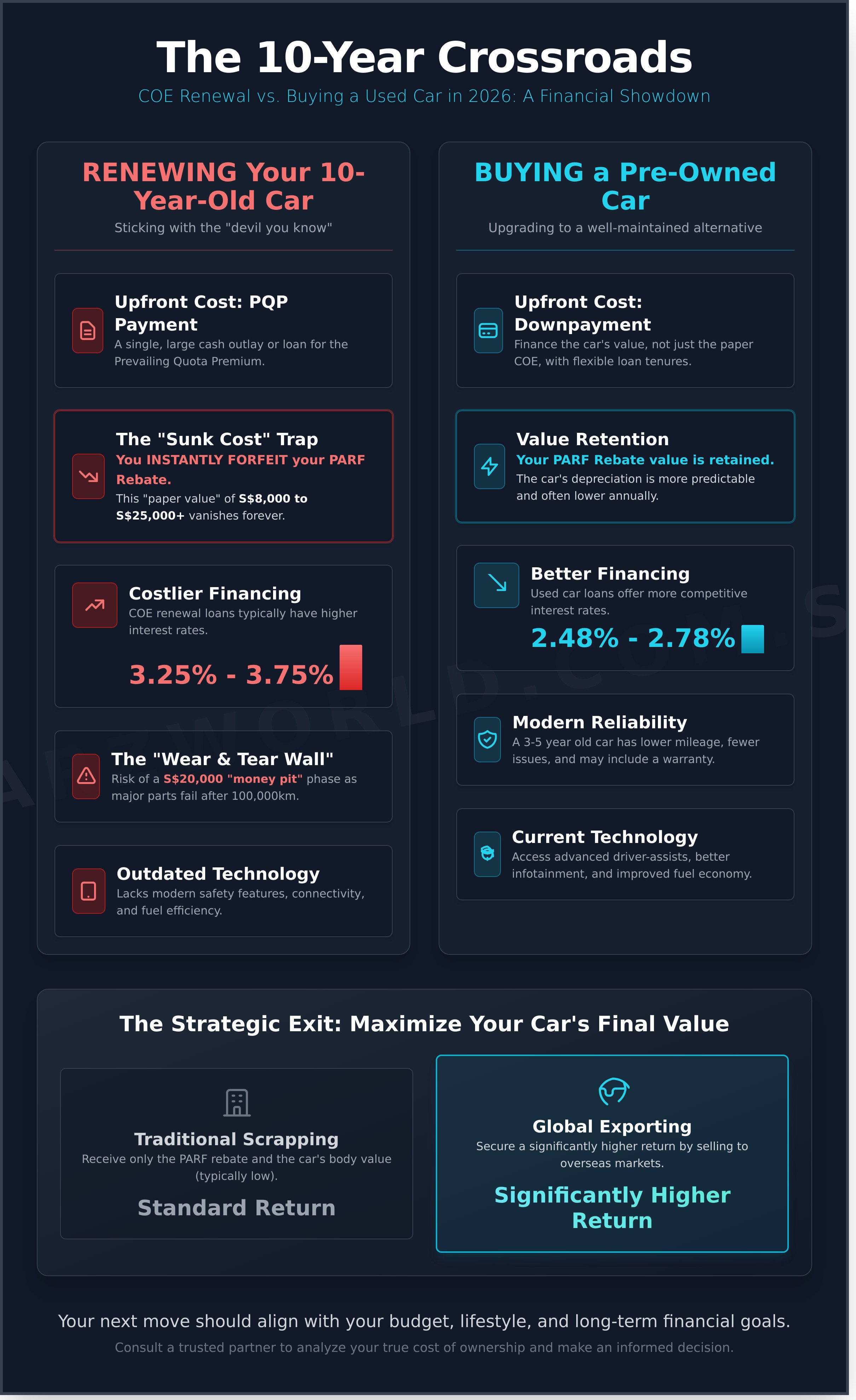
Renewing your COE involves paying the PQP, which is the moving average of COE prices over the last 3 months. You can choose a 5-year or 10-year renewal. A 5-year renewal costs half the PQP but comes with a major restriction: you cannot renew the car again after that period. A 10-year renewal allows for subsequent renewals as long as the car remains roadworthy. One critical detail is the immediate loss of the PARF rebate. When you renew, you forfeit the paper value of the car, which can range from S$8,000 to over S$25,000 for luxury models. This is a significant "sunk cost" that many owners overlook.
The Pre-Owned Market Advantage in 2026
The used car market in 2026 offers better value than it did just five years ago. A large inventory of vehicles from the 2021 to 2023 period is now entering the secondary market. These cars feature modern safety tech and better fuel efficiency than 10-year-old models. Buyer confidence has also grown due to the rise of certified pre-owned programs. These programs provide professional inspections and warranties that mimic the new car experience. At Carz World Pte Ltd, we maintain a selection of high-quality used cars for immediate delivery. This allows you to avoid the long waiting lists often found at new car showrooms while still upgrading your driving experience. Choosing a well-maintained 3-year-old car often results in lower annual depreciation compared to the high PQP costs of a 10-year renewal.
- PQP Volatility: Prices change monthly, making timing essential.
- Maintenance: Older cars require more frequent parts replacements.
- Tech Gap: 2026 pre-owned cars offer superior connectivity and safety.
Deciding on COE renewal vs buying used car requires a methodical look at your lifestyle and budget. If you drive a low-mileage car that is in pristine condition, renewal might make sense. However, for most drivers, the secondary market provides a more dependable and modern alternative without the risk of losing your PARF rebate entirely.
The Cold Hard Cash: A Financial Comparison
Deciding between COE renewal vs buying used car requires looking past the monthly installment. You've got to calculate the total cost of ownership, starting with the Prevailing Quota Premium (PQP). According to recent trends in COE renewal, more drivers are opting to keep their current rides despite high PQP prices. However, many overlook the "sunk cost" of the PARF rebate. When you renew your COE, you immediately forfeit the Preferential Additional Registration Fee (PARF) rebate you'd have received if you scrapped the car at the 10-year mark. If your car has a S$10,000 PARF value, that's an invisible S$1,000 added to your annual depreciation over a 10-year renewal.
Loan structures also differ significantly. For 2026, expect COE renewal loans to carry interest rates between 3.25% and 3.75%, whereas used car financing usually stays lower, around 2.48% to 2.78%. Financing a renewal often requires a shorter tenure, typically up to seven years, which can lead to higher monthly outflows than a longer-term used car loan. Insurance is another factor. Once a car crosses the 10-year threshold, premiums don't always drop. Many insurers view older vehicles as higher risks for mechanical failure or parts scarcity, which keeps premiums stagnant or even increases them compared to a five-year-old vehicle.
Depreciation Case Study: Renewing a 2016 Altis vs. Buying a 2021 Model
Let's look at the numbers over a five-year horizon. Renewing a 2016 Toyota Altis with a S$95,000 PQP and a lost PARF rebate of S$8,500 results in a five-year prorated cost of S$51,750. In contrast, buying a 2021 Altis for S$132,000 and selling it five years later for an estimated S$62,000 creates a cost of S$70,000. While the newer car has a higher ARF and better future resale value, the upfront depreciation is steeper. Upgrading to the 2021 model costs you roughly S$304 more every month than sticking with your renewed 2016 ride.
Hidden Costs of Ownership
Older cars come with government-mandated surcharges that eat into your savings. Your road tax increases by 10% each year after the tenth year, peaking at a 50% surcharge by year 15. For a 1.6L engine, your annual tax of S$744 eventually climbs to S$1,116. You also face mandatory LTA inspections every single year instead of every two years. We recommend setting aside a S$2,000 annual maintenance contingency fund for cars over 10 years old. This covers aging components like cooling systems, engine mountings, and suspension bushings that typically fail during the second COE cycle. If you're unsure about your current car's health, you can request a professional valuation to see if renewal makes sense for your specific vehicle.
Ultimately, the choice between COE renewal vs buying used car hinges on your tolerance for maintenance and your long-term budget. A renewed car offers lower "paper" depreciation, but the rising road tax and repair needs close the gap quickly. If your current vehicle has been meticulously maintained, renewal is a thrifty move. If it's already showing signs of fatigue, the reliability of a younger used car often justifies the higher monthly price tag. Be sure to run these numbers based on your specific PARF value and current PQP rates before signing any papers.
Reliability and Technology: Why the 'Devil You Know' Might Fail You
A common misconception among Singaporean car owners is that a decade of trouble-free driving guarantees future reliability. If your car hasn't broken down in 10 years, you might feel confident about renewing your COE. However, mechanical components don't age linearly. Most vehicles hit a "wear and tear wall" between the 100,000km and 120,000km mark. This is the point where the engineered lifespan of major systems typically expires, regardless of how well you've maintained the exterior.
When weighing COE renewal vs buying used car, you have to account for the sudden failure of high-ticket items. A 2014 sedan might seem immortal, but by year 12, the aircon compressor, alternator, and cooling system often require total replacement. Replacing a gearbox can cost between S$4,000 and S$7,500 depending on the make and model. These aren't just maintenance costs; they are "off-the-road" risks that disrupt your daily commute and family logistics for weeks at a time.
Fuel economy is another hidden cost of keeping an older vehicle. A 2016 petrol-driven car might average 12km/L. In contrast, a 2021 hybrid from the used market, such as a Toyota Prius or Hyundai Ioniq, easily achieves 22km/L to 25km/L. With petrol prices frequently hovering around S$2.80 per litre for 95-octane, a newer used car can save you over S$1,500 annually in fuel alone if you drive 15,000km a year. Over a five-year period, that's S$7,500 back in your pocket.
The Maintenance Nightmare: Parts Availability in 2026
Global supply chains have shifted focus toward electric vehicle components and current-generation models. By 2026, finding OEM parts for a 12-year-old vehicle will become increasingly difficult and expensive. We've seen owners wait 14 to 21 days for simple sensors or specialized suspension bushings. This "off-the-road" time is a significant hidden cost in the COE renewal vs buying used car debate, as you'll likely spend hundreds on private hire cars while your vehicle sits in the workshop.
Tech and Safety Upgrades You Can't Ignore
Safety standards took a massive leap between 2016 and 2021. Older cars rely mostly on passive safety, which protects you during a crash. Modern used cars feature active safety like Lane Departure Warning and Autonomous Emergency Braking (AEB). Data from Euro NCAP shows that AEB can reduce rear-end collisions by 38 percent. Beyond safety, having integrated Apple CarPlay or Android Auto as a standard feature significantly improves daily quality of life, allowing for seamless navigation and hands-free communication without the clutter of third-party phone mounts.
Choosing a newer used car isn't just about the aesthetics. It's about securing a vehicle that utilizes the latest engineering to keep your family safer and your monthly running costs lower. At Carz World, we ensure our pre-owned inventory meets strict quality standards so you don't inherit someone else's repair bill. We focus on providing high-quality, well-maintained vehicles that offer a seamless transition from your current ride.
The Strategic Exit: Exporting vs. Scrapping
When your vehicle reaches its ninth year, you face a critical financial crossroad. You must decide if the path of COE renewal vs buying used car makes more sense for your lifestyle. Many Singaporean drivers assume that once a car hits the ten-year mark, its only destination is a local scrapyard. This assumption often leads to leaving thousands of dollars on the table. Your car is an asset that retains significant value in the global market, even if its time on Singapore roads is coming to an end.
A local scrap yard primarily values your car based on the weight of its metal. In contrast, the export market values the vehicle's brand, engine health, and spare part potential. Carz World operates an extensive global network that connects your car to buyers in regions where right-hand drive vehicles are in high demand. We often secure prices that are S$1,500 to S$4,000 higher than what a typical scrap yard offers. This extra cash isn't just a small bonus; it serves as a substantial down payment for your next vehicle, significantly lowering your future monthly installments.
Timing your exit is the secret to maximizing these returns. Most owners wait until the final week before their COE expires to take action. This is a mistake. By then, you're forced to accept whatever price is offered. The "sweet spot" usually occurs around the 9-year and 6-month mark. At this stage, your car still has "life" left on the paper, making it more attractive to international dealers who need time to process the shipment and resale.
How the Export Process Works
The difference between local body value and international demand is stark. While a local dealer might offer a few hundred dollars for the "body," international buyers in markets across Africa or Southeast Asia seek specific Singaporean models. Vehicles like the Toyota Corolla Altis, Toyota Vios, and Honda Civic command a premium because of their legendary reliability and the high maintenance standards typical of Singaporean owners. We recommend that you sell or export your cars through professional channels to ensure you're tapping into these high-value markets rather than settling for scrap rates. Our team handles the complex paperwork and LTA documentation, making the transition effortless for you.
Maximizing Your PARF Rebate
Understanding the math of deregistration is vital for any owner. If you choose not to renew your COE, you're entitled to the Preferential Additional Registration Fee (PARF) rebate. This rebate is a percentage of the ARF you paid when the car was first registered. For most cars, deregistering at the 9-year mark grants you a 50% PARF rebate. For a car with an ARF of S$35,000, that's a guaranteed S$17,500 back from the government. You can check your current status via the OneMotoring website to see the exact breakdown of your COE and PARF rebates. Strategic timing at 9 years and 6 months allows you to capture this high rebate while the car still holds peak export value. This double-win provides the strongest financial foundation for your next purchase.
Deciding between COE renewal vs buying used car requires a clear look at these exit numbers. If your car's export value and PARF rebate combined exceed S$20,000, it's often more logical to take the cash and upgrade. Our consultants provide transparent valuations to help you see exactly how much equity is sitting in your driveway right now.
Ready to see what your car is truly worth in the global market? Talk to our export experts today for a non-obligatory valuation.
Conclusion: Making the Right Move for Your Lifestyle
Deciding between COE renewal vs buying used car isn't just a math problem; it's a lifestyle choice that impacts your daily peace of mind. While the Prevailing Quota Premium (PQP) fluctuates monthly, your car's mechanical health is a constant factor you can't ignore. We've seen owners spend S$12,000 on a 10 year old engine overhaul only to have the transmission fail six months later. This is why a professional valuation is the first step you should take. Our team at Carz World provides a transparent, honest assessment to help you see if your current asset is a keeper or a ticking financial clock. We believe in providing the data you need to make an informed choice without any pushy sales tactics.
Transitioning to a different vehicle doesn't have to be a headache. We focus on making the trade-in and financing process a seamless and pleasant one for every driver. Whether you're looking for a high quality pre-owned model or exploring flexible loan options that fit your monthly budget, our consultants like Ryan and Adam are here to provide patient, expert advice. Don't let inertia keep you in a depreciating asset that's costing you more in maintenance than it's worth in utility. A fresh start often leads to lower long-term costs, better safety features, and much higher reliability on the road. It's about finding the balance between what you love to drive and what makes financial sense for your future.
When You Should Definitely Renew
Renewal makes sense if your car has exceptionally low mileage, perhaps under 80,000km over a full decade, and has been kept in pristine condition. If you own a rare continental model or a specific performance car where a modern equivalent costs upwards of S$280,000, renewing the COE is often the only way to keep that specific driving experience within reach. It's also a practical path if your short-term budget is extremely tight and you can't manage the 30% or 40% down payment required for a newer vehicle purchase in the current high-COE climate. If your car has sentimental value and a clean bill of health from a trusted mechanic, staying the course can be a valid emotional and financial move.
Why a Used Car is Often the Smarter 2026 Choice
Looking ahead to 2026, a used car often presents a significantly lower risk profile for most Singaporean families. You can secure a vehicle that's still under its original agent warranty or one that has passed a rigorous certified inspection. Newer models offer much better fuel economy; many drivers find they can move from an older car doing 10km/L to a modern hybrid achieving 22km/L or more. This translates to thousands of dollars saved at the pump over the next few years. Lower road tax on newer, more efficient engines also helps reduce your annual overhead. If you're ready to move on from your current car, you can also browse our latest brand new cars to see if a fresh registration fits your lifestyle better than the used market.
Ultimately, the choice of COE renewal vs buying used car comes down to your risk tolerance and your 5 year plan. If you value predictable costs and modern technology, switching is usually the right move. If you have a well-maintained vehicle with low running costs, renewal might serve you well. Whatever you decide, Carz World is here to ensure the process is professional, methodical, and tailored to your needs. Talk to us today to get a fair valuation of your current car and explore your options for a better driving experience.
Navigate Your 2026 Motoring Transition with Confidence
Deciding on COE renewal vs buying used car requires a careful look at your vehicle's health and your long-term budget. While renewing keeps you in a familiar seat, the rising cost of parts for older models often makes a high-quality pre-owned vehicle the smarter financial move. Modern used cars offer better fuel efficiency and safety tech that older engines simply can't match. It's about choosing the path that offers the most reliability for your daily commute through Singapore's changing landscape.
Carz World is here to make this transition seamless. With over 1,000+ satisfied customer reviews, we've built a reputation for being a dependable partner in the local automotive market. Our expert export services are designed to help you maximize your car's value, ensuring you don't leave money on the table. Whether you want a thorough assessment or a fresh ride, visit our convenient Ubi and Alexandra showrooms for professional, honest advice. Talk to us at Carz World for a professional COE evaluation and car valuation today!
Your next chapter on the road should be exciting and stress-free. We look forward to helping you make the right move for your lifestyle.
Frequently Asked Questions
Is it better to renew COE for 5 or 10 years?
A 10-year renewal is generally the better choice if you plan to keep the vehicle long-term because it allows for subsequent renewals. If you choose a 5-year renewal, you're legally required to scrap the car at the end of that period with no option to extend it further. Most drivers find the 10-year option more cost-effective as it preserves the car's future lifespan and resale potential.
Can I still get a car loan for a COE-renewed car in 2026?
Yes, you can still secure financing for a COE-renewed car in 2026 through various bank and in-house loan schemes. Most financial institutions offer loans that cover the remaining tenure of the new COE, usually with interest rates between 3.25% and 4.5%. Our team at Carz World provides professional guidance to help you find the most competitive rates for these specific vehicle types.
What happens to my PARF rebate if I renew my COE?
You'll lose your entire Preferential Additional Registration Fee (PARF) rebate the moment you choose to renew your COE. This rebate, which can range from S$5,000 to over S$25,000 for high-OMV cars, is forfeited to the state in exchange for the right to keep the car on the road. When weighing COE renewal vs buying used car, it's vital to include this lost cash value in your total cost calculations.
How much is the road tax surcharge for a car older than 10 years?
The road tax surcharge starts at 10% of the base rate once a car passes the 10-year mark and increases by 10% every year. This annual increase continues until it hits a maximum cap of 50% in the 14th year of the car's life. For a 1.6L engine with a base tax of S$744, you'll end up paying S$1,116 annually once the full 50% surcharge applies.
Is it difficult to sell a car that has already had its COE renewed?
Selling a renewed COE car isn't difficult because there's a consistent demand for affordable transport options in Singapore. These vehicles are popular with new drivers or those looking for a short-term transport solution without a heavy financial commitment. We've seen that well-maintained models with at least 3 years of COE remaining typically find buyers within 14 to 21 days on the market.
How do I calculate the PQP for my car's renewal?
You calculate the Prevailing Quota Premium (PQP) by taking the moving average of the COE prices from the last three months. This involves averaging the results of the previous six bidding rounds to determine the current month's renewal cost. Because these figures change every month, it's helpful to monitor the bidding trends or use our online tools to get an accurate, up-to-date figure for your renewal.
What is the 'body value' of my car when I scrap it?
The body value represents the cash price an exporter or scrap yard pays for the vehicle's physical materials and salvageable parts. For a standard Toyota Corolla, the body value might be around S$500 to S$1,000, while luxury European models or popular export SUVs can fetch over S$3,000. This is the only money you'll receive if your COE has expired and your PARF rebate is already forfeited.
Should I buy a used hybrid or a renewed petrol car in 2026?
A used hybrid is the smarter choice for high-mileage drivers who can benefit from fuel savings of roughly 25% to 35% compared to petrol models. However, you should set aside a maintenance fund of S$3,000 to S$5,500 for a potential battery replacement if the car is older than 8 years. A renewed petrol car offers simpler maintenance and a lower purchase price but will result in higher monthly fuel expenses.
In Same Category
- COE Price Trend Analysis 2026: Is Now the Best Time to Buy a Car in Singapore?
- Japanese and Korean Cars in Singapore: The Ultimate 2026 Buying Guide
- What Affects Car Resale Value in Singapore? A 2026 Guide to Maximising Your Return
- Car Valuation Certificate in Singapore: Your Complete Guide to Official Vehicle Worth
- Selling a Car with an Outstanding Loan in Singapore: The 2026 Complete Guide