Low Depreciation Cars in Singapore 2026: The Smart Buyer’s Guide

What if the most expensive car on the showroom floor actually costs you less over five years than the "budget" alternative? In a market where COE premiums can swing by S$30,000 in just three months, many drivers find that high monthly installments don't always tell the full story. You've likely felt the frustration of seeing your car's value plummet while your loan remains stubbornly high. It's a common struggle because finding low depreciation cars singapore requires looking past the sticker price and into the complex world of ARF and OMV math.
We understand that you want a vehicle that serves your family without bleeding your savings dry. This guide clears the confusion between PARF and ARF rebates, helping you master the specific calculations that define true ownership costs. You'll discover exactly which models are projected to retain the most value in 2026. We've analyzed the latest market data to provide a clear list of reliable, high-resale value cars so you can make your next purchase with absolute confidence.
Key Takeaways
- Master the unique Singaporean formula for calculating annual depreciation to uncover the true cost of ownership beyond the initial sticker price.
- Discover which specific low depreciation cars singapore drivers should prioritize in 2026, featuring high-retention models from Toyota and Honda.
- Learn the "Golden Rule" of car age and why the fourth year often represents the perfect balance between price and remaining value.
- Gain the technical edge by learning how to calculate PARF rebates and verify a vehicle's "Paper Value" before committing to a purchase.
- Understand how a transparent, math-driven approach to car buying ensures your next vehicle aligns with your long-term financial goals.
Understanding Car Depreciation in the Singapore Context
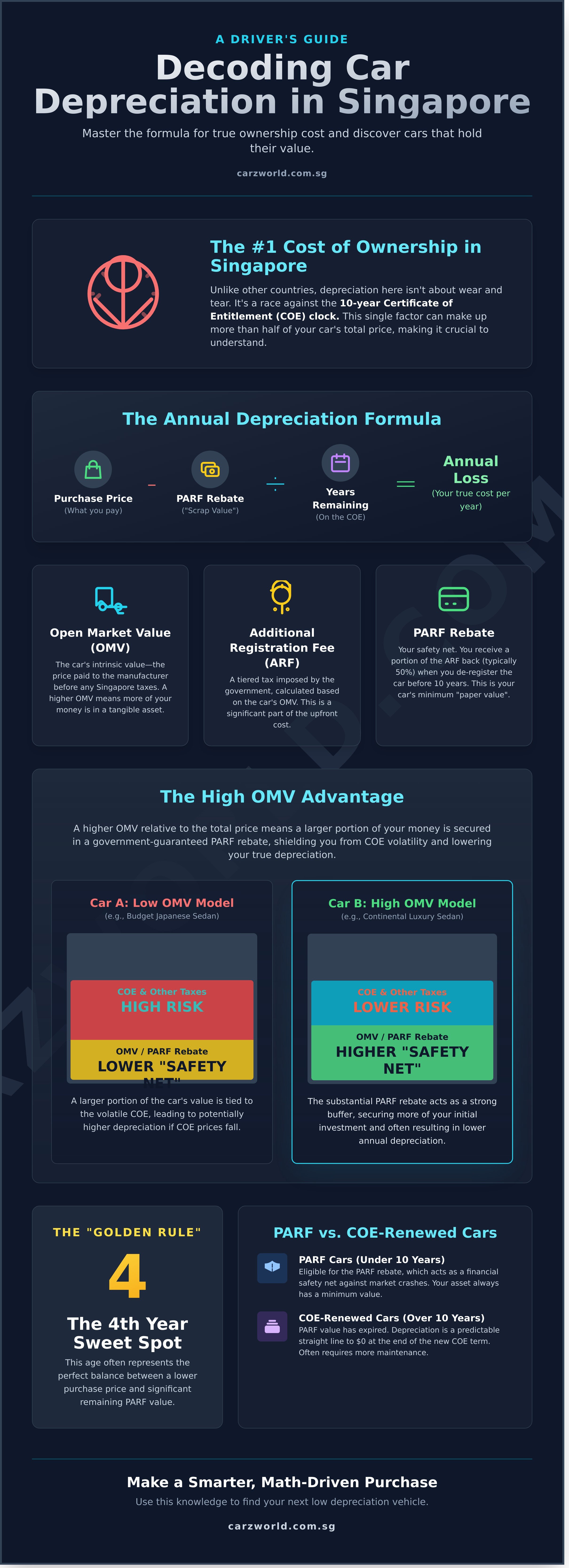
Depreciation is the single largest cost of vehicle ownership in Singapore. It represents the annual amount you lose over the 10-year statutory lifespan of your vehicle. Unlike other markets where wear and tear drive value loss, Singapore's system is tied directly to the ticking clock of the Understanding the Certificate of Entitlement (COE). Every year that passes reduces the remaining value of that certificate, which often makes up more than half of the car's total price.
To calculate this accurately, you need a specific formula. You take the total purchase price, subtract the minimum PARF rebate you get at the end of 10 years, and divide that figure by the remaining years of the COE. This gives you a clear yearly figure. In the current market, finding low depreciation cars singapore requires looking closely at the Open Market Value (OMV). The OMV acts as a buffer because it determines your PARF rebate. A car with a high OMV provides a higher "scrap value" at the end of its life, which can effectively lower your annual depreciation even if the upfront cost is higher.
To better understand this concept, watch this helpful video:
Current depreciation rates are heavily influenced by the 2026 COE supply cycle. Many cars registered during the 2016 peak will reach their 10-year limit in 2026, which is expected to increase the supply of COEs and potentially stabilize prices. Owners buying now must factor in how these future supply shifts will impact their car's resale value in three to five years. If COE prices drop significantly in 2026, cars bought at today's record highs of S$100,000 or more will face much steeper depreciation hits.
The Difference Between Depreciation and Cash Flow
Many buyers confuse low depreciation with low monthly costs. A car might lose only S$12,000 in value per year, but your monthly loan installments could still be very high. This happens because of the Monetary Authority of Singapore (MAS) 70% Loan-to-Value (LTV) rule. For a car priced at S$160,000, you must pay at least S$48,000 as a cash downpayment. Your cash flow is about the money leaving your bank account each month, while depreciation is the long-term loss of equity. A paper loss is the theoretical drop in your car's market value while you still own it, whereas a realized loss only happens when you actually sell the vehicle and lock in that deficit.
PARF vs. COE Cars: Which Depreciates Faster?
PARF cars are vehicles under 10 years old that are still eligible for the Preferential Additional Registration Fee (PARF) rebate. This rebate is usually 50% of the ARF (Additional Registration Fee) paid. It acts as a safety net, ensuring the car always has a minimum "paper value." In contrast, COE-renewed cars have already seen their PARF value expire. They depreciate in a "straight-line" manner, where the value hits zero at the end of the new 5 or 10-year COE term.
- Safety Net: PARF rebates protect you if the resale market crashes.
- Predictability: COE cars offer fixed, lower depreciation but require more maintenance.
- The Continental Factor: High-OMV continental cars, such as a Mercedes-Benz E-Class with an OMV of S$55,000, can sometimes offer better value retention than budget Japanese models with an OMV of only S$18,000.
When searching for low depreciation cars singapore, looking at the OMV to price ratio is essential. A car with a high OMV relative to its total price often represents a safer financial bet because a larger portion of your money is "locked" in a government-guaranteed rebate rather than being lost to COE volatility.
The Math of Value: OMV, ARF, and PARF Rebates
Understanding the financial skeleton of a vehicle is vital for identifying low depreciation cars singapore. The Open Market Value (OMV) serves as the foundation. It's the actual price paid to the manufacturer, including freight and insurance, before any local taxes apply. Think of it as the car's true intrinsic value. When you buy a car with a high OMV, you're essentially putting more money into a tangible asset that retains value better than the taxes stacked on top of it. It's the "real" part of your investment that doesn't simply vanish the moment you drive off the showroom floor.
The Preferential Additional Registration Fee (PARF) rebate is the most significant safety net for your investment. If you deregister your car before it hits the 10-year mark, the government returns a portion of the ARF you paid. Under the current PARF rebate system, you'll receive 50% of your ARF back if you scrap the car at exactly 10 years. This "paper value" acts as a floor for your car's resale price. It ensures that even if the market for your specific model softens, the car still holds a guaranteed minimum value in the eyes of the Land Transport Authority. This rebate is why cars with high ARF components often seem to have a higher "scrap value" at the end of their COE life.
Seeking the "Sweet Spot" usually leads savvy buyers to the 3 to 5-year-old range. During the first 24 months, a new car's value can drop by as much as 30% due to the immediate loss of its "brand new" status. By choosing used cars that have already survived this initial plunge, you let the first owner absorb the heaviest hit. You get a modern vehicle with updated safety features and technology, but your annual depreciation is significantly lower because the remaining value is closely tied to the PARF rebate and the prevailing Certificate of Entitlement (COE) prices.
Case Study: Toyota Corolla Altis vs. BMW 3 Series
Comparing a mass-market sedan like the Toyota Corolla Altis (OMV approx. S$25,000) to a luxury BMW 3 Series (OMV approx. S$55,000) reveals how the ARF floor impacts your wallet. The BMW faces tiered ARF rates, where the portion of OMV above S$40,000 is taxed at 190% or more. This means the BMW's upfront cost is heavily weighted toward taxes rather than the machine itself. Over a 5-year ownership period, the Altis generally keeps more capital. Its annual depreciation might sit around S$13,500, while the BMW could easily lose S$24,000 annually. For those prioritizing low depreciation cars singapore, the economy model often wins because its tax-to-value ratio is much healthier.
The Impact of COE PQP on Used Car Prices
The Prevailing Quota Premium (PQP) is the 3-month moving average of COE prices, and it dictates the cost of renewing a car's lifespan for another 5 or 10 years. If you buy a used car when COE is high, your vehicle remains a valuable asset as long as COE prices stay elevated. However, there's a risk of "negative equity." If you purchase a car with a high COE component and prices crash by S$30,000 the following year, your car's market value will drop instantly. This can leave you owing the bank more than the car is worth on the open market. If you're unsure about the current market timing, you can request a quote for a professional valuation of your current vehicle to see where you stand.
Top Low Depreciation Cars in Singapore for 2026
Finding low depreciation cars singapore requires looking at market data from the past 24 months. Toyota and Honda continue to lead the pack because their parts are easily accessible and their engines are built to last. For instance, a 2024 Toyota Corolla Altis typically retains 65% of its value after three years of ownership. This is significantly higher than the industry average of 50% to 55% seen in other brands. Buyers in 2026 prioritize reliability above all else, which keeps the secondary market for these Japanese workhorses extremely competitive.
Japanese Reliability and Resale Kings
The Toyota Prius and Honda Fit remain the gold standard for value retention. Their popularity in the private-hire vehicle (PHV) sector creates a constant floor price. Since fleet operators and individual drivers always need these fuel-efficient models, they rarely sit on dealer lots for more than 14 days. You can often find a price advantage by looking at brand new cars through parallel importers. These models often come with a different Open Market Value (OMV) compared to authorized dealer units. A lower OMV usually translates to lower annual depreciation, making the car more attractive when you eventually decide to sell.
High demand for the Honda Fit, especially the 1.3L and 1.5L e:HEV variants, stems from its versatility. In 2026, used car buyers are willing to pay a premium for cars that offer low running costs. This demand directly offsets the natural loss in value over time. If you choose a model with a proven track record in the PHV market, you're essentially buying into a liquid asset that's easy to exit.
Not all European cars lose value quickly. The Mercedes-Benz GLA and BMW X1 are notable exceptions to the "Continental depreciation" rule. These entry-level luxury SUVs are highly sought after by young professionals in Singapore. A 2025 GLA 180 might only see an annual depreciation of S$16,000 to S$18,000. Larger luxury sedans often lose over S$25,000 yearly in the same period. The compact size and brand prestige of these models ensure they remain a top choice for those moving up from Japanese brands.
The New Era: Low Depreciation EVs and Hybrids
The Toyota Sienta Hybrid is the current value king for Singaporean families. It offers a low entry price and high utility with its seven-seat configuration. Under the 2026 Vehicle Emissions Scheme (VES), many hybrids receive a S$15,000 or S$25,000 rebate. This rebate lowers the "effective" purchase price, which means the gap between the new price and the resale price is much smaller. This narrow gap is the secret to achieving low depreciation cars singapore buyers love.
Battery health has become a primary factor for 2026 used car valuations. The BYD Atto 3 has surprised the market by holding 60% of its value after two years. This is largely due to the Blade Battery technology, which has shown minimal degradation in Singapore's tropical climate. Buyers now look for a battery health certificate during the handover process. If the battery remains above 92% capacity after three years, the car's resale value stays remarkably high. Choosing an EV with a reputable battery thermal management system is now just as important as choosing a car with a reliable engine.
Strategic Buying: How to Minimize Your Losses
Buying a car in Singapore isn't just about the monthly installment; it's about the exit strategy. If you want to own low depreciation cars singapore drivers recommend, you need to understand the 4th-year rule. New cars lose the most value the moment they leave the showroom, often dropping 20% to 25% in value within the first 24 months. By the 48th month, this steep curve flattens. You're buying a vehicle that has already shed its most expensive years but still retains 6 years of COE life, making it a professional and financially sound choice.
Before you commit, always check the car's 'Paper Value' on the LTA OneMotoring portal. This figure is the sum of the PARF rebate and the pro-rated COE balance. If a car's market price is S$90,000 and its paper value is S$55,000, your real financial exposure is only S$35,000. High-quality, well-maintained cars with a Full Agent Service History (FASH) typically command a premium of S$3,000 to S$5,000 over those with missing records. Buyers want proof that the car was cared for by experts, and they're willing to pay more for that peace of mind.
You should also consider the mileage. A car with under 10,000km clocked per year is a rarity in Singapore and can significantly boost resale value. Most dealers will look at the 60,000km or 80,000km major servicing milestones. If these are already completed and documented, it's a strong selling point that minimizes future losses for both you and the next owner.
Timing the Market: COE Cycles
The COE quota follows a predictable 10-year cycle. Since 2016 saw high registration volumes, the 2026 outlook suggests a significant increase in COE supply as those cars reach the end of their lifespan. This could lead to a correction in premiums for both Cat A and Cat B. When signing a purchase contract, ensure your COE rebate level is clearly stated. If the COE price at the time of registration is lower than your rebate level, the dealer should refund you the difference in cash. It's a simple, methodical way to protect your downside in a volatile market.
Selling for the Best Price
When it's time to upgrade, selling via consignment usually nets you 5% to 10% more than a standard dealer trade-in. Dealers need to factor in their own holding costs and profit margins, which often results in a lower offer for you. Consignment allows you to set a higher price while the car stays in your possession. Spend S$200 on professional paint touch-ups and a full interior grooming before valuation. These small fixes can increase your final sale price by S$1,500 or more. For cars hitting the 9.5-year mark, professional car exporters are your best bet. They often pay 15% above scrap value if the model is popular in overseas markets.
Ready to find a high-quality vehicle that holds its value? Talk to us at Carz World today for a seamless and pleasant experience.
Why Carz World is the Trusted Partner for Value-Driven Buyers
Finding the right vehicle in Singapore's high-cost market requires more than just a test drive; it requires a clear financial roadmap. At Carz World Pte Ltd, we've built our reputation on a "not-pushy" philosophy that prioritizes your long-term wealth over a quick sale. Our consultants understand that a car is a significant asset. They focus on your specific financial goals, helping you identify which low depreciation cars singapore drivers currently favor to minimize total cost of ownership. We take pride in being patient and helpful, ensuring you never feel pressured into a decision that doesn't align with your budget.
Transparency is the foundation of every transaction we handle. We don't just give you a monthly installment figure; we show you the math behind the depreciation. Our team breaks down the annual depreciation, scrap value, and PQP (Prevailing Quota Premium) projections so you know exactly what your daily cost of ownership looks like. This data-driven approach ensures you aren't surprised by hidden costs three or four years down the road. Our curated inventory of pre-owned cars consists only of high-quality, well-maintained vehicles that have passed rigorous mechanical inspections. We select cars that hold their value, protecting your capital for the future.
Beyond the car itself, we provide comprehensive support that simplifies the entire ownership cycle. This includes securing financing at competitive interest rates, which we coordinate through our network of trusted banking partners. We manage the entire handover process, ensuring every vehicle is professionally groomed and mechanically sound before you drive off the lot. Our goal is to make the transition into your next vehicle a smooth and pleasant experience from start to finish.
Proof-Based Professionalism
Our commitment to excellent service is documented by hundreds of satisfied customers. Sales consultants like Ryan and Carson are frequently praised in recent 2024 reviews for making the complex COE bidding and renewal process feel seamless. We handle the technicalities so you don't have to worry about paperwork errors. If you're looking to upgrade, our global export services provide a reliable exit strategy. Because Carz World Pte Ltd delivers cars worldwide, we can often offer better valuations for your older vehicle by tapping into international markets where demand remains high.
Your Next Steps to a Smarter Drive
Ready to make a move that makes financial sense? Start by requesting a free, no-obligation valuation for your current vehicle. We provide a fair, transparent offer based on real-time market data and local demand. Once you have your valuation, book a test drive for one of our top-rated low depreciation cars singapore models. Seeing the quality of our well-maintained fleet in person makes the decision easy. Our team is ready to show you how a smarter car choice can lead to better financial freedom. Talk to Carz World Pte Ltd today to find a car that fits your lifestyle and your bank account.
Drive Smarter with a High-Value Asset in 2026
Navigating the Singapore car market in 2026 requires a sharp eye on OMV and PARF rebates to protect your hard-earned capital. Choosing low depreciation cars singapore owners value ensures you aren't just buying a vehicle, but a stable financial asset. It's about more than just the initial sticker price; it's about the S$15,000 or S$20,000 you retain over the ownership cycle through strategic model selection. By focusing on high-quality builds and proven resale performers, you significantly reduce your total cost of ownership.
Carz World makes this entire journey seamless and transparent. We operate as a direct parallel importer for brand new models and provide expert consignment services to maximize your final sale price. Our reputation is backed by over 100+ 5-star customer testimonials that highlight our professional, non-pushy approach. We prioritize your long-term satisfaction by offering well-maintained vehicles that hold their worth. You deserve a car that works as hard for your wallet as it does for your daily commute.
Discover our latest high-value pre-owned cars at Carz World
Your next smart investment is ready for a test drive today.
Frequently Asked Questions
What is considered a 'good' annual depreciation in Singapore for 2026?
A good annual depreciation for a mass-market sedan in 2026 ranges between S$15,000 and S$17,000. This reflects current Certificate of Entitlement (COE) trends where Cat A premiums consistently hover above S$80,000. If you find a well-maintained vehicle with a depreciation rate below S$14,500, it's an exceptional value in the current market. Higher-end continental models typically see rates exceeding S$25,000 per year.
Does a higher OMV always mean lower depreciation?
A higher Open Market Value (OMV) doesn't guarantee lower depreciation; it often results in higher annual costs. While a high OMV increases your PARF rebate at the end of 10 years, the initial purchase price and Additional Registration Fee (ARF) are also significantly higher. For example, a car with a S$40,000 OMV might lose S$20,000 yearly, while a S$20,000 OMV car loses only S$15,000.
Is it better to buy a brand new car or a 5-year-old used car to save on depreciation?
Buying a 5-year-old used car is generally better for saving on depreciation because the steepest value drop occurs in the first 36 months. A new car can lose 20% of its value the moment it leaves the showroom. By choosing a high quality 5-year-old vehicle, you avoid that initial hit and benefit from a more linear depreciation curve over the remaining five years of the COE.
How does the VES rebate affect my car's resale value later on?
The Vehicular Emissions Scheme (VES) rebate reduces your car's ARF, which directly lowers its future scrap value. If you receive a S$15,000 VES rebate, your PARF rebate at the 10-year mark is based on that reduced ARF amount. This means your resale price might be lower compared to a car without the rebate, as the "paper value" is smaller when you sell.
Can I really save money by switching from an ICE car to a Hybrid?
You'll save approximately S$2,000 to S$3,500 annually on fuel and taxes by switching to a Hybrid. Hybrids are currently some of the most popular low depreciation cars singapore buyers look for due to their high fuel efficiency of 20km/L or more. Their strong demand in the second-hand market helps maintain a higher resale price compared to traditional internal combustion engine vehicles.
What happens to my depreciation if COE prices drop significantly after I buy?
Your paper depreciation remains fixed at the price you paid, but your car's market value will drop if COE prices fall. If COE premiums decrease by S$20,000, new cars become cheaper, forcing you to lower your asking price to stay competitive. This doesn't change your monthly loan installments; it just means you'll realize a larger loss if you sell before the 10-year mark.
Why do Toyota cars seem to have the lowest depreciation in Singapore?
Toyota cars maintain low depreciation because of their reputation for reliability and a massive export market demand. Models like the Corolla Altis often retain 50% of their value after five years, which is higher than many European counterparts. Since parts are affordable and the engines are durable, there's always a pool of buyers ready to pay a premium for a used Toyota.
Is it worth renewing COE for another 10 years, or should I buy a new car?
Renewing your COE for 10 years is often the more professional financial choice if your car's maintenance costs stay below S$3,000 annually. You only pay the Prevailing Quota Premium (PQP) and avoid the high ARF and dealer margins of a new car. However, if your car requires frequent major repairs, the reliability of a new model might justify the higher S$18,000 annual depreciation.
In Same Category
- Find reliable low maintenance second hand cars in Singapore by mileage
- Car Trade-In Services in Sengkang for Comparing Offers
- Car Loan Hidden Fees: Which Application and Setup Charges Are Reasonable
- What to Do If Your Car Loan Is Rejected and Find Options
- Sell My Car Fast in Punggol: A Practical Guide