What to Look for When Buying a 2nd Hand Car in Singapore (2026 Guide)
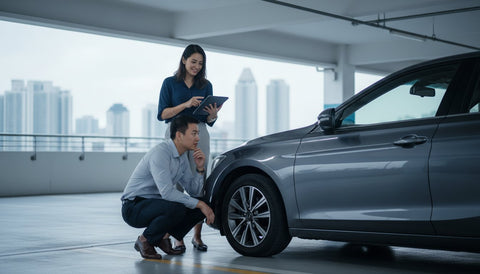
In 2026, the lowest price tag on a used car in Singapore often leads to the highest long-term cost. It's natural to feel a bit of anxiety when browsing listings; nobody wants to inherit someone else's mechanical headaches. You're likely looking for a reliable daily driver that offers fair depreciation value, but the complexity of COE cycles and the fear of hidden faults can make the process feel overwhelming.
We believe car shopping should be a seamless and pleasant experience. This guide will teach you exactly what to look for when buying a 2nd hand car so you can shop with the confidence of a seasoned pro. We'll show you how to navigate the 2026 market with ease. You'll learn how to master the math behind PQP and depreciation, identify mechanical red flags that even "clean" cars might hide, and ensure every transaction is transparent. From checking the chassis to understanding service histories, we've compiled everything you need to secure a high quality vehicle without the stress.
Key Takeaways
- Understand why annual depreciation is the most critical figure to calculate when navigating the unique costs of the Singapore car market and COE cycles.
- Learn exactly what to look for when buying a 2nd hand car by identifying subtle physical red flags like uneven panel gaps and engine oil leaks.
- Master the test drive by knowing how to detect rough idles and transmission jerks that could signal hidden mechanical issues.
- Discover how to verify ownership history through the OneMotoring portal and why a complete service booklet is essential for a high-quality purchase.
- Evaluate the benefits of buying from a professional dealer to ensure you are protected by Singapore’s Lemon Law and enjoy a seamless financing process.
The 'Singapore Math': Evaluating Paper Value and Depreciation
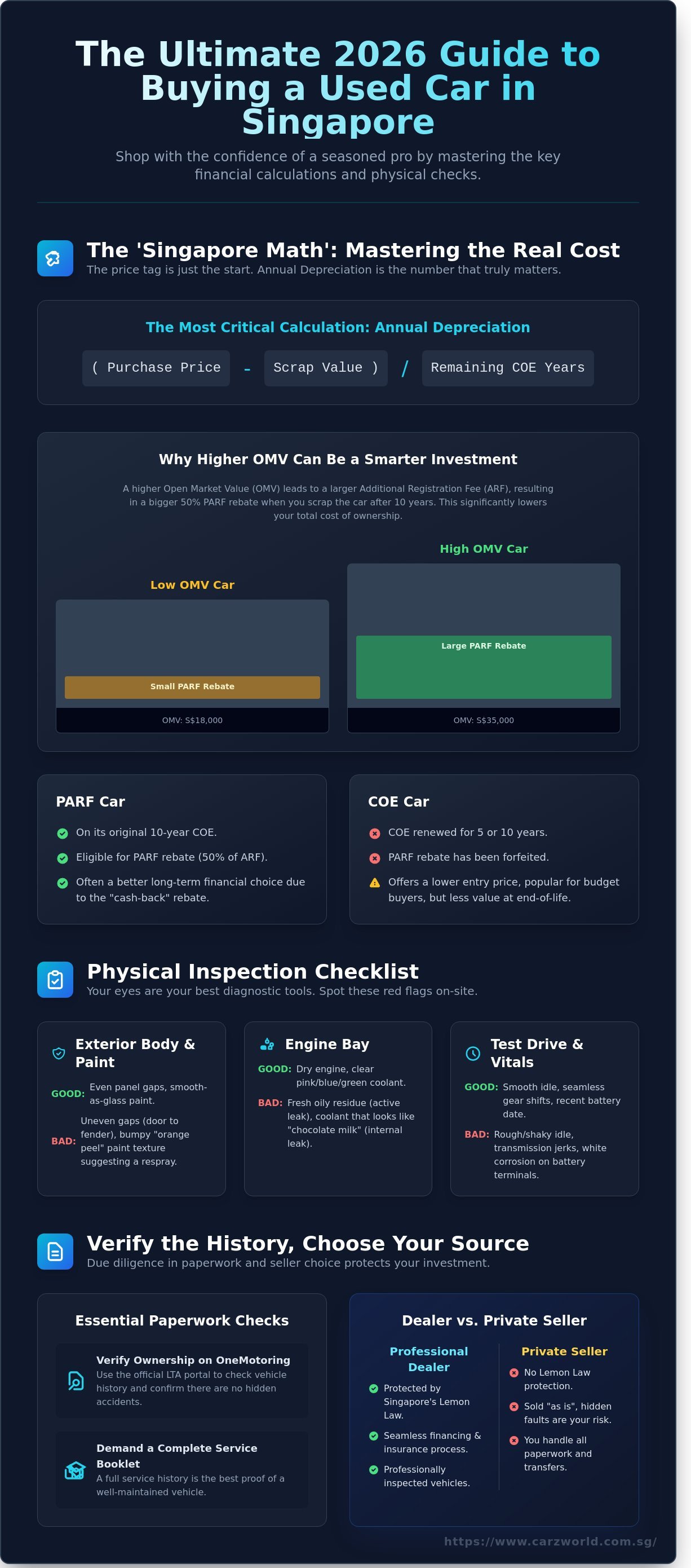
In Singapore, the price tag on a car's windscreen only tells half the story. To truly understand the cost of ownership, you must master the "Singapore Math." The most critical figure you'll encounter isn't the total sale price, but the Annual Depreciation. This number represents the actual amount you lose every year after accounting for the car's scrap value. It's the ultimate benchmark for comparing different models. When researching what to look for when buying a 2nd hand car, professional buyers prioritize this figure over everything else. It's a simple calculation: subtract the projected scrap value from the purchase price and divide the result by the number of years remaining on the Certificate of Entitlement (COE).
The COE is the engine that drives the Singapore car market. It's a 10-year license that often costs as much as the vehicle itself. Because the COE has a fixed lifespan, every day that passes reduces the car's "paper value." You should always check vehicle history reports to confirm the registration date and ensure there are no hidden accidents that might compromise the car's structural integrity or future resale potential.
To better understand the physical aspects of an inspection alongside these financial calculations, watch this helpful video:
COE Balance: How many years are left?
You'll choose between a "PARF car" and a "COE car." A PARF car is still on its original 10-year COE and is eligible for the Preferential Additional Registration Fee (PARF) rebate. A COE car has had its COE renewed for another 5 or 10 years but has lost its PARF rebate eligibility. In 2026, cars with 5 years of COE left will be highly popular for budget buyers because they offer a lower entry price. However, buying a car with less than 24 months of COE remaining is risky. You face high immediate depreciation and the financial pressure of a "zero-value" asset if COE prices are at a peak when your renewal date arrives.
OMV and ARF: The hidden value
Open Market Value (OMV) is the price paid or payable for a vehicle imported into Singapore. This figure is vital because it determines your Additional Registration Fee (ARF), which is a tiered tax. The ARF rebate structure heavily incentivizes owners to scrap their cars exactly at the 10-year mark. At that point, you receive a 50% rebate of the ARF paid. This creates a "safety net" or a minimum cash-back value. When considering what to look for when buying a 2nd hand car, remember that a vehicle with a S$35,000 OMV is often a better long-term investment than one with a S$18,000 OMV. The higher OMV car provides a much larger guaranteed rebate at the end of its life, effectively lowering your total cost of ownership despite a higher upfront price.
Understanding these numbers ensures you aren't just buying a car; you're making a calculated financial decision. At Carz World Pte Ltd, we focus on transparency. We help you break down these complex figures so you can drive away with confidence. Our team ensures every "paper value" calculation is accurate and honest. This methodical approach is why our customers consistently recommend our professional service for a seamless buying experience.
Physical Inspection Checklist: Spotting Red Flags On-Site
When you arrive to view a vehicle, your eyes are your best diagnostic tools. Knowing exactly what to look for when buying a 2nd hand car can save you thousands in future repairs and give you the upper hand during price negotiations. Start with a slow walk around the vehicle in broad daylight. Look specifically for uneven panel gaps where the bonnet meets the fenders or where doors shut. A gap that is wider on the left than the right usually indicates a poor repair following a collision. Check the paint finish for "orange peel," which is a bumpy, textured surface that suggests a non-factory respray. High-quality factory paint should be as smooth as glass.
Next, pop the bonnet to inspect the engine's health. Look for fresh oily residue around the head gasket or the bottom of the engine bay. While a clean engine is nice, a suspiciously "detailed" engine bay might be a seller's attempt to wash away evidence of an active leak. Check the coolant reservoir; the fluid should be a clear pink, blue, or green. If it looks like chocolate milk, there is likely an internal engine leak. Don't forget the battery. Check the manufacturing date and look for white, powdery corrosion on the terminals. A battery older than 30 months is often nearing the end of its life in Singapore's humid climate.
The interior often tells a more honest story than the odometer. Inspect the driver's seat bolster and the steering wheel for excessive shine or cracking. If a car shows only 30,000km but the steering wheel leather is peeling and the pedal rubbers are worn smooth, the mileage may have been tampered with. Before committing to a purchase, it is also wise to look at the financial health of the deal. Understanding COE and PARF rebates helps you determine if the asking price is fair relative to the car's scrap value. If you'd rather skip the guesswork, you can always explore our certified pre-owned inventory where these checks are completed by experts before the car hits the showroom.
Finally, check the "shoes" of the car. Look for the four-digit DOT code on the tyre sidewall. For example, "1422" means the tyre was manufactured in the 14th week of 2022. We follow the 5-year rule: any tyre older than 60 months should be replaced immediately, as the rubber compounds harden and lose grip. Ensure the tread depth is at least 1.6mm, though 3mm is the recommended minimum for safety during heavy tropical downpours.
Signs of Past Accidents or Flooding
View the car under bright, natural sunlight to spot mismatched paint shades between panels. Open the boot and lift the floor cover to inspect the spare tyre well. Any signs of silt, fine sand, or a lingering musty smell are immediate red flags for flood damage. Look at the bolt heads inside the engine bay that hold the fenders in place. If the paint on these bolts is scratched or shows tool marks, the panels have been removed for repair or replacement.
Electronics and Air-Conditioning
In Singapore, the air-conditioning is non-negotiable. Perform the "Singapore Test" by turning the AC to its lowest temperature and maximum fan speed. It must reach a freezing temperature within 60 seconds. Test every single window switch, side mirror motor, and infotainment button. When you turn the ignition to the "on" position, ensure the ABS and engine warning lights illuminate briefly then turn off. If a light doesn't appear at all, a seller might have disconnected it to hide a persistent fault.
The Test Drive: How to Listen for Trouble
The test drive is your most effective tool for uncovering hidden mechanical issues. While a car might look pristine in a showroom, its true condition only reveals itself on the road. When considering what to look for when buying a 2nd hand car, you should always insist on a cold start. If the engine is already warm when you arrive, the seller might be hiding a struggling starter motor or a rough idle that only occurs at low temperatures. A healthy engine should settle into a steady idle around 800 to 1,000 RPM within 30 seconds without hunting or vibrating excessively.
Transmission health is another critical factor, especially in Singapore's stop-start traffic. During low-speed city driving, feel for any "jerks" or hesitation when the car shifts between first and second gear. An automatic gearbox should transition smoothly; any sudden lurching suggests a failing torque converter or worn clutch packs. For a broader perspective on buyer protections and standard checks, you can consult this FTC Guide to Buying a Used Car, which offers a professional framework for evaluating dealer inventory.
Suspension and braking deserve equal scrutiny. Use Singapore's numerous speed humps to your advantage. A "clunk" or "thud" as the front wheels crest a bump often indicates worn bushings or ball joints, repairs that can easily exceed S$600. When braking on a flat, quiet road, check if the car "pulls" to one side or if the pedal feels spongy. Vibrations felt through the steering wheel during deceleration usually point to warped brake rotors, which is a common issue in cars that have faced heavy urban usage.
Engine and Transmission Performance
Find a clear stretch of road, such as an entrance to the PIE or KPE, to test acceleration. The car should pick up speed linearly without "slipping," where the RPMs rise but the speed doesn't follow. Listen for a high-pitched "whining" noise from the gearbox, which often signals bearing wear. Keep a close eye on the rearview mirror for exhaust smoke. Blue smoke indicates the engine is burning oil, while thick white smoke suggests a coolant leak or a compromised head gasket, both of which are deal-breakers.
Handling and Steering Alignment
When understanding what to look for when buying a 2nd hand car, steering precision is non-negotiable. Find a safe parking lot and turn the wheel to full lock in both directions. A "clicking" sound while moving indicates failing CV joints. On a straight path, briefly loosen your grip on the wheel to see if the car tracks straight. If it drifts significantly to one side, the alignment is off or the tires are unevenly worn. Finally, bring the car up to 70-90 km/h to evaluate cabin noise levels. Excessive humming at these speeds often points to worn wheel bearings or poor-quality tires.
LTA Paperwork and Professional Third-Party Inspections
Getting the legal and technical paperwork right is just as vital as checking the engine. In Singapore, the Land Transport Authority (LTA) maintains a transparent system through the OneMotoring portal. You should always ask the seller to log in and show you the vehicle details on the spot. This confirms the car isn't a parallel import masquerading as an authorized agent unit. Understanding the administrative side is a key part of what to look for when buying a 2nd hand car.
Checking the "transfer count" is a critical step that many buyers overlook. A car with 4 owners in just 3 years is a major red flag; it suggests recurring mechanical issues that previous owners couldn't fix. Ideally, you want a vehicle with a low owner count relative to its age. This documentation is a vital component of what to look for when buying a 2nd hand car in Singapore to avoid inheriting someone else's headache.
Maintenance logs are your best friend during the negotiation. A complete service booklet from the authorized dealer or a reputable workshop proves the car received its 10,000km oil changes and 40,000km major servicing. If the logs have been missing for the last 24 months, you've got to assume the worst about the car's internal health. Transparent sellers will have these records ready to build trust.
The LTA Transfer Process
Before you sign any sales agreement, ensure the car is clear of outstanding financing. LTA won't allow a transfer if there's an active hire-purchase loan or unpaid traffic fines. The buyer typically pays a S$25 transfer fee to LTA via the portal. You must have valid motor insurance in your name before the transfer happens. If you're planning to sell your car to fund this new purchase, ensure your own paperwork is ready to avoid any handover delays.
Professional Evaluation Centres
A professional inspection is non-negotiable for serious buyers. Centres like STA or VICOM provide a comprehensive 120-point check that looks far deeper than a visual scan. An STA Grade A or B means the chassis is straight and there's no evidence of structural repair from major accidents. A Grade C or D usually indicates past collisions or significant frame damage. These reports provide the objective data you need to make an informed decision.
Use these reports as a powerful negotiation tool. If the inspection finds S$800 worth of worn-out suspension bushings or a leaking radiator, ask for a S$1,000 discount. It's a small price to pay for peace of mind. As the industry saying goes, 'A S$200 inspection can save you S$5,000 in unforeseen repairs.' Don't skip this step just to save a few hours; the long-term cost of a "hidden" accident is far higher.
Choosing Your Source: Dealer vs. Private Seller
Deciding where to purchase your vehicle is a critical step in understanding what to look for when buying a 2nd hand car in Singapore. While private sellers might offer slightly lower sticker prices, they cannot provide the legal safety net found at a registered dealership. In Singapore, the 'Lemon Law' under the Consumer Protection (Fair Trading) Act protects buyers for up to 6 months after delivery. If a significant defect surfaces that wasn't disclosed, a dealer is legally required to repair, replace, or provide a refund. Private sales are strictly 'caveat emptor' or buyer beware, leaving you with zero legal recourse if the engine fails a week later.
Dealers also act as efficient one-stop shops for the heavy administrative lifting. Handling the LTA ownership transfer, sourcing a competitive motor insurance quote, and securing a bank loan can take 10 to 15 hours of manual coordination. A professional dealer streamlines this into a single appointment. They often have access to preferential interest rates from major banks, typically ranging from 2.48% to 2.78%, which might be lower than what an individual can secure on their own.
Trust is built through transparency rather than aggressive sales tactics. When researching a source, look for social proof that names specific individuals. Testimonials mentioning consultants like Ryan, Carson, or Adam suggest a culture of accountability. A reputable business thrives on its long-term reputation, focusing on making the transaction a smooth process rather than just a quick sale.
The Dealer Advantage
Top-tier dealerships differentiate themselves through a "not pushy" approach. They understand that a car is a major S$100,000+ investment and give you the space to be patient during inspections. Before any vehicle is listed, it undergoes a rigorous refurbishment. This often includes a 120-point check and a full interior valet. You can browse a diverse range of pre-owned cars at established showrooms in Vertex or Alexandra to experience this level of preparation firsthand. These vehicles are high quality and well maintained, often coming with extended warranties that private sellers simply can't offer.
Closing the Deal with Confidence
When you've found the right vehicle, the final paperwork requires your full attention. Carefully review the Sales Agreement for any hidden admin fees, which usually range between S$500 and S$1,000. Ensure the document clearly states the agreed-upon repair works or accessories included in the price. This clarity is a vital part of what to look for when buying a 2nd hand car to avoid disputes later.
The handover process should be methodical and detailed. Don't drive off the lot until you've completed a final checklist. This includes verifying the presence of:
- The original spare key (replacements often cost S$300 to S$600)
- The factory owner's manual and service booklet
- The vehicle's jack, tool kit, and spare tire or repair kit
- Functional checks of all electronic components like the head unit and reverse camera
A professional handover ensures all 100% of the promised value is delivered. If you're ready to start your journey with a partner you can trust, talk to our experts at Carz World for a professional used car experience. Our team is dedicated to ensuring your next purchase is both seamless and pleasant.
Drive Home Your Ideal Pre-Owned Car Today
Mastering the Singapore car market requires more than just a quick glance at a speedometer. You've now learned how to calculate paper value and why a professional third-party inspection is non-negotiable. Knowing what to look for when buying a 2nd hand car protects your S$60,000 to S$200,000 investment from hidden mechanical issues or inflated depreciation costs. Always prioritize the test drive and verify all LTA paperwork before signing any agreements.
At Carz World, we transform this complex journey into a seamless and pleasant experience. Our professional sales consultants, including Ryan, Carson, Adam, and Ben, provide expert guidance without any high-pressure tactics. You can visit us at our centrally located showrooms at Vertex and Alexandra Central Mall to browse a curated selection of high-quality vehicles. We focus on transparency and thoroughness to ensure your next ride is as reliable as it is exciting. Explore our high-quality, well-maintained pre-owned cars today and experience a better way to buy. Your perfect drive is waiting for you right now.
Frequently Asked Questions
What is a good annual depreciation for a used car in Singapore?
A good annual depreciation for a mass-market used car in Singapore typically ranges between S$10,000 and S$15,000. Luxury models or Continental cars often see higher figures, sometimes exceeding S$25,000 annually. When you're researching what to look for when buying a 2nd hand car, calculating the annual depreciation helps you understand the true cost of ownership. It's the total cost minus the scrap value, divided by the remaining years of the COE.
Can I buy a used car in Singapore without a bank loan?
You can buy a used car in Singapore without a bank loan by paying the full purchase price in cash. While many buyers opt for financing, paying upfront eliminates monthly interest charges and simplifies the ownership transfer process. If you do choose a loan, remember that Monetary Authority of Singapore (MAS) regulations require a minimum down payment of 30% for cars with an OMV of S$20,000 or less, or 40% if the OMV exceeds S$20,000.
Does the Singapore 'Lemon Law' apply to private car sales?
Singapore's Lemon Law doesn't apply to private car sales between two individuals. It only protects consumers who purchase from registered businesses or motor dealerships. If you buy from a private seller, the transaction is generally "as is," meaning you've got no legal recourse for defects found after the sale. This makes professional inspections vital. Our team ensures every vehicle meets high quality standards so you don't face these financial risks.
What happens to the COE when I buy a second-hand car?
The Certificate of Entitlement (COE) remains attached to the vehicle when you purchase a second-hand car. You don't need to bid for a new one. The remaining tenure of the COE directly impacts the car's price and its eventual scrap value. If a car has 3 years left on its 10-year COE, you'll inherit that exact duration. You can choose to renew the COE for 5 or 10 years once it expires.
How many previous owners is too many for a 5-year-old car?
More than 2 previous owners for a 5-year-old car is often considered high in the Singapore market. Ideally, you want a vehicle with only 1 previous owner to ensure consistent maintenance records. If a car has 4 or more owners within 60 months, it might suggest recurring mechanical issues or frequent short-term usage. Always check the LTA log card to verify the ownership history before committing to a purchase.
Is it better to buy a PARF car or a COE car?
Choosing between a PARF car and a COE car depends on your budget and how long you plan to drive. A PARF car is less than 10 years old and qualifies for a Preferential Additional Registration Fee (PARF) rebate when deregistered. A COE car has already passed its 10th year and had its COE renewed; it's cheaper upfront but offers no rebate. Most of our clients prefer PARF cars for their reliability and higher resale value.
What documents do I need to prepare for a used car purchase?
You'll need to prepare your NRIC or passport, a valid motor insurance cover note, and the signed sales agreement. If you're applying for a loan, have your latest 3 months of payslips or CPF contribution history ready. Our consultants handle the LTA transfer via the Singpass portal to make the process seamless. Having these documents ready ensures the handover happens within 3 to 5 working days.
How do I check if a used car has been in a major accident?
You can check for major accidents by inspecting the car's chassis rails for welds or ripples and looking for inconsistent paint thickness across panels. Check if the bolts on the fenders or hood have been turned, as this indicates parts were replaced. Knowing what to look for when buying a 2nd hand car includes verifying the service history for structural repairs. We provide comprehensive inspection reports for all our well maintained vehicles to give you peace of mind.
In Same Category
- Understanding the MAS Car Loan Restrictions in Singapore (2026)
- Scrap Car vs Export Car in Singapore: How to Choose the Better Option
- Pros and Cons of Buying a High PARF Car in Singapore
- Car Valuation Services in Bukit Merah: A Seller’s Guide
- Scrapping Your Car Before 10 Years in Singapore: What Happens?