The True Cost of Car Ownership: Hidden Costs of Buying a Car in Singapore (2026 Edition)

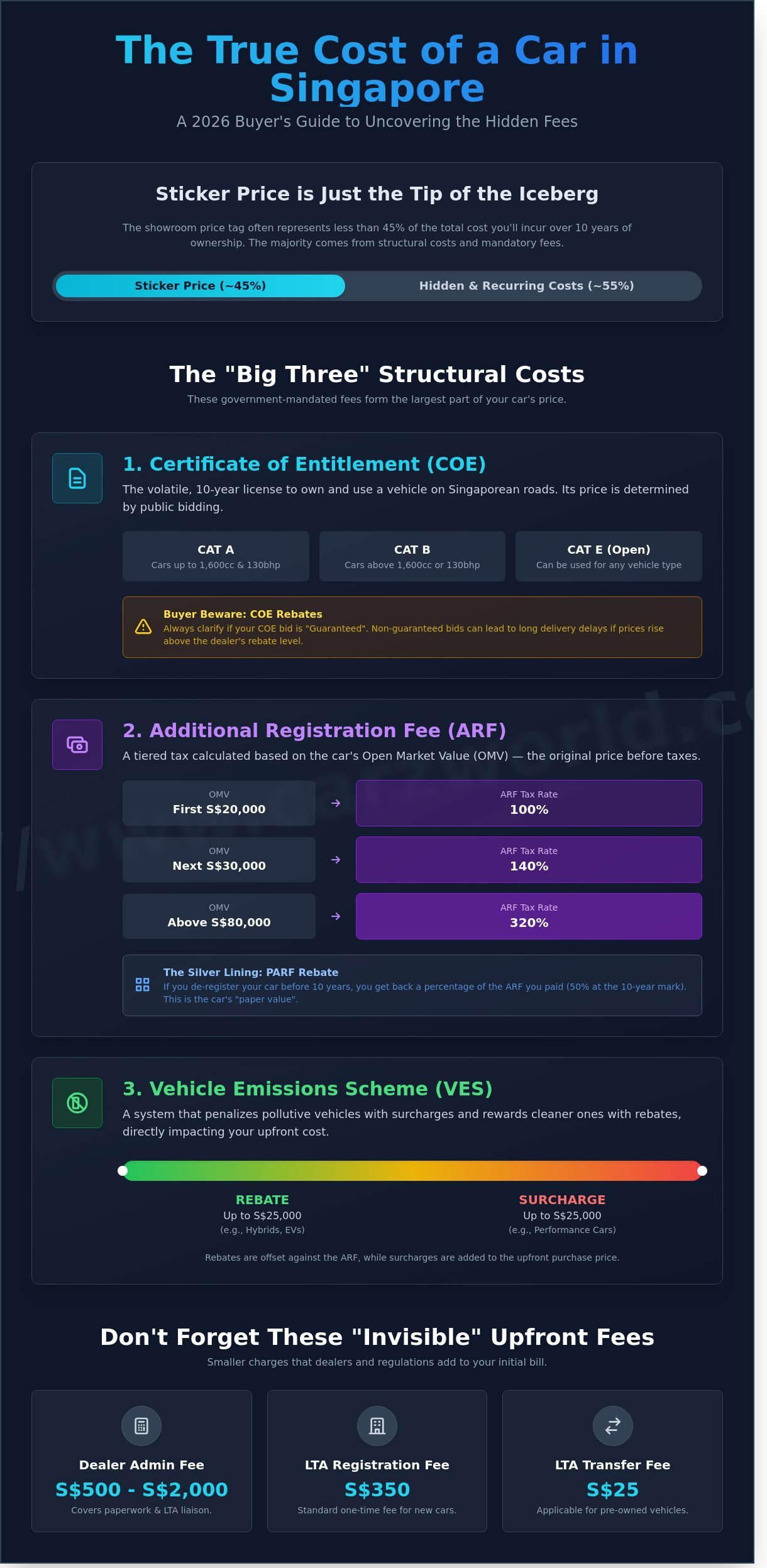
The "sticker price" you see in a showroom represents less than 45% of what you'll actually spend during your first decade on the road. For many Singaporeans, the excitement of a new ride quickly turns into stress when they realize the hidden costs of buying a car in singapore can add S$25,000 or more to the initial budget before the first oil change. It's a frustrating reality, especially when COE premiums for Category A stay consistently near the S$100,000 mark. You likely feel that budgeting has become an impossible task, and you're not alone in fearing those "admin fees" that some dealers hide in the fine print.
At Carz World, we believe in a professional and transparent approach where every cent is accounted for. We promise to reveal the exhaustive list of upfront fees, recurring expenses, and those "invisible" markups that every buyer must know to avoid financial surprises. This 2026 guide provides a clear, line-item budget and practical ways to reduce your Total Cost of Ownership. You'll gain the confidence to navigate ARF and PARF rebates without the headache, ensuring your car buying journey remains a seamless and pleasant one.
Key Takeaways
- Understand why the sticker price is just the beginning and how 2026 COE trends impact your total upfront investment.
- Identify the hidden costs of buying a car in singapore, including dealer administrative fees and loan processing charges that can add thousands to your bill.
- Prepare for recurring expenses like the ERP 2.0 system and annual road tax to ensure your monthly budget remains manageable.
- Learn to navigate the "maintenance curve" to anticipate when costs for tyres, batteries, and brake pads typically spike.
- Discover professional ways to optimize your purchase, such as choosing high-quality pre-owned vehicles to avoid the initial depreciation hit.
Beyond the Sticker Price: The "Big Three" Structural Costs
Walking into a showroom in Singapore can be a deceptive experience. You might see a sleek sedan listed at a certain price, but that figure rarely represents the final invoice. Unlike most global markets, the list price here is just the starting point. The costs of driving in Singapore are driven by a complex web of taxes and certificates that often double or triple the car's original manufacturing value. To understand the hidden costs of buying a car in singapore, you have to look past the metal and rubber at the structural costs mandated by the Land Transport Authority (LTA).
The "Big Three" comprise the Certificate of Entitlement (COE), the Additional Registration Fee (ARF), and the Vehicles Emissions Scheme (VES). These aren't small administrative fees; they're substantial financial pillars that dictate your monthly installments and your car's future resale value. For instance, a car with an Open Market Value (OMV) of S$25,000 can easily end up costing over S$150,000 once these layers are applied. Our team at Carz World believes in total transparency, so let's break down these mechanics for the 2026 market.
Understanding COE Categories and Their Volatility
The COE system remains the most volatile element of car ownership. As we head into 2026, supply constraints continue to influence bidding behavior. You'll choose between Cat A (cars up to 1,600cc and 130bhp) and Cat B (larger, more powerful vehicles). Cat E is the "Open" category, often used for luxury imports. Many dealers offer "COE Rebates" in their packages. This is a double-edged sword. If the dealer bids S$90,000 for a COE but the rebate level is set at S$95,000, the dealer keeps the S$5,000 difference. If prices rise above your rebate level, your delivery could be delayed for months. Always check the "guaranteed" versus "non-guaranteed" status of your COE bid to avoid surprises.
ARF, OMV, and the PARF Rebate System
The OMV is the actual price of the car paid to the manufacturer. The ARF is a tax calculated as a percentage of that OMV. Since February 2023, the tiers have become significantly steeper. The first S$20,000 of OMV is taxed at 100%. The next S$30,000 is taxed at 140%, and any value above S$80,000 attracts a 320% tax rate. This tiered system is one of the primary hidden costs of buying a car in singapore for luxury buyers. However, the ARF isn't just a lost cost. It forms your Preferential Additional Registration Fee (PARF) rebate. If you de-register your car at the 10-year mark, you'll receive 50% of the ARF paid back in cash. This "paper value" acts as a forced savings account, providing a financial cushion when it's time to upgrade.
VES Surcharges and Your Final Invoice
The Vehicles Emissions Scheme (VES) can shift your final price by tens of thousands of dollars. Cars are categorized into five bands based on their pollutant levels. For 2026, the standards remain stringent. An efficient hybrid might qualify for a Band A1 or A2 rebate of up to S$25,000, which is directly offset against the ARF. Conversely, a high-performance petrol engine in Band C2 will attract a S$25,000 surcharge. This surcharge is added to the purchase price, making it a "cash-up-front" cost that increases your initial down payment. Choosing a car with a favorable VES rating is one of the most effective ways to manage the structural costs of ownership.
The "Invisible" Upfront Fees: What the Dealer Might Not Mention
The sticker price on a car window in Singapore is rarely the final price you pay. While most buyers prepare for the Certificate of Entitlement (COE) and the Open Market Value (OMV), the hidden costs of buying a car in singapore often lie in the smaller, "invisible" fees. These charges can add several thousand dollars to your initial outlay, catching many first-time owners off guard when they receive their first invoice.
One of the most common charges is the Dealer Administrative Fee, which typically ranges from S$500 to S$2,000 depending on the dealership. An Admin Fee is a service charge for paperwork and LTA liaison. While this fee covers the logistical effort of registering the vehicle, the wide price range exists because different dealers bake varying levels of profit into this line item. You'll find that independent dealers and parallel importers often have more flexible fee structures compared to authorized distributors, though this requires more vigilance during the negotiation phase.
Official government charges are another layer of upfront costs. The Land Transport Authority (LTA) imposes a standard registration fee of S$350 for every new car. If you're buying a pre-owned vehicle, you'll face a transfer fee of S$25. Beyond these, you must account for the physical hardware required to drive on Singapore roads. The In-Vehicle Unit (IU), or the newer On-Board Unit (OBU) for ERP 2.0, costs approximately S$160 including installation and GST. These are non-negotiable costs that must be settled before you can drive out of the showroom.
Financing your vehicle brings its own set of "agreement fees." Banks and financial institutions usually charge a processing fee that ranges from S$200 to S$800. This is a one-time cost to set up your hire-purchase agreement. According to research from NUS, these high entry costs often create a psychological "sunk cost" effect, where owners feel pressured to drive more frequently to justify the massive upfront investment. Understanding these fees early helps you maintain a realistic budget.
Navigating Dealer Markups and Admin Charges
When you're dealing with parallel importers, the admin fee is often a point of negotiation. Don't be afraid to ask for a detailed breakdown of what the fee covers. If a dealer is charging S$2,000 for "admin," they should be able to justify the specific services provided. You can often negotiate to have this fee waived or reduced if you're taking a larger loan through the dealer's preferred bank, as they receive a commission from the lender.
Insurance Premiums and GST Impact
Your first-year insurance premium is a significant upfront cost that many forget to factor into their cash flow. In Singapore, you cannot drive your car off the lot without a valid insurance policy, and this premium must be paid upfront in cash. It cannot be rolled into your car loan. For a mid-sized sedan, this could mean an immediate cash outflow of S$1,500 to S$3,000 depending on your driver profile and No Claims Discount (NCD).
The current GST rate of 9%, which took effect on 1 January 2024, also applies to car accessories, solar films, and extended service packages. If you're adding S$5,000 worth of upgrades to your new ride, remember that S$450 of that is purely tax. To avoid these surprises, it's best to work with a partner that values transparency. You can explore our brand new cars to see how we present pricing without the smoke and mirrors.
If you're feeling overwhelmed by the math, our team is here to help you calculate the true hidden costs of buying a car in singapore so you can plan your purchase with confidence. For a clear, line-by-line breakdown of your next vehicle, talk to us at Carz World today.
Calculating the "Lifestyle" Costs: Recurring Monthly Expenses
Buying the car is just the start of your financial commitment. The real impact on your bank account comes from the monthly "lifestyle" expenses that keep the vehicle on the road. These recurring fees often represent the true hidden costs of buying a car in singapore, as they fluctuate based on your driving habits and inflation. You'll need to budget for everything from electronic tolls to the rising price of energy.
The Reality of ERP 2.0 and Smart Parking
Singapore's transition to ERP 2.0 has changed how drivers budget for tolls. The satellite-based system uses an On-Board Unit (OBU) to track your distance and location, making toll collection more precise. If your daily commute involves the Central Expressway (CTE) or the Ayer Rajah Expressway (AYE) during peak hours, expect to spend between S$150 and S$250 monthly on ERP charges alone. This figure doesn't include parking fees, which vary wildly across the island.
- HDB Season Parking: Residents pay S$80 per month for surface car parks or S$110 for multi-storey lots.
- CBD Commercial Parking: Monthly rates in areas like Raffles Place or Tanjong Pagar often exceed S$450.
- Miscellaneous Maintenance: A professional car wash costs roughly S$15 per session, while parking fines for minor "over-parking" start at S$50.
Budgeting for these smaller items is vital. A driver who visits the CBD daily and washes their car weekly can easily spend over S$600 a month before even turning the engine on. These are the details that catch new owners off guard.
Road Tax and Insurance: The Annual Financial Hurdle
Road Tax is a mandatory annual fee based on your car's engine capacity or power rating. For a standard 1,600cc petrol car, you'll pay approximately S$744 per year. However, the calculation changes for those choosing greener options. By 2026, Electric Vehicle (EV) owners will face a revised road tax structure that includes an Additional Flat Component to compensate for lost fuel excise duties. Road Tax increases significantly for cars older than 10 years, with a surcharge that grows by 10% annually until it hits a 50% cap.
Insurance premiums represent another major recurring cost. Providers price their policies based on the vehicle's "risk profile" and the driver's history. Continental brands like BMW or Mercedes-Benz typically command higher premiums, often exceeding S$2,500 annually, because their replacement parts are more expensive. In contrast, Japanese models like a Toyota Corolla Altis might cost between S$1,200 and S$1,800 to insure. You can lower these costs by maintaining a clean driving record; a No Claims Discount (NCD) can reduce your premium by up to 50% after five consecutive years without an at-fault accident.
Energy costs remain the most visible monthly expense. In 2026, a daily commuter driving 50km will find that fuel and electricity prices have shifted. With 95-octane petrol averaging S$3.05 per liter, a petrol car with a fuel efficiency of 15km/L will cost about S$305 per month. Conversely, an EV owner using public chargers at S$0.65 per kWh will spend roughly S$195 for the same distance. While EVs offer a clear saving on "fuel," the higher initial purchase price and specific road tax requirements are part of the hidden costs of buying a car in singapore that require a long-term view.
Maintenance and Depreciation: The Long-Term Financial Traps
While the initial purchase price dominates the conversation, the ongoing upkeep represents the true hidden costs of buying a car in singapore. Most owners budget for petrol and parking, but they often overlook the "Maintenance Curve." This is the predictable yet expensive reality where repair costs escalate sharply at the three, five, and eight-year marks. During the first 36 months, your primary concern is standard oil changes. Once the manufacturer warranty expires at year three, you're suddenly responsible for every sensor failure or electronic glitch. By year five, mechanical components like engine mountings and suspension bushings start to perish, often resulting in bills exceeding S$2,000 in a single visit.
Singapore's tropical climate adds another layer of financial strain. Our 32-degree average temperature and high humidity are brutal on rubber components and batteries. A standard car battery that might last four years in temperate climates often fails within 18 to 24 months here. Tyres also suffer. The constant stop-start traffic in the CBD wears down tread quickly, meaning a fresh set of four tyres, costing between S$600 and S$1,500, becomes a recurring expense every 35,000km to 40,000km. Brake pads and rotors follow a similar timeline, demanding replacement more frequently than the manufacturer's global handbook might suggest.
Major servicing milestones are where the budget truly breaks. When a vehicle hits 80,000km to 100,000km, it requires a "Gold" or "Major" service. This involves replacing the timing belt, water pump, spark plugs, and transmission fluids. For a Japanese sedan, expect to pay S$1,200 to S$1,800. For a continental car, this figure can easily climb to S$3,500. These aren't optional repairs; neglecting them leads to catastrophic engine failure that could cost five times as much to fix.
Predicting Servicing Costs Based on Vehicle Age
Standard servicing every 10,000km usually costs between S$200 and S$450 for most Japanese "workhorses." However, European brands carry a premium of 40% or more due to specialized diagnostic tools and imported parts. If you're looking for a vehicle that won't surprise you at the workshop, Browse our high-quality used cars with full service histories to see exactly how they've been maintained.
The Depreciation Trap: Straight-Line vs. Real World
Depreciation is the most significant of all hidden costs of buying a car in singapore. While you don't pay it monthly, you feel it when you sell. If you buy a car for S$170,000 and its scrap value is S$20,000 after 10 years, you're losing S$15,000 annually. Brands like Toyota and Honda typically hold their value better, depreciating at a slower rate than niche luxury brands. To minimize your losses, we recommend trading in your vehicle around the six-year mark. This allows you to exit before the heavy maintenance costs of year eight kick in, while the car still retains a healthy resale value in the second-hand market.
This significant financial drain often leads buyers to compare the long-term value of a vehicle against other major investments, such as property, which may appreciate over time. For those exploring how capital can be allocated toward appreciating assets in Singapore's luxury market, you can learn more.
Understanding these long-term traps helps you choose a vehicle that fits your actual lifestyle and bank balance. Don't just look at the monthly installment; look at the cost of the car over its entire lifespan. If you want a clear picture of what your current vehicle is worth or what your next one will cost to run, talk to our experienced consultants for an honest assessment.
How to Cost-Optimize Your Purchase in 2026
Buying a vehicle in Singapore remains a high-capital commitment that requires tactical planning. By 2026, COE prices and LTA regulations will likely continue to shift, making smart financial choices more essential than ever. You can effectively mitigate the hidden costs of buying a car in singapore by prioritizing pre-owned models over brand-new ones. A new car typically loses 15% to 25% of its value the moment it leaves the showroom. By opting for a vehicle that is at least three years old, you successfully bypass this initial depreciation cliff while still enjoying modern safety features and engine efficiency.
The Benefits of Pre-Owned and Consignment Cars
Data shows that buying a 3-year-old car can save you approximately 30% in Total Cost of Ownership (TCO) compared to a new model. At Carz World, we focus on "High Quality" and "Well Maintained" certifications to ensure these financial savings don't come at the expense of reliability. Consignment is another powerful tool for cost-optimization. It allows sellers to set a price closer to market value than a dealer trade-in, while buyers gain access to transparent service histories. If you're looking to upgrade, you can sell your car via consignment to maximize your return. This approach helps you avoid the heavy markups often found in traditional used car inventories.
Your financing strategy is the next big lever for optimization. Standard hire purchase agreements in Singapore usually offer stable interest rates, often hovering around 2.78%. Balloon schemes might look attractive because they lower your monthly installments by deferring a portion of the principal to the end of the loan. However, this structure increases the total interest you pay over the loan term. If your goal is long-term equity and lower total expenditure, stick to a standard hire purchase. It's a more predictable path that builds ownership value faster.
Working with a trusted dealership is your best defense against the hidden costs of buying a car in singapore. Professional teams provide clear, line-by-line breakdowns of every dollar spent. They ensure that administrative fees, which can range from S$500 to over S$2,500 at less reputable shops, are disclosed upfront. This transparency prevents the "sticker shock" that many buyers face during the final signing process.
Final Checklist Before You Sign the Sales Agreement
Before you commit to a purchase, use this 5-point checklist to ensure complete financial transparency. It's the final step to securing a fair deal in a complex market.
- Verify all fees: Check the exact "Admin Fee" and "Agreement Fee" listed on the Sales Order.
- Confirm taxes: Ensure the quoted price includes the S$220 LTA transfer fee and the prevailing GST rate.
- Evaluate rebates: Confirm the PARF and COE rebate values to understand your car's guaranteed future scrap value.
- Insurance clarity: Request a full breakdown of the insurance premium and ask about any specific "loading" charges for your profile.
- Timeline certainty: Get a written timeline for the COE bidding process or the physical delivery date of the vehicle.
Don't hesitate to ask your sales consultant direct questions. Ask, "Are there any mandatory service packages tied to this price?" or "What is the total interest amount I'll pay over five years?" A professional consultant will provide these numbers without hesitation. For a transparent, no-obligation quote, speak to our professional team at Carz World today. Our goal is to make your car buying journey a smooth and pleasant process from start to finish.
Secure Your Financial Future on the Road
Owning a vehicle in 2026 requires more than a glance at the showroom price. You've seen how Additional Registration Fee (ARF) tiers and fluctuating COE premiums can shift your budget by S$20,000 or more overnight. Factor in the S$3,000 average annual maintenance cost and the steep 20% first-year depreciation. These represent the real hidden costs of buying a car in singapore that savvy buyers must track. You don't have to navigate these complex financial waters alone. Our professional consultants, including Ryan, Carson, Adam, and Ben, provide transparent advice without the pushy sales tactics. We've built an extensive library of verified customer testimonials from drivers who've enjoyed a seamless experience. Whether you're looking for local sales or specialized worldwide car exports, our team ensures every detail is handled with precision. Discover transparent car deals and expert advice at Carz World to make your next purchase a rewarding investment. It's time to drive home with total peace of mind.
Frequently Asked Questions
How much is the average dealer admin fee in Singapore in 2026?
You can expect to pay between S$800 and S$2,000 for dealer admin fees in 2026. This fee covers the administrative work for loan processing, insurance coordination, and LTA ownership transfers. It's one of the common hidden costs of buying a car in singapore that buyers often overlook. Always ask for a transparent breakdown of these charges before you sign the agreement to ensure you're getting professional service.
Can I use my CPF to pay for any part of my car purchase?
You cannot use your CPF savings to pay for any part of your car purchase. CPF funds are strictly reserved for housing, healthcare, and retirement needs under Singapore law. You'll need to prepare cash or secure a bank loan for the downpayment. Most buyers set aside at least 30% of the car's price in cash to meet the minimum downpayment requirements set by the Monetary Authority of Singapore.
What happens to my PARF rebate if I scrap my car early?
You'll receive a pro-rated Preferential Additional Registration Fee (PARF) rebate if you scrap your car before its 10-year mark. This rebate is calculated based on a percentage of the Additional Registration Fee (ARF) paid when the car was first registered. For example, a car deregistered at 9 years old yields a 50% PARF rebate. This amount is paid back to you in cash or can be used to offset the costs of your next vehicle purchase.
Is it cheaper to buy a new car or a used car with a renewed COE?
Buying a used car with a renewed COE is generally cheaper in terms of monthly depreciation and upfront costs. A new car loses value rapidly in its first three years, often exceeding S$15,000 annually. However, a COE-renewed car has no PARF value at the end of its life. You'll save on the initial purchase price but must budget more for repairs as the vehicle ages beyond its first decade.
Do I have to pay GST on a second-hand car from a dealer?
You'll pay 9% GST only on the profit margin made by the dealer, not the full selling price of the second-hand car. This is part of the Gross Margin Scheme used by GST-registered motor traders in Singapore. For instance, if a dealer buys a car for S$80,000 and sells it for S$85,000, the GST is only applied to the S$5,000 difference. It's a fair way to keep quality pre-owned cars affordable for buyers.
How much should I budget for annual maintenance on a Japanese sedan?
Budget between S$600 and S$1,200 annually for the routine maintenance of a Japanese sedan like a Toyota Corolla or Honda Civic. This estimate covers two standard servicing sessions and minor part replacements like brake pads or air filters. Regular servicing at reputable workshops ensures your car remains in pristine condition. It also helps you avoid the hidden costs of buying a car in singapore that arise from neglected mechanical issues.
What are the additional costs of owning an Electric Vehicle (EV) in Singapore?
You'll face higher annual road tax and potential home charger installation costs when owning an Electric Vehicle. Road tax for EVs is calculated based on power output and includes an additional flat component of S$700 per year as of 2024. While you save on fuel, a private charging station installation can cost between S$2,000 and S$4,000. These specific expenses are essential to factor into your long-term transport budget before making the switch.
Is car insurance more expensive for P-plate drivers?
Car insurance is significantly more expensive for P-plate drivers due to their perceived higher risk profile. Premiums for new drivers can be 50% to 100% higher than those for experienced motorists with a 50% No Claims Discount. Most insurers also impose a standard "Young and Inexperienced Driver" excess of about S$2,500. This means you'll pay more out of pocket if you're involved in an accident during your first year on the road.
In Same Category
- How to Transfer Car Ownership in Singapore: A Step-by-Step Guide (2026)
- Best Car Insurance for Used Cars in Singapore: 2026 Expert Guide
- Car Insurance Quotes Singapore 2026: The Ultimate Comparison & Buyer’s Guide
- Bad Credit Car Loan Singapore: How to Get Approved in 2026
- In-House Car Financing vs Bank Loan: Which is Right for You in 2026?