COE Car Meaning: A Complete Guide to Buying Renewed Cars in Singapore
What if you could drive a high quality, well maintained sedan in Singapore for less than half the annual depreciation of a brand new model? It's a common question for many local drivers today. We all know that with COE premiums for Category A and B consistently staying near the S$100,000 mark throughout 2024, the dream of car ownership feels out of reach. It's frustrating to watch prices climb while trying to figure out the complex math of rebates and paper values.
This guide clarifies the COE car meaning so you can decide if a "renewed" vehicle is your best path to affordable transport. You'll learn exactly how these cars differ from PARF models and how to leverage them for sensible car ownership in 2026. We'll also address maintenance anxiety for vehicles older than 10 years with professional, honest advice. We'll break down the financial trade-offs and provide a clear roadmap for choosing a reliable renewed car that fits your budget and lifestyle.
Key Takeaways
- Learn the practical COE car meaning and how renewing the Certificate of Entitlement after 10 years offers a budget-friendly alternative to brand-new models.
- Understand the vital financial trade-offs between COE and PARF cars, including how the loss of ARF rebates impacts your total cost of ownership.
- Discover the "Short-Term Drive" strategy to navigate high car prices in 2026, allowing you to stay mobile while waiting for market volatility to settle.
- Master an essential pre-purchase inspection checklist to help you distinguish well-maintained vehicles from neglected units.
- Find out how Carz World’s transparent vetting process and detailed condition reports provide peace of mind when choosing your next pre-owned car.
What is a COE Car? Meaning and Basic Definition
Understanding the COE car meaning is the first step for any driver looking for a high quality vehicle without the steep price tag of a brand new model. In Singapore, a COE car refers to a vehicle that has had its certificate renewed after its initial 10-year lifespan. While most cars are de-registered after a decade, these specific units continue to stay on the road because their owners or dealers paid the Prevailing Quota Premium (PQP) to extend their usage.
Owners of pre-owned cars often distinguish between COE cars and PARF cars. A PARF car is a vehicle still within its first 10-year cycle, making it eligible for a Preferential Additional Registration Fee (PARF) rebate if scrapped. Once that 10-year mark passes, the car loses this rebate eligibility. At this stage, the law is clear: the car must be scrapped or the COE must be renewed. A COE car is a vehicle that has bypassed its "death sentence" through a PQP payment.
The Role of the Certificate of Entitlement (COE)
The Certificate of Entitlement (COE) is the cornerstone of the Vehicle Quota System (VQS) managed by the Land Transport Authority (LTA). This system is essential because Singapore is a land-scarce nation where only 12% of the land area is used for roads. To prevent massive traffic congestion, the government uses the COE to control the total car population.
Every new vehicle registered in the city-state comes with a standard 10-year "expiry date." This certificate grants the owner the legal right to own and use the vehicle during that period. Because the supply is limited and demand is often high, the cost of a COE can fluctuate significantly, directly impacting the COE car meaning and its overall market value.
Renewing the COE: 5-Year vs. 10-Year Options
When a vehicle reaches its 10th year, owners must decide how long they want to keep the car. There are two primary renewal paths:
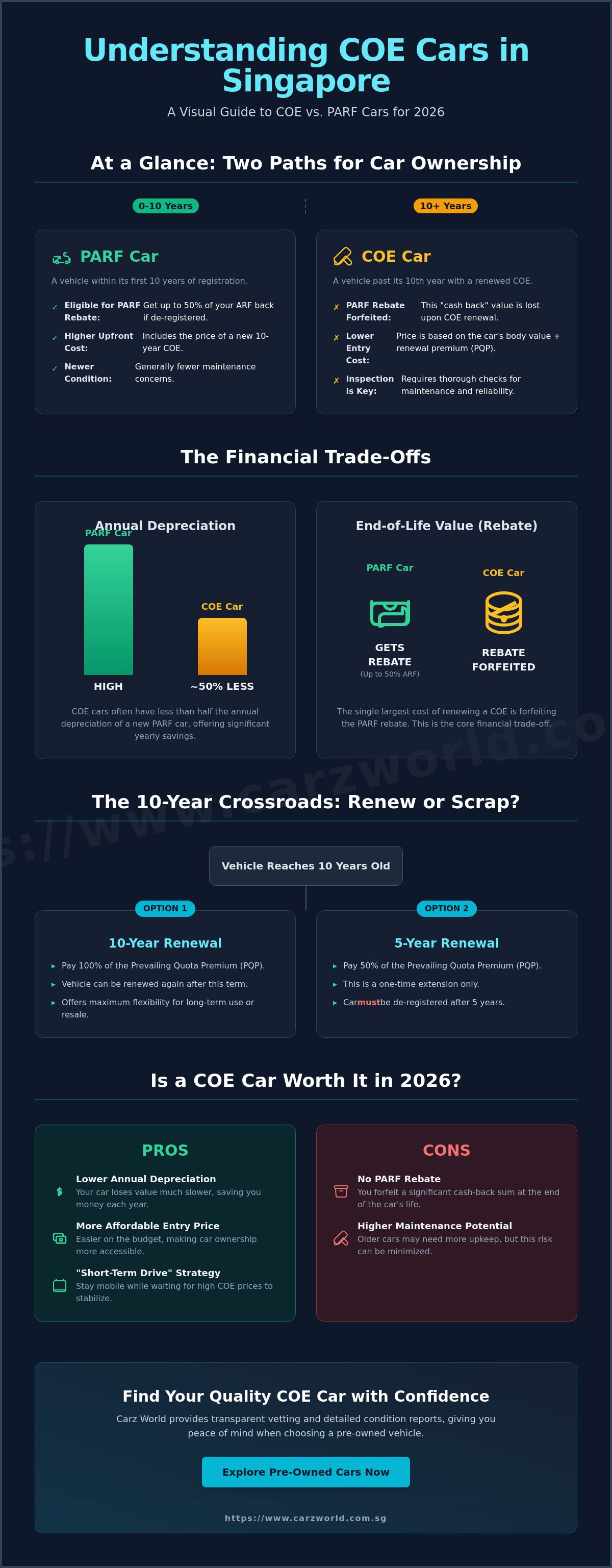
- 10-Year Renewal: This option requires paying the full PQP. It allows the vehicle to be renewed again indefinitely every 10 years, provided it passes LTA inspections.
- 5-Year Renewal: This involves paying 50% of the PQP. However, it's a one-time extension. Once these five years expire, the car must be scrapped and cannot be renewed again.
The choice between these two options depends on your budget and long-term plans. A 10-year renewal offers more flexibility for future resale or continued use. A 5-year renewal is often seen as a short-term, cost-effective solution for those who don't need a vehicle for a full decade. Since there's no PARF rebate left to lose, the financial risk is often lower than buying a brand new car, making COE cars a professional and practical choice for many Singaporean households.
COE vs. PARF Cars: Understanding the Financial Trade-offs
Understanding the financial distinction between PARF and COE cars is essential for any driver in Singapore. When buyers research the COE car meaning, they're usually comparing the upfront savings against long-term value. A PARF (Preferential Additional Registration Fee) car is a vehicle still in its first 10-year cycle. A COE car is one that has had its lifespan extended beyond that initial decade by paying a new premium. The primary difference between the two lies in what happens to your money when the car is eventually de-registered.
The PARF Rebate Explained
Think of the PARF rebate as a secured savings account tied to your vehicle. When a new car is registered, the owner pays an Additional Registration Fee (ARF). If you de-register the car before it hits the 10-year mark, the Land Transport Authority returns a portion of this fee to you. At exactly 10 years, you're entitled to 50% of the ARF back in cash. Choosing to renew the COE means you forfeit this entire rebate. This loss is the single largest cost of converting a vehicle into a COE car, as that "savings account" effectively disappears the moment you renew.
PQP: The Cost of Renewing a COE
To keep a car on the road past its 10th year, you must pay the Prevailing Quota Premium (PQP). This is not a fixed price. The PQP is calculated as the moving average of the official COE bidding process results from the previous three months. PQP is the entry price for turning a 10-year-old car into a COE car. Owners can choose to pay for a 5-year or a 10-year renewal, though a 5-year renewal means the car must be scrapped at the end of that period with no further extensions allowed.
Why do many drivers prefer COE cars despite the lack of a rebate? It often comes down to annual depreciation. A brand new PARF car might see an annual depreciation of S$15,000 to S$25,000. In contrast, a well maintained COE car often has a much lower annual depreciation, frequently falling between S$9,000 and S$12,000. While older vehicles require more frequent servicing for parts like the alternator or suspension, the lower yearly "paper loss" makes it a professional and practical choice. If you want a dependable vehicle without the high depreciation of a new model, you can explore our range of high quality used cars to see the cost benefits for yourself.
Is a COE Car Worth It in 2026? Pros and Cons
Looking at the Singapore automotive market in 2026, new car ownership remains a massive financial commitment. With COE premiums for Category A and B frequently hovering near the S$100,000 mark, many drivers are exploring alternatives. Understanding the COE car meaning is the first step toward making a savvy investment. Essentially, these are vehicles that have outlived their original 10-year lifespan and had their certificates extended. This choice is particularly attractive for those who want to avoid the steep initial depreciation that hits brand-new models the moment they leave the showroom.
Many of our customers use a COE car as a "short-term drive" strategy. If you expect market volatility or anticipate a drop in COE prices within the next 24 to 36 months, buying a renewed car allows you to stay mobile without locking into a high-interest, 7-year loan on a new vehicle. It also removes the psychological stress of daily driving. You won't lose sleep over a minor door ding in a crowded HDB carpark or a small scratch on the bumper. This is a luxury owners of brand-new luxury sedans rarely enjoy.
The Advantages of Going COE
- Lower upfront cost: You'll need a much smaller downpayment. For a high quality used car with a renewed COE, the entry price is often less than half that of a new equivalent.
- Predictable depreciation: Your financial loss is transparent. It is basically the PQP amount divided by the years remaining, making it much easier to budget for your transport costs.
- Ideal for new drivers: It's a low-stakes way to gain confidence on the road. Scraping a pillar while parking feels much less painful in a car that has already seen a decade of service.
The Potential Drawbacks
While the savings are clear, you must account for aging components. Parts like cooling systems, suspension bushings, and engine gaskets often reach their end-of-life around the 12-year mark. However, the idea that these cars are "money pits" is often exaggerated. If the previous owner followed a strict service schedule, a COE car remains remarkably reliable. You should also factor in the road tax surcharge. For cars older than 10 years, the road tax increases by 10% each year, eventually capping at a 50% surcharge by the 15th year. You can find the specific details on Renewing your COE via the LTA website.
Financing is another hurdle to consider. Banks typically offer shorter loan tenures for older vehicles. You might face interest rates of 3.5% to 4.5%, which is higher than the rates for brand-new cars. Despite this, the lower total loan amount usually results in more manageable monthly installments for the average Singaporean household. By understanding the COE car meaning and weighing these financial trade-offs, you can decide if a renewed vehicle fits your lifestyle in 2026.
Buying Checklist: How to Inspect a COE Car
Understanding the COE car meaning involves more than just knowing about the 10-year renewal process. It requires a deep dive into the vehicle's actual condition. Since these cars have been on the road for at least a decade, a pre-purchase inspection (PPI) at a third-party workshop is mandatory. Don't rely solely on a visual check or the seller's word. A professional mechanic can identify hidden structural damage or engine wear that isn't obvious during a 10-minute test drive.
When you evaluate a unit, look beyond the odometer. A "well-maintained" car with 160,000km is often a safer bet than a "neglected" one with 80,000km. You should prioritize mechanical soundness over aesthetic perfection, as cosmetic flaws are cheap to fix compared to a blown head gasket or a failing transmission.
Mechanical Red Flags to Watch For
- Engine health: Open the hood and check for fresh oil leaks or "sweating" around the engine block. Start the car and look for blue smoke from the exhaust, which signals internal oil burning. The engine should idle steadily without vibrating the cabin excessively.
- Transmission smoothness: Shift through the gears while stationary. If an automatic gearbox hesitates for more than a second or "kicks" hard when engaging, it likely needs an expensive overhaul.
- Chassis and suspension: Take the car over a few speed bumps. Listen for metallic knocks, rattles, or squeaks. These sounds usually point to worn-out bushings, ball joints, or shock absorbers that will cost hundreds of dollars to replace.
The Paperwork Audit
A thorough inspection isn't just about the hardware; it's about the history. Request the LTA log card to verify the remaining COE duration. Be certain whether the car is on a 5-year or 10-year renewal. Remember that a car on its second 5-year COE cycle must be scrapped at the end of the term. Check the number of previous owners as well. While a high owner count isn't always a dealbreaker, it can indicate a "lemon" that has spent more time in the workshop than on the road.
Review the service history for proof of major component replacements. In Singapore's stop-start traffic, gearboxes and cooling systems work hard. If the car has reached the 100,000km or 200,000km mark, ask for receipts showing a timing belt change or a radiator replacement. Without these documents, you are essentially buying a ticking financial time bomb. Knowing the COE car meaning in a practical sense means recognizing that maintenance records are just as valuable as the car itself.
Ready to find a reliable vehicle that has passed our rigorous standards? Explore our high-quality used cars today.
Finding Quality COE Cars at Carz World
Understanding the COE car meaning is the first step toward making a smart financial decision in Singapore's vehicle market. However, the true value lies in finding a car that remains reliable long after its tenth year. At Carz World, we ensure your transition to a renewed vehicle is a seamless and pleasant one through a rigorous vetting process. Every pre-owned car in our inventory undergoes a professional inspection to identify mechanical wear and structural integrity issues before it reaches our showroom floor.
Transparency is the foundation of our business. We provide honest history reports and detailed condition summaries, so you aren't left guessing about a vehicle's past. Because older cars often face stricter loan requirements from traditional banks, we offer flexible financing and insurance solutions specifically tailored for COE-renewed models. This helps you manage your S$ budget without the stress of rigid repayment structures or high upfront costs.
Why Buy Pre-Owned from a Trusted Dealer?
Buying from a direct owner might seem cheaper, but it carries significant risks. There's often no legal recourse if the engine fails a week after purchase, and hidden mechanical issues can lead to expensive repair bills. When you consider the COE car meaning in the context of long-term ownership, having a professional consultant like Ryan or Adam becomes essential. They guide you through every step of the complex LTA paperwork. They ensure all ownership transfers and renewals are handled accurately. You can explore our curated selection of quality used cars to see our current high-quality, well-maintained inventory.
Trade-In and Consignment Options
We make it easy to upgrade or switch to a more economical drive. If you're currently driving a car nearing its deregistration date, our team provides a smooth process for trade-ins or consignments. We evaluate your vehicle based on current market trends and condition to ensure you get a fair valuation when you sell your car to us. This value can be directly applied to your next purchase, reducing your initial cash outlay and making the transition effortless.
Our goal is to be your dependable and experienced partner. We value long-term trust over short-term sales. That's why our staff is trained to be helpful and patient rather than pushy. Visit our showrooms at Ubi or Alexandra today to find your next value-for-money drive and experience our excellent service firsthand.
Drive Home Your Ideal COE Car Today
Navigating the Singapore car market requires a clear grasp of the COE car meaning and how it impacts your long-term budget. You've learned that while these vehicles offer lower upfront costs, choosing the right unit depends on a thorough inspection and a solid understanding of the financial trade-offs between COE and PARF models. It's about finding that balance between value and reliability for your daily commute. At Carz World, we simplify this journey through a transparent, non-pushy sales process that puts your needs first. Our expert consultants are ready to assist you at our Ubi and Alexandra showrooms, ensuring you feel supported at every step. With over 100+ 5-star customer reviews, our reputation for excellence is built on delivering high-quality, well-maintained vehicles to drivers across the island. We're here to make your next purchase seamless and stress-free. Browse our latest inventory of certified pre-owned cars in Singapore and discover the quality that sets us apart. We look forward to helping you drive home the perfect car today.
Frequently Asked Questions
Can I renew the COE of my car for 5 years and then change it to 10 years later?
No, you can't extend a 5-year COE renewal once it's been processed. Under LTA regulations, a vehicle that's renewed for 5 years must be deregistered and scrapped once that period expires. You lose the right to any future renewals for that specific vehicle. If you want the option to keep the car for more than 5 years, you must choose the 10-year renewal option from the start.
Is road tax more expensive for COE cars in Singapore?
Yes, road tax for cars older than 10 years includes an additional surcharge that increases annually. You'll pay an extra 10% on the base road tax rate for every year after the initial 10-year period, capped at a maximum of 50%. For a car with a base road tax of S$1,000, the annual cost becomes S$1,500 once the vehicle reaches its 15th year of age.
What happens to my COE car if I decide to scrap it before the 10 years are up?
You'll receive a pro-rated rebate on the COE amount you paid, based on the remaining time left on the certificate. This rebate is calculated to the day. However, you won't get any PARF rebate back. The payout is strictly the unused portion of the Prevailing Quota Premium (PQP) plus the car's body value from the scrap yard.
Can I get a bank loan for a car that is more than 10 years old?
Most major banks don't offer standard automotive loans for cars that have exceeded their original 10-year lifespan. Instead, buyers typically use finance companies or in-house dealership loans. These loans usually have a maximum tenure that matches the remaining COE life. Interest rates for these vehicles are often higher than those for brand new or younger pre-owned cars.
Does a COE car still have a PARF rebate value?
No, a car loses its PARF rebate value the moment you renew its COE. This loss of the Preferential Additional Registration Fee rebate is a fundamental part of the COE car meaning in the Singapore market. Your vehicle's value is then tied entirely to the remaining COE and its physical condition. This is why COE cars are significantly cheaper upfront than cars still in their first 10-year cycle.
What is the "PQP" and how does it affect the price of a COE car?
The Prevailing Quota Premium (PQP) is the moving average of COE prices over the preceding 3-month period. It's the specific price you must pay to the LTA to renew a car's COE for another 5 or 10 years. Because the PQP changes every month, it directly influences the resale price of renewed cars. A high PQP period makes renewing and buying these cars more expensive for everyone.
Is it better to buy a 5-year or 10-year renewed COE car?
A 10-year renewal is generally the better choice for long-term stability because it allows for further renewals in the future. A 5-year renewal only requires 50% of the PQP upfront, making it a cheaper short-term option, but the car must be scrapped at the end of the term. If you plan to drive the car for a long time, the 10-year option provides more flexibility.
How do I check how much COE is left on a used car?
You can verify the remaining COE duration by checking the vehicle's details on the LTA OneMotoring website. By using your Singpass to log in, you can see the exact expiry date and the PQP amount paid for the current cycle. Understanding this date is vital to grasping the COE car meaning and calculating the true annual depreciation of any used vehicle you're considering.
In Same Category
- How to Get a Car Loan with No Down Payment in Singapore (2026 Guide)
- Car Loan for New Permanent Residents in Singapore: The 2026 Ultimate Guide
- How Much Savings Do You Need Before Buying a Car in Singapore? (2026 Guide)
- Car Loan Rejected? What to Do Next in Singapore (2026 Guide)
- Buying a Used Nissan Note e-Power in Singapore: The Ultimate 2026 Guide