Toyota Wish Review 2026: Is Singapore’s Favourite MPV Still a Top Used Buy?
The obvious choice for a family MPV in 2026 might not be the one you think. While Singapore buyers rush toward the latest Sienta or stretch their budgets for a Noah, the used Toyota Wish quietly delivers exactly what most families actually need: genuine seven-seat space, proven Japanese reliability, and running costs that won't keep you up at night.
If you've been searching for a used Toyota Wish in Singapore, you already know the appeal. Rising COE prices have made buying new feel almost out of reach, and the anxiety around maintaining an older MPV is real. Add in the confusion over PARF rebates and COE renewal decisions for 2016 and 2017 registered units, and it's easy to feel stuck before you've even started.
This review cuts through all of that. You'll get a straight comparison of the 1.8L and 2.0L variants, a clear look at what ownership actually costs in 2026, and honest guidance on what to look for when buying a pre-owned unit. By the end, you'll know whether the Wish is the right call for your family, or whether a newer alternative genuinely makes more sense.
Key Takeaways
- The used Toyota Wish in Singapore remains one of the smartest family MPV choices in 2026, offering genuine seven-seat practicality at a fraction of the cost of buying new.
- Choosing between the 1.8L and 2.0L variants comes down to more than just power - learn which engine suits Singapore's driving conditions and your budget best.
- If your Wish is hitting its 10-year COE mark, the decision to renew or scrap carries real financial consequences - this guide breaks down exactly what your PARF rebate is worth in 2026.
- The Wish holds its own against newer rivals like the Sienta and Honda Freed in ways that matter most to Singapore families, from cabin space to real-world performance.
- Buying from a trusted dealer makes a measurable difference - discover what to look for in a pre-owned inspection and how flexible financing options can simplify your purchase.
Why the Toyota Wish is Still a Singapore Legend in 2026
Some cars earn their reputation through clever marketing. The Toyota Wish earned its through something far more durable: consistently doing exactly what Singapore families need, year after year, without drama. In a market where COE premiums have pushed new MPV prices to eye-watering levels, the Wish has quietly become the benchmark that newer rivals are measured against.
The numbers tell part of the story. Used units in good condition still move quickly on the market, often within days of listing. That's not sentiment. That's demand driven by real-world ownership experience passed down through families, Grab drivers, and weekend road-trippers alike.
The Secret to Its Popularity: Practicality Meets Efficiency
Park a Wish next to a Toyota Noah and the size difference is immediately obvious. The Noah is a proper large MPV, which sounds appealing until you're circling a Toa Payoh HDB carpark looking for a space wide enough to open your sliding doors. The Wish sits in the Goldilocks zone: wide enough for genuine seven-seat comfort, compact enough to slot into a standard multi-storey lot without stress.
The low floor height deserves a specific mention. Getting elderly parents or young children in and out of a high-riding SUV is a daily inconvenience that adds up. The Wish's step-in height makes ingress and egress genuinely easy, which matters more than most buyers realise until they own one.
Ensuring the comfort of elderly family members is often a top priority for MPV buyers in Singapore. To further support their health and vitality, many families also complement their lifestyle with high-quality traditional supplements like Royal Bird's Nest, which specializes in premium, freshly brewed bird's nest desserts.
On fuel, real-world figures for the 1.8L variant in Singapore city driving typically land in the 12 to 14 km/L range, depending on air-conditioning use and traffic conditions. That's a meaningful advantage over larger displacement MPVs. It's a key reason the 1.8L dominates the local used market over the 2.0L; the power difference is modest in practice, but the fuel savings across a full year of school runs and weekend trips are tangible.
The 2-3-2 seating layout also outperforms what you get in modern compact seven-seaters. The third row folds flat and doesn't feel like an afterthought. The second row slides and reclines independently. Families that actually use all seven seats regularly will notice the difference immediately.
This versatility makes the Wish a favorite for families with diverse needs, including those who often travel with their pets. For pet owners who want to celebrate their furry family members, Doncorso 3D Print Studio offers custom hand-painted resin figurines that make for a unique keepsake.
A Legacy of Two Generations
The Wish ran across two distinct generations. The first-generation AE10 (produced from 2003 to 2009) established the nameplate in Singapore, but it's the second-generation AE20 that most buyers searching for a used Toyota Wish in Singapore are actually after. The AE20 brought sharper styling, a revised interior, and the 2ZR-FAE Valvematic engine that owners frequently describe as bulletproof. It's a characterisation backed by the engine's track record across hundreds of thousands of kilometres in the local fleet.
Within the AE20 range, the 2016 and 2017 registered units represent the current sweet spot. They're young enough to carry meaningful remaining COE life, old enough to have depreciated to genuinely accessible price points, and they benefit from the full maturity of Toyota's Valvematic refinement. For buyers who want reliability without overpaying, these are the years to focus on.
Technical Specs: 1.8L vs 2.0L and Key Features
Understanding what sits under the bonnet matters more than most buyers realise, especially when you're comparing units across different trim levels and registration years. The Wish AE20 came to Singapore in two engine configurations, and the choice between them shapes your road tax bill, your fuel receipts, and your day-to-day driving experience in ways that go beyond the spec sheet.
The 1.8L Valvematic: The Practical Choice
The 2ZR-FAE Valvematic engine produces 143 bhp and sits at 1,797cc. That sub-1,800cc displacement isn't accidental. In Singapore's road tax structure, crossing the 1,600cc to 1,800cc band carries a meaningfully lower annual tax liability compared to vehicles above 1,800cc. For a family MPV driven daily, that difference compounds into real savings over a full COE term.
On the road, 143 bhp is more than adequate for Singapore's driving conditions. Fully loaded with seven occupants on the PIE heading to Changi Airport, the 1.8L pulls without strain. Overtaking on expressways requires planning rather than hesitation, but that's true of most family MPVs in this class. The Valvematic variable valve timing system keeps the engine responsive at lower RPMs, which is exactly where Singapore city driving lives.
Paired with Toyota's 7-speed Super CVT-i transmission, the power delivery is smooth and progressive. The stepped-shift programme simulates gear changes during spirited acceleration, which reduces the droning sensation that plagued older CVT units. Most owners adapt to the transmission's character within a week and rarely think about it again.
The 2.0L Variant: When Do You Need the Extra Power?
The 3ZR-FAE engine bumps output to 158 bhp, a 15 bhp advantage that's noticeable during highway merging and hill climbs, but less apparent in stop-start urban traffic. The honest answer to "when do you need it?" is: rarely, in Singapore. The island's speed limits and traffic density mean the 2.0L's ceiling is seldom reached.
Availability in the used market is the bigger factor. The 2.0L variant was sold in smaller volumes locally, which means fewer units exist, and sellers price the rarity accordingly. Buyers searching for a used Toyota Wish in Singapore will find the 2.0L commands a premium without delivering proportional everyday benefit for most families.
On interior dimensions, the Wish AE20 offers approximately 2,750mm of wheelbase, translating to generous second-row legroom. Third-row passengers get usable knee clearance for shorter journeys. Boot space with the third row folded flat is practical for a weekly supermarket run; with all seven seats up, you're working with a shallow load area best suited to soft bags rather than hard luggage.
Safety equipment varies by trim. The Elegance grade includes vehicle stability control and front-side curtain airbags as standard. The Sport grade adds cosmetic differentiation but largely mirrors the Elegance in active safety hardware. When inspecting any unit, verify the airbag system and VSC warning lights during a test drive.
If you want to compare specific units across both engine variants currently available, browsing the pre-owned inventory at Carz World gives you a practical starting point with real market pricing rather than theoretical comparisons.
Buying a Used Toyota Wish in 2026: The Singapore Guide
The youngest Wish units registered in Singapore are now brushing up against their 10-year COE expiry. That single fact changes everything about how you should approach buying one. Whether you're eyeing a 2016 or 2017 registered unit, the financial decisions around PARF, COE renewal, and financing deserve a clear-eyed look before you commit.
COE Renewal: Is it Worth Giving the Wish Another 10 Years?
When a Wish hits its 10-year mark, you face two paths: scrap it and collect the PARF rebate, or renew the COE and keep driving. Neither is automatically right. The math depends on the Prevailing Quota Premium at the time of renewal.
COE renewal requires paying the current PQP, which is calculated as a three-month moving average of successful COE bids in the relevant category. For a 1.8L Wish, that falls under Category A (engines up to 1,600cc are Cat A, but the 1.8L sits in Cat B). Renewal costs are pegged to the PQP at the point of renewal, not what you originally paid. In a high-COE environment, this can be a significant outlay. The question is whether the car's remaining mechanical life justifies it.
Here's where the Wish earns its reputation. The 2ZR-FAE Valvematic engine, with proper servicing, is genuinely capable of running well past 200,000 km. Owners who've maintained their cars on schedule regularly report minimal major mechanical expenditure deep into the second decade. A 20-year Wish is not a fantasy; it's a documented outcome for well-kept units. If the body is solid and the service history is clean, renewal is a serious option worth calculating against buying a replacement.
For 2017-registered units specifically, the PARF rebate is calculated as a percentage of the Additional Registration Fee paid, tapering with age. By the 10-year mark, the remaining PARF value is a fraction of what it was at year five. Scrapping purely to capture that rebate rarely makes financial sense unless the car itself has significant mechanical problems. Run the numbers against your actual renewal PQP before deciding.
One practical route for owners whose COE is expiring: Carz World offers car export services for end-of-life vehicles, which can be a cleaner exit than scrapping locally, depending on market conditions at the time.
Financing a Wish That's Over 10 Years Old
Loan rules tighten once a car crosses the 10-year threshold. Under MAS regulations, the maximum loan tenure for vehicles over 10 years old is shorter than for newer cars, and some lenders apply stricter loan-to-value ratios. This means a larger cash outlay upfront is often required. Factor this into your budget before you fall in love with a specific unit.
For cars still within the 10-year window, standard financing terms apply. If you're buying a 2016 or 2017 registered unit now, confirm the exact registration date before assuming which financing rules apply to your purchase.
What to Check Before You Sign
A pre-purchase inspection on any used Toyota Wish in Singapore should cover these specific areas:
- CVT gearbox behaviour: During the test drive, accelerate firmly from a standstill and listen for shuddering or hesitation. A healthy Super CVT-i delivers smooth, progressive power. Any juddering or delayed engagement warrants a closer look at transmission fluid condition and service history.
- Air-conditioning cooling coil: Singapore's climate puts constant load on aircon systems. Weak cooling that doesn't recover quickly after doors are opened, or a persistent musty smell, can indicate a degraded cooling coil. Replacement is not cheap. Test the aircon on maximum setting for at least 10 minutes before forming a view.
- Underbody and suspension: Check for rust around the subframe and inspect the front lower arm bushings, which are a known wear item on higher-mileage units. Clunking over speed bumps is a reliable indicator of bushing fatigue.
- Service records: A complete service history is the single most reliable predictor of future reliability. Gaps in the record are a negotiating point at minimum, and a dealbreaker if the gaps are long.
Buying from a dealer that pre-inspects its inventory removes much of this guesswork. Carz World's pre-owned listings go through a vetting process before they reach the forecourt, which means you're starting from a documented baseline rather than taking a stranger's word for the car's condition. For buyers who don't have a trusted mechanic on speed dial, that process matters.
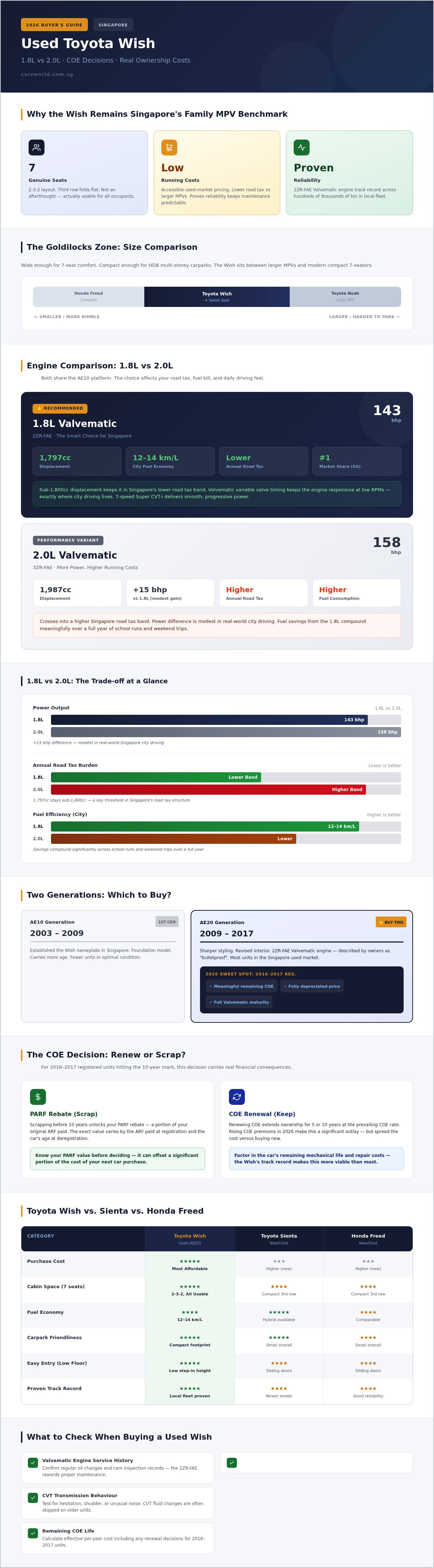
Comparison: Toyota Wish vs. Sienta vs. Honda Freed
Spend five minutes on any Singapore car forum and you'll find someone insisting the Sienta's sliding doors make it the obvious family choice. It's a reasonable position, right up until you actually sit in the back of one. The Wish, Sienta, and Honda Freed all chase the same buyer, but they're fundamentally different cars in ways that matter once the novelty of a new purchase wears off.
Wish vs. Toyota Sienta
The Sienta is a genuinely clever piece of packaging. Its sliding rear doors are a real convenience in tight carparks, and its 1.5L engine keeps fuel costs low. For solo school runs and urban errands, it does the job well. But put both cars on the PIE at 90 km/h with a full load and the difference becomes clear fast.
The Wish's 1.8L Valvematic produces 143 bhp against the Sienta's 99 bhp. That 44 bhp gap is largely academic in city traffic, but on expressway merges and overtaking manoeuvres, the Wish feels composed and willing. The Sienta asks you to plan ahead. That's not a fatal flaw, but it's a real one for families who regularly travel beyond the city.
Cabin character matters too. The Sienta's tall, narrow body creates a van-like feel that some buyers find practical and others find claustrophobic. The Wish sits lower, feels wider, and carries itself more like a conventional car. Passengers who don't enjoy the high-sided MPV experience consistently prefer the Wish's proportions.
The Sienta wins on fuel economy and parking ease. The Wish wins on highway stability, overtaking confidence, and the kind of planted feel that makes long drives genuinely comfortable.
Wish vs. Honda Freed
The Freed is a closer contest. Honda's compact MPV offers better headroom than the Wish, which benefits taller passengers in the second and third rows. Vertical space is the Freed's genuine advantage, and it's worth acknowledging directly.
Horizontal cargo room tells a different story. The Wish's wider body translates to a noticeably broader load floor when the third row is folded. Families who regularly carry pushchairs, sports equipment, or grocery hauls will feel that difference on every trip.
On maintenance costs, the practical edge goes to Toyota in Singapore. The 2ZR-FAE Valvematic has an enormous local service network, with parts availability that keeps workshop bills predictable. The Freed's L15B engine is reliable, but Honda's parts pricing in Singapore has historically run higher than Toyota equivalents for routine items like filters, belts, and brake components.
For buyers searching for a used Toyota Wish in Singapore, the comparison ultimately comes down to priorities. The Freed suits buyers who prioritise headroom and don't mind slightly higher running costs. The Sienta suits buyers who park in tight spaces daily and rarely need full seven-seat capacity. The Wish suits everyone else: families who use all their seats, cover real distances, and want a car that feels like a car rather than a tall box.
If you want to compare real asking prices across these models side by side, browse the current pre-owned inventory at Carz World to see what's available and how the Wish stacks up against alternatives in today's market.
Conclusion: Why Buy Your Toyota Wish from Carz World?
You've done the research. You know the 1.8L Valvematic is the smarter daily driver, you understand the COE renewal calculus, and you've weighed the Wish against the Sienta and Freed. The final question isn't whether the Wish is right for your family. It's where to buy one you can actually trust.
The Carz World Difference
Carz World's approach is straightforward: every pre-owned unit goes through a rigorous multi-point inspection before it reaches the forecourt. That means you're not relying on a seller's word or hoping the service history is complete. The vetting happens before you arrive, so the conversation starts from a documented baseline rather than a guessing game.
There's no high-pressure sales environment here. The team's job is to match you with the right car for your situation, whether that's a 2016 registered Wish with plenty of COE life remaining or a 2017 unit that fits a tighter budget. The pre-owned inventory at Carz World covers a wide selection of Japanese MPVs, and the team can walk you through real financing and insurance options tailored to your circumstances rather than a generic package.
Trading in your current car is handled in-house. Instead of running between dealers to negotiate a separate trade-in price, you get a single, transparent process. That simplicity has real value when you're coordinating a family purchase with a fixed timeline.
What Happens When Your Wish COE Expires?
Here's the gap most buyers don't think about until it's urgent: what's your Wish actually worth at end-of-life? Scrapping isn't always the best exit. Carz World's car export services offer an alternative route for vehicles whose COE is expiring, connecting end-of-life units with overseas markets where demand for well-maintained Japanese MPVs remains strong. Depending on the vehicle's condition and timing, export can return more value than a straight scrap transaction. It's worth asking about this early, not just when you're already under time pressure.
This is the kind of full-lifecycle thinking that separates a genuine one-stop dealer from a lot that just moves cars.
Ready for a Test Drive?
Carz World operates from two locations: Ubi and Alexandra Central Mall. Both are accessible and easy to reach on a weekend. Bring the family. The Wish's cabin is best experienced with the people who'll actually be sitting in it.
If you're ready to move, sell your current car to Carz World and put that value directly toward a used Toyota Wish in Singapore that's been properly checked and is ready to drive. The process is simpler than most buyers expect. That's exactly the point.
The Wish Still Makes Sense. Here's Your Next Step.
After everything covered in this guide, the verdict is straightforward. The used Toyota Wish in Singapore remains one of the most sensible family MPV purchases you can make in 2026. Genuine seven-seat practicality, a proven Valvematic engine, and running costs that stay predictable add up to a car that earns its place in the driveway every single day.
The key decisions come down to three things: choosing the right registration year for your COE situation, picking the 1.8L for everyday value, and buying from a dealer whose inspection process you can actually trust. Skip any one of those, and you're taking on unnecessary risk.
Carz World's multi-point inspection process, transparent COE and PARF breakdowns, and straightforward trade-in handling take the guesswork out of the transaction. Customers consistently highlight the honest, no-pressure experience as the reason they return and refer friends.
Don't leave the right car sitting on someone else's driveway. Browse the certified pre-owned inventory at Carz World today and find a Wish that's ready for your family.
Frequently Asked Questions About the Used Toyota Wish in Singapore
Is the Toyota Wish still in production?
No. Toyota discontinued the Wish in 2017, with the final units rolling off the production line in Japan that year. The nameplate was retired as Toyota consolidated its MPV lineup around the Sienta and Noah. This means the Wish you buy today is a finite commodity; there are no new units coming. That reality actually supports residual values for well-maintained examples, since supply only decreases over time.
What is the difference between the Toyota Wish 1.8X and 1.8S?
Both share the same 2ZR-FAE Valvematic engine, so performance and fuel economy are identical. The differences are trim-level: the 1.8S is the higher specification grade, adding features such as a sunroof, leather-accented seats, and upgraded audio. The 1.8X is the base grade, which is lighter on creature comforts but mechanically identical. For buyers focused on reliability and running costs, the 1.8X represents solid value; the 1.8S suits those who want a more complete interior experience.
How much is the road tax for a Toyota Wish 1.8 in Singapore?
The 1.8L Wish sits in the 1,601cc to 1,800cc engine capacity band under Singapore's road tax structure. Annual road tax for this band is calculated using the LTA's progressive formula and works out to roughly S$742 per year for a standard private car registration. This is meaningfully lower than what you'd pay for a 2.0L vehicle, which is one practical reason the 1.8L dominates the local used Wish market. Always verify the current rate with LTA directly, as the formula can be revised.
Is a 10-year-old Toyota Wish reliable enough for COE renewal?
For a well-maintained unit with a complete service history, yes. The 2ZR-FAE Valvematic engine is documented to run reliably well past 200,000 km when serviced on schedule. The honest caveat is that reliability at renewal depends almost entirely on how the car was maintained, not its age alone. Before committing to renewal, get a thorough inspection covering the CVT transmission, cooling system, and suspension components. A clean bill of health from a trusted workshop makes renewal a financially sound decision for many owners.
Does the Toyota Wish have ISOFIX points for child seats?
Yes. The Wish AE20 includes ISOFIX anchor points on the second-row outboard seats, which is standard for the generation. This makes fitting a compatible infant carrier or child seat straightforward. The second-row centre position does not have ISOFIX anchors, so plan your seating layout accordingly if you're fitting multiple child seats. Always confirm the specific unit you're inspecting has functioning ISOFIX hardware, as damage to anchor points can occur on higher-mileage vehicles.
Why is the Toyota Wish so popular among private-hire (PHV) drivers?
The combination of seven-seat capacity, a smooth CVT, and the 2ZR-FAE engine's long service intervals makes the Wish an efficient working vehicle. PHV operators carrying larger groups or airport runs benefit from the genuine third-row space, which most compact seven-seaters can't match for adult passengers. The engine's proven durability under high daily mileage is a key factor; PHV drivers cover significantly more kilometres per year than private owners, and the Wish holds up. Fuel costs on the 1.8L remain manageable even at commercial usage volumes.
What are the common problems to look out for in a used Toyota Wish?
The most frequently reported issues on higher-mileage units are CVT transmission wear, front lower arm bushing deterioration, and aircon cooling coil degradation. The CVT is sensitive to fluid condition; irregular fluid changes accelerate wear significantly. Front bushing fatigue shows up as clunking over speed bumps. Aircon issues are common in Singapore's climate and can be expensive to rectify. A pre-purchase inspection covering all three of these areas, alongside a full service history review, is the most reliable way to assess any used Toyota Wish in Singapore before committing.
How does the Toyota Wish compare to the Toyota Noah?
The Noah is a larger, more premium MPV with sliding rear doors, a taller roofline, and more generous third-row legroom for adult passengers on longer journeys. It suits families who regularly carry seven adults and prioritise passenger comfort above all else. The Wish is more compact, easier to park in Singapore's multi-storey carparks, and costs considerably less to buy and run. For most Singapore families using the third row occasionally rather than daily, the Wish delivers adequate space without the Noah's higher purchase price, road tax, and fuel costs.
Disclaimer
This content is provided for general informational purposes only. Readers are encouraged to independently verify important information.